

Comet Tsuchinshan-ATLAS may be impressive in evening

Author: Alan Pickup
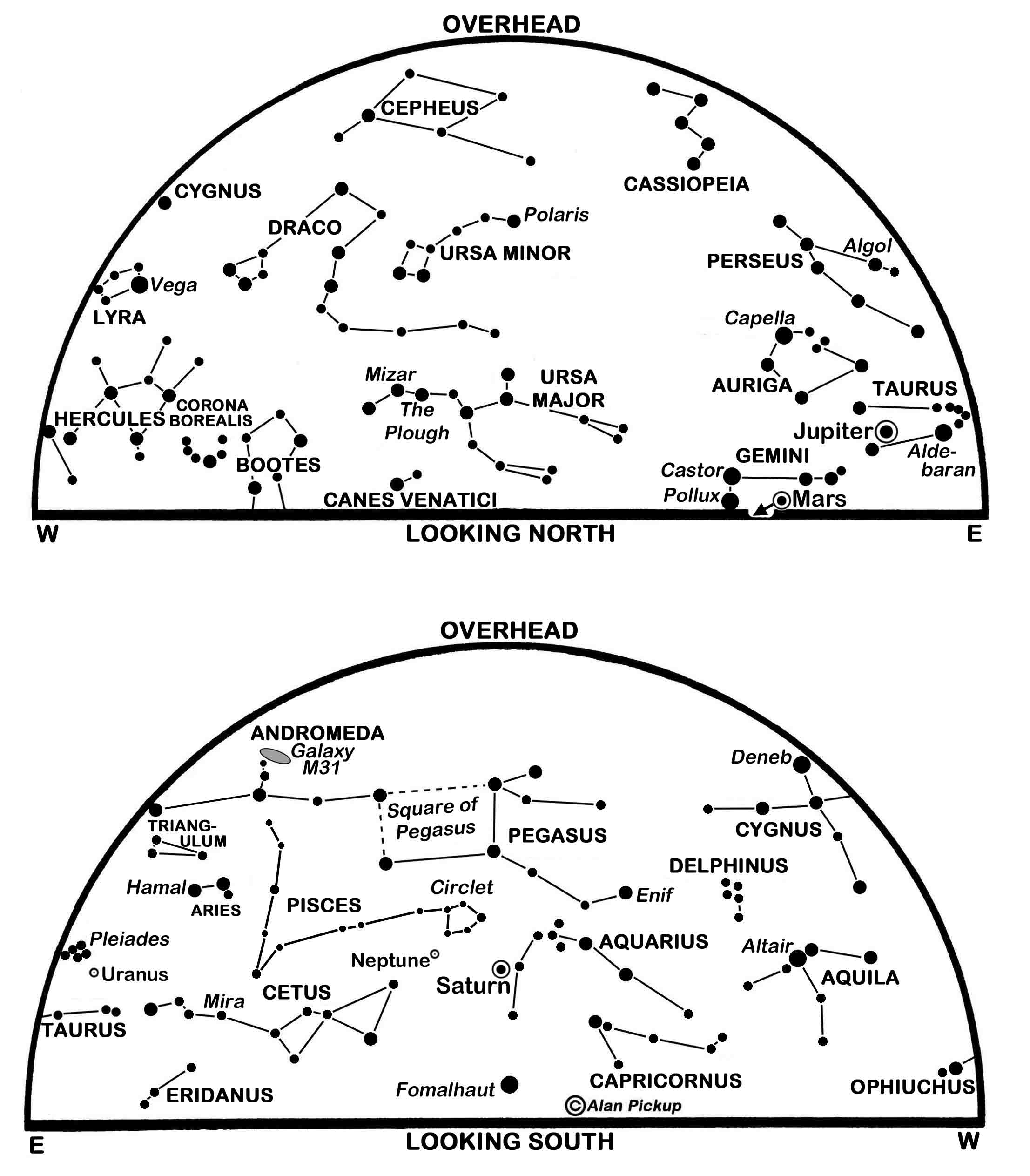
The maps show the sky at 23:00 BST on the 1st, 22:00 BST (21:00 GMT) on the 16th and at 20:00 GMT on the 31st. An arrow depicts the motion of Mars until the 10th. British Summer Time ends at 02:00 BST on the 27th when clocks go back one hour to 01:00 GMT.
The time of reckoning for Comet 2023 A3 Tsuchinshan-ATLAS is at hand.
Found early last year using telescopes in China and South Africa, it is approaching the Sun from the farthest reaches of our solar system for the very first time. Many astronomers wondered whether its icy nucleus would break apart and disappear in the face of the Sun’s heat or, if not, would it become spectacular in Earth’s sky?
At least, the disintegration lobby seems to have been proved wrong. From mid-September observers had sight of the comet through binoculars low in the eastern dawn twilight while later that month it shone near the third magnitude with a banner-like tail up to two degrees in length. It was closest to the Sun, 59 million km, on 27 September when it stood 136 million km from us. Its path into the solar glare and around the Sun’s near side takes it 4° north of the Sun on the 9th.
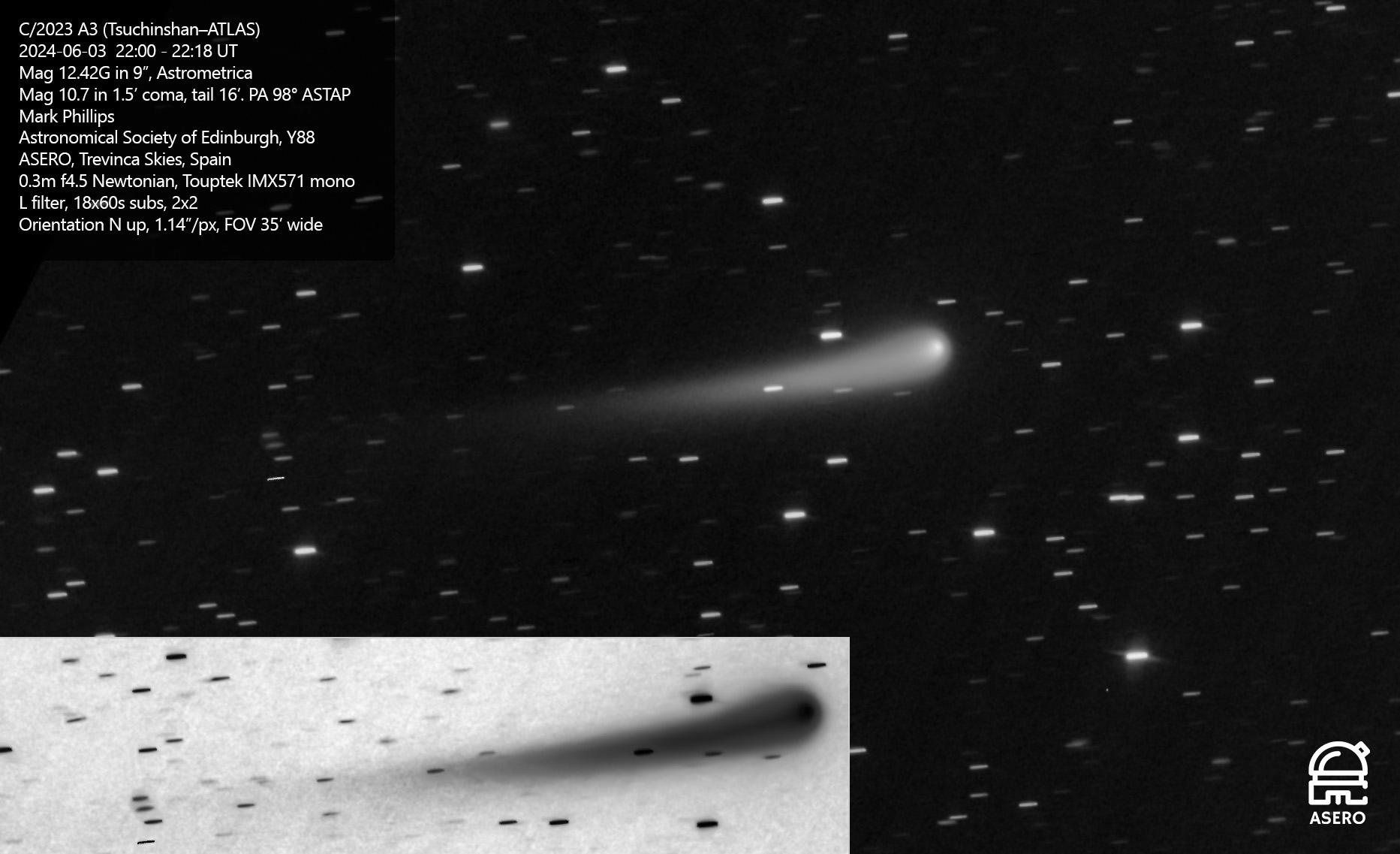
C/2023 A3 taken on 2024-06-03 using our ASERO remote observatory in Spain
Comet Tsuchinshan-ATLAS reaches its closest to the Earth, 71 million km, on the 12th. On that evening, it may be visible in our western evening twilight soon after sunset, being 20° below and left of the star Arcturus in Bootes, the brightest star in the west as the twilight fades. Depending on its brightness and length, its tail may remain visible pointing up and to the left, even as the comet’s head sinks towards the horizon. In truth, comets are fickle and their appearances notoriously hard to predict, so only time will tell whether it excels or flops. Claims that it would be the “Comet of the Century” never seemed credible and we may need binoculars to see it well.
Our best chances of spotting it come over the following days as it climbs higher and to the left with each evening, preceded by its tail but probably fading. It hugs the sky’s equator as it tracks from Virgo, through Serpens and into Ophiuchus where it may end the month as a sixth magnitude smudge setting almost due west at our star map times.
Another object that is too early in the night to be plotted on our charts is the evening star, Venus. This shines brilliantly at magnitude -3.9 but stands only 5° high in Edinburgh’s south-west at sunset on the 1st and may be hard to spot before it sets 43 minutes later. It improves a little over the month so that by the 31st it is a degree higher in the south-south-west at sunset and remains visible for 75 minutes. Mercury remains too deep in the evening twilight to be seen from our latitudes this month.
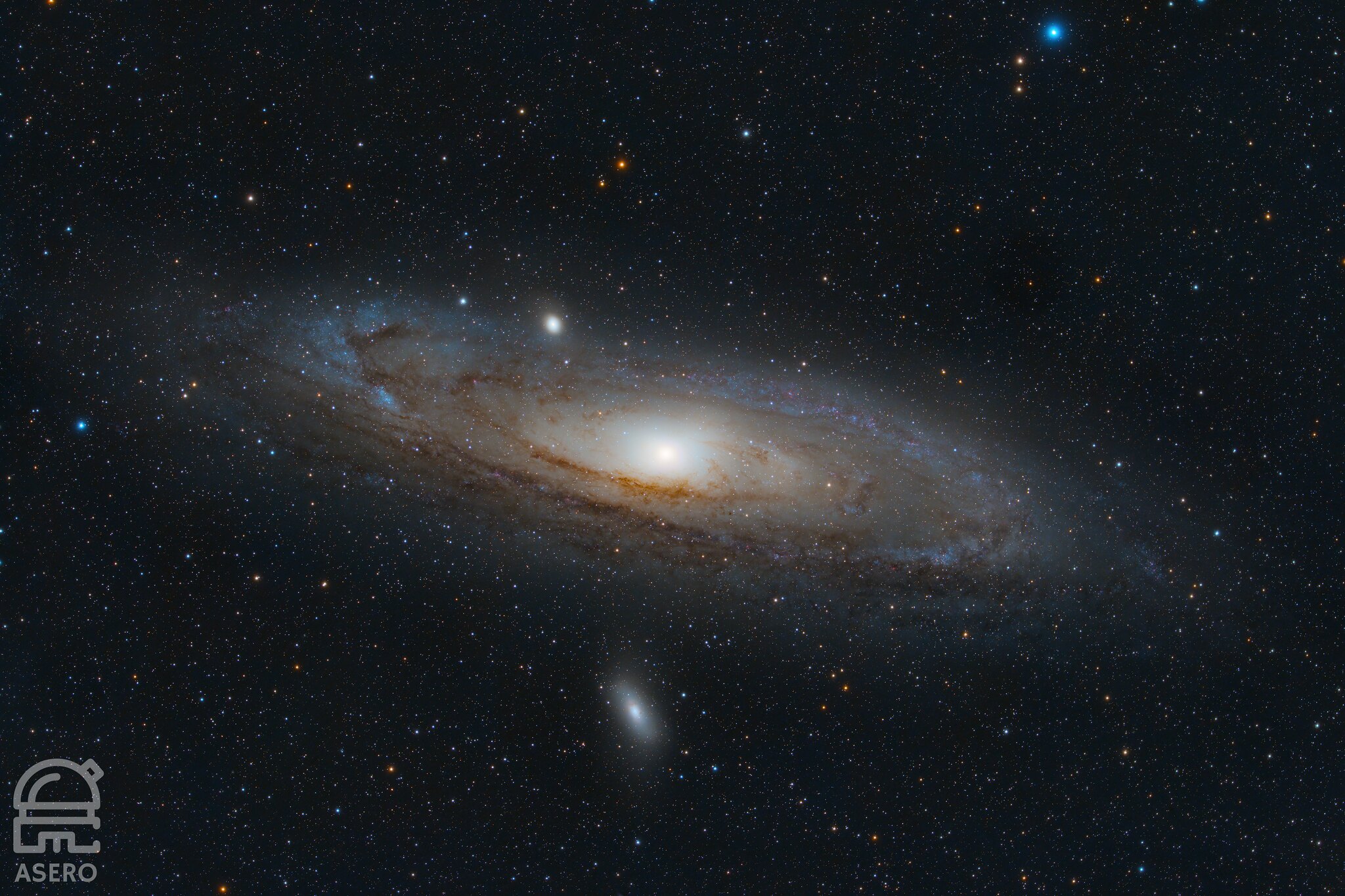
M31 Andromeda Galaxy imaged from Spain using ASERO, processed by Eros Tang
The Summer Triangle still dominates the upper half of our southern sky at nightfall but its bright corner stars, Vega, Deneb and Altair, are declining westwards by our map times. Those maps depict the Square of Pegasus reaching the meridian ahead of the stars of Andromeda. Look for the oval glow of the Andromeda Galaxy which holds perhaps a trillion (a million million) stars at a distance of 2.5 million light years.
According to Greek mythology, Andromeda, the daughter of King Cepheus and Queen Cassiopeia, was chained to a rock and threatened by the sea monster Cetus before being rescued by Perseus. The constellation of Cetus lurks lower in the south-east, below Pisces, but both Cepheus and Cassiopeia lie almost overhead, and Perseus stands level with Andromeda in the east.
The Sun sinks 11 degrees southwards during October while Edinburgh’s sunrise/sunset times change from 07:16/18:47 BST (06:16/17:47 GMT) on the 1st to 07:17/16:33 GMT on the 31st, after British Summer Time ends on the 27th.
The new moon on the 2nd brings an annular eclipse of the Sun along a track that slants south-eastwards over Rapa Nui (Easter Island) and across southern Chile and Argentina. With the Moon too far away to hide the Sun completely, it remains surrounded by a dazzling ring of sunlight in what is also called a “Ring of Fire”. Neighbouring regions enjoy a partial solar eclipse.
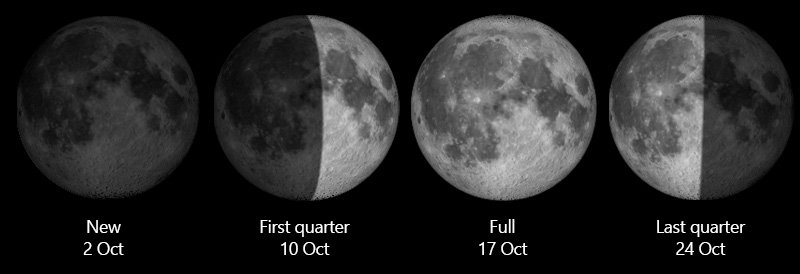
Following new, the Moon is slow to reappear in our evening sky and is unlikely to be visible from Scotland when it stands 4° below Venus at sunset on the 5th. By first quarter on the 10th, it is very low in the south at nightfall and just east (left) of the Teapot of Sagittarius. Continuing through Capricornus and Aquarius, it stands less than a degree below Saturn on the evening of the 14th.
Saturn moves from the south-east at nightfall to pass 26° high in the south at our map times and set in the west less than six hours later. It dims a little this month from magnitude 0.6 to 0.8 as it continues to edge westwards in Aquarius. Telescope show its disk to be 19 arcseconds wide while its rings span 42 arcseconds, their north face tipped at only 5° to the Earth.
Jupiter is conspicuous between the horns of Taurus as it brightens from magnitude -2.5 to -2.7. Rising in the north-east at about 21:15 BST tomorrow and two hours earlier (18:15 GMT) by the month’s end. It is stationary against the stars on the 9th before beginning to edge westwards while its disk appears some 44 arcseconds wide.
Mars tracks 14° eastwards from central Gemini to lie just over the border with Cancer, and in line with Castor and Pollux, as October ends. It brightens from magnitude 0.5 to 0.1 as its small reddish disk, with its white north polar cap, swells from 7.6 to 9.2 arcseconds.
Picking up on the Moon’s progress this month, full moon occurs in Pisces on the 17th, and it is still bright as it brushes the southern stars of the Pleiades cluster in Taurus on the 19th. The next evening finds it directly above Jupiter and it lies below Pollux in Gemini and above-left of Mars late on the 23rd. Last quarter occurs in Cancer on the 24th.
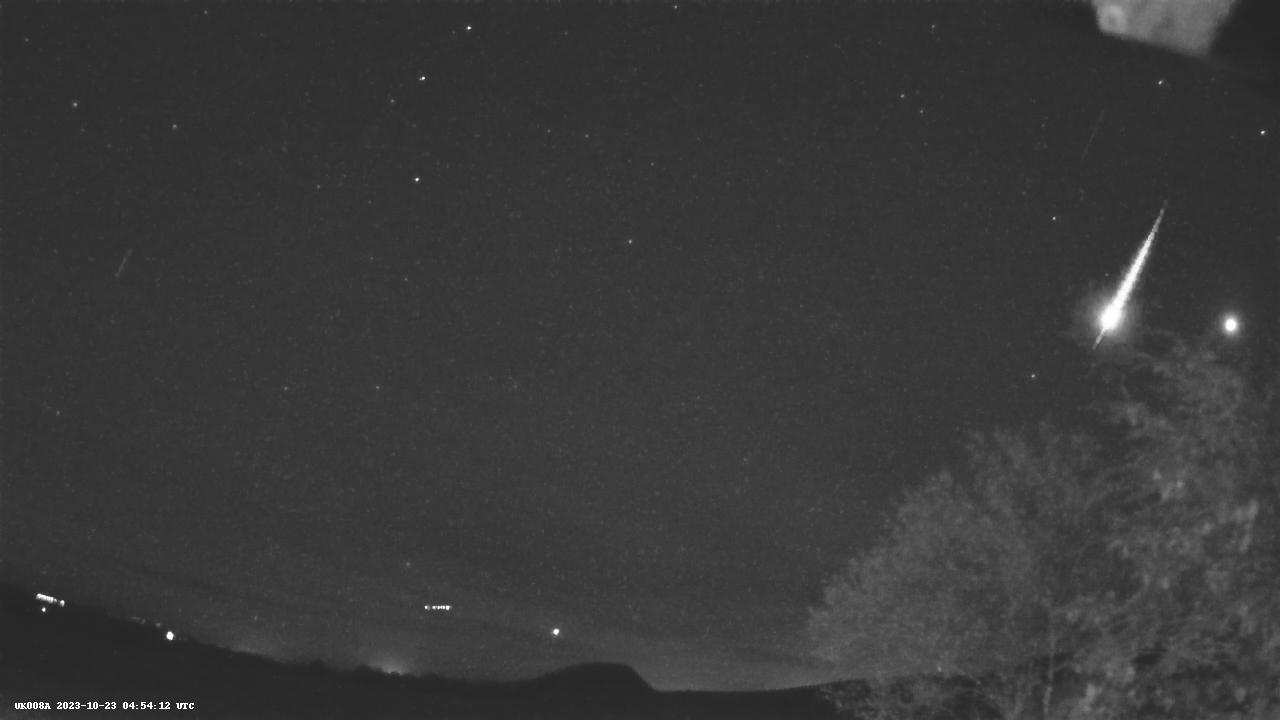
A bright Orionid next to Jupiter caught by one of our meteor cameras 2023-10-23
The Orionids meteor shower is active for more than a month from the 2nd and reaches its peak around the 21st. The radiant, the point in the sky from which its meteors diverge, lies north-east of Betelgeuse and around 15° south-east of Jupiter, so no meteors appear until this rises at about our map times. While we might have expected up to 20 or more fast meteors per hour under ideal conditions, the bright Moon this year lies close to the radiant at maximum and will swamp many of them.
Diary for 2024 October
Times are BST
- 2nd 20h New Moon and annular solar eclipse
- 5th 21h Moon 3° S of Venus
- 7th 20h Moon 0.2° S of Antares
- 9th 08h Jupiter stationary (motion reverses from E to W)
- 10th 20h First quarter
- 14th 19h Moon 0.1° N of Saturn
- 17th 12h Full Moon
- 19th 22h Moon 0.2° N of Pleiades star cluster
- 21st Peak of Orionids meteor shower
- 21st 07h Mars 6° S of Pollux
- 21st 09h Moon 6° N of Jupiter
- 23rd 19h Moon 1.7° S of Pollux
- 23rd 21h Moon 4° N of Mars
- 24th 09h Last quarter
- 24th 19h Moon 3° N of Praesepe star cluster
- 25th 20h Venus 3° N of Antares
- 26th 15h Moon 2.9° N of Regulus
- 27th 02h BST = 01h GMT End of British Summer Time
This is an extended version, with added diary, of Alan’s article published in The Scotsman on 30 September 2024, with thanks to the newspaper for permission to republish here.