
Partial solar eclipse, Perseid meteor shower, Saturn in the morning
by Mark Phillips
Using data from Dominic Ford’s in-the-sky.org and other sources
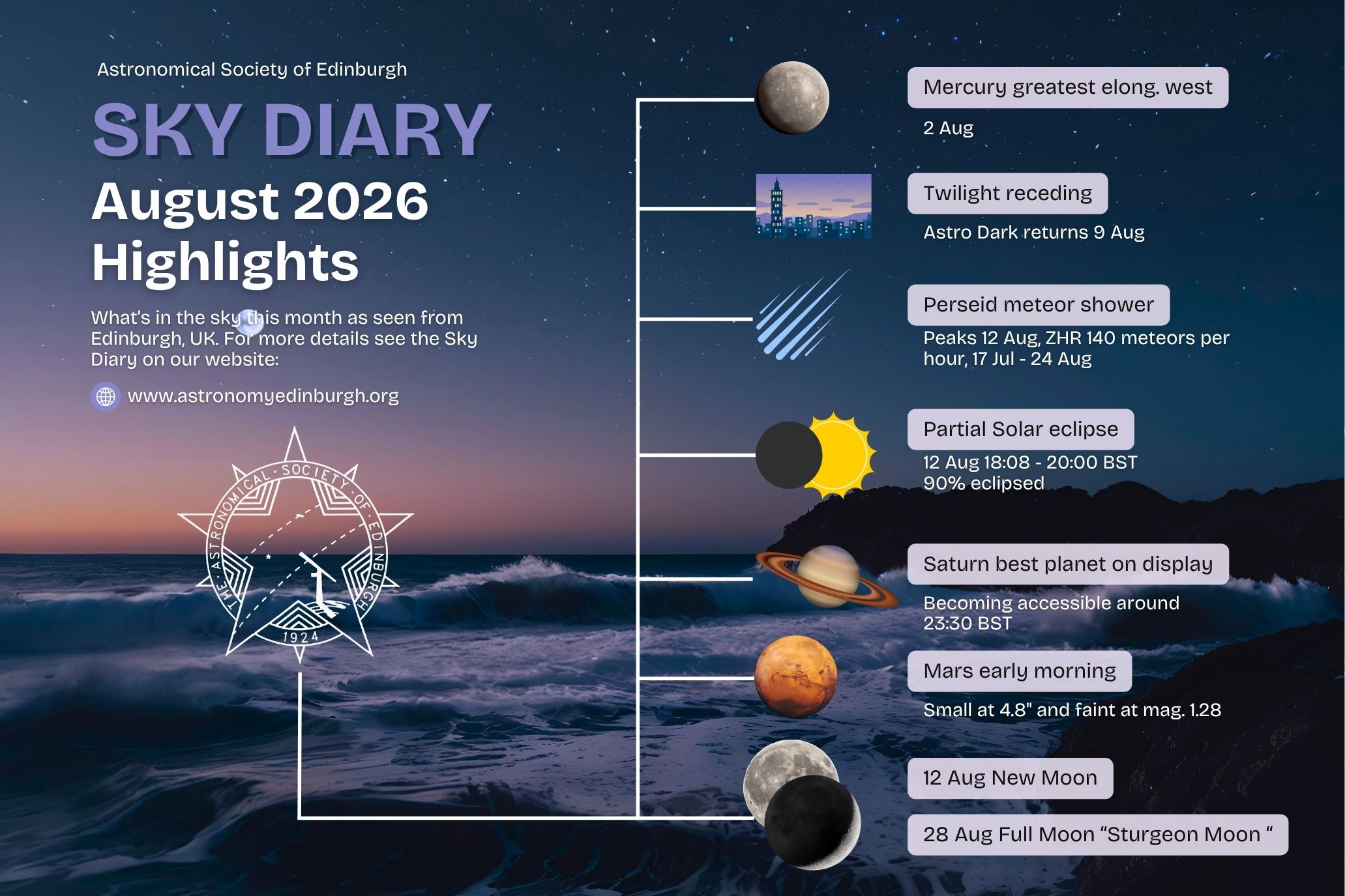
Mercury at greatest elongation west
02 Aug 2026 at 14:54 BST (13:54 UTC)
Reasonably placed but difficult to observe, reaching a peak altitude of 12° above the horizon at sunrise on 7 Aug 2026. Never hunt for it while the Sun is still up!
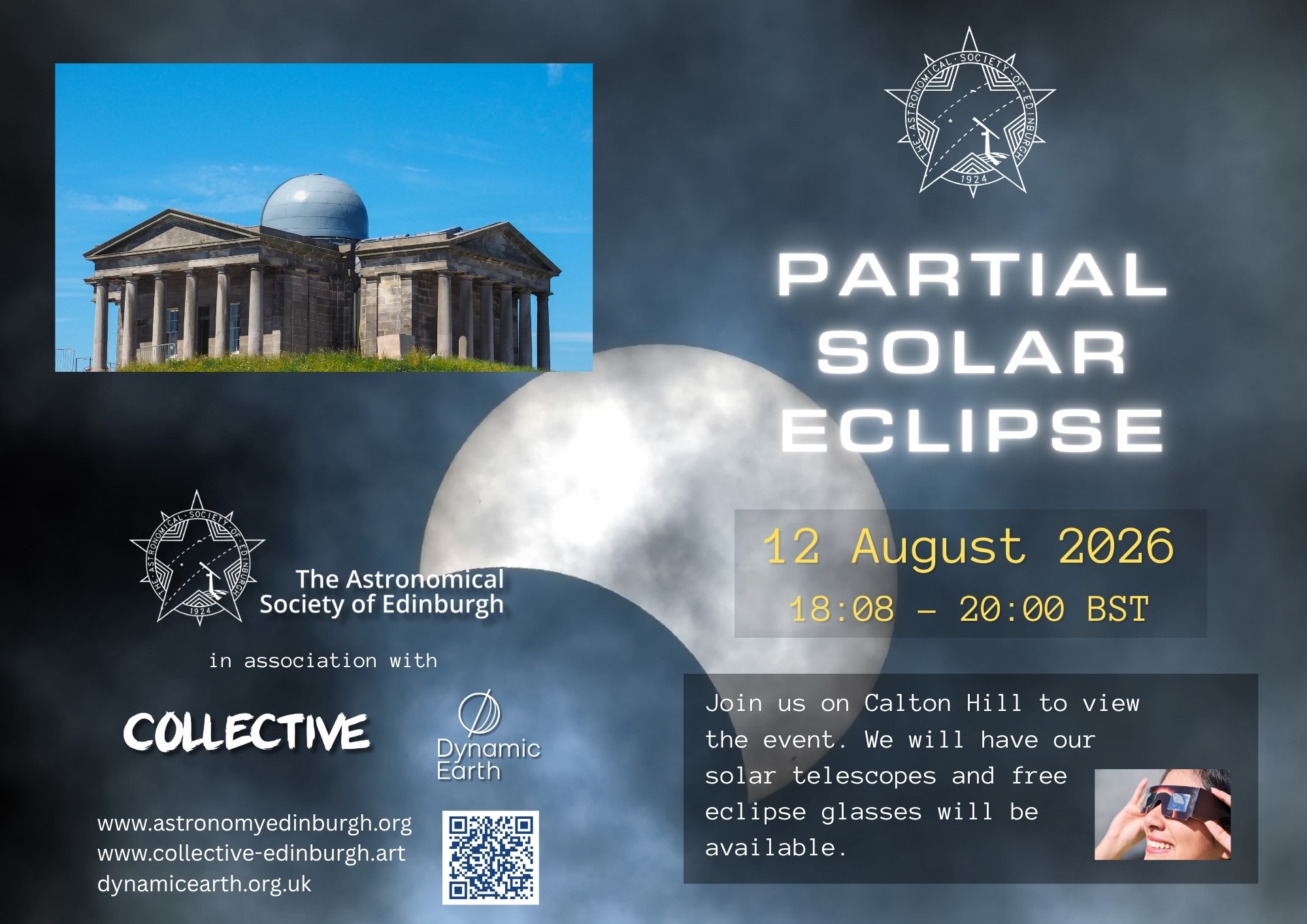
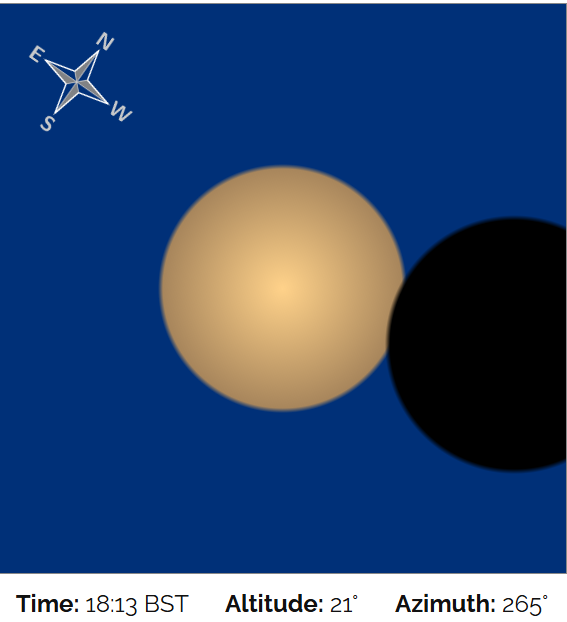
Partial eclipse of the Sun
From Edinburgh this is partial but a total eclipse elsewhere (Greenland and Spain).
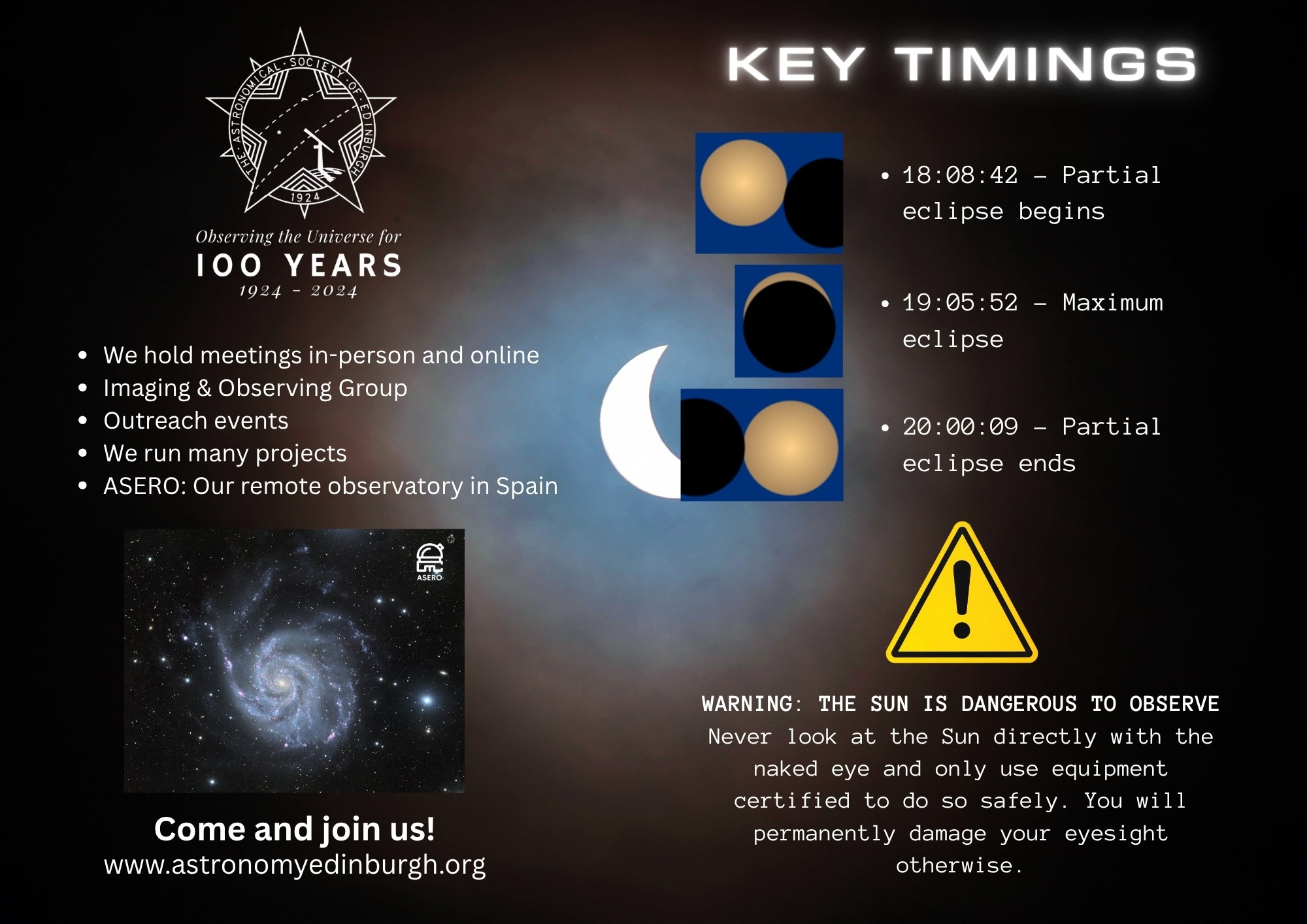
- 18:08:42 – Partial eclipse begins
- 19:05:52 – Maximum eclipse
- 20:00:09 – Partial eclipse ends
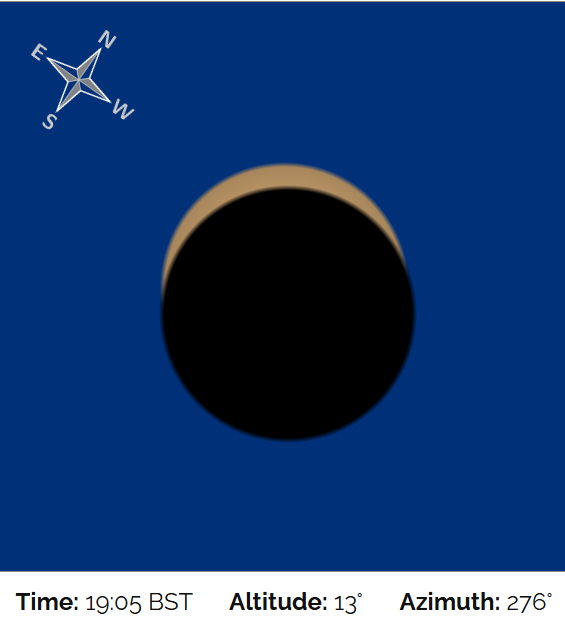
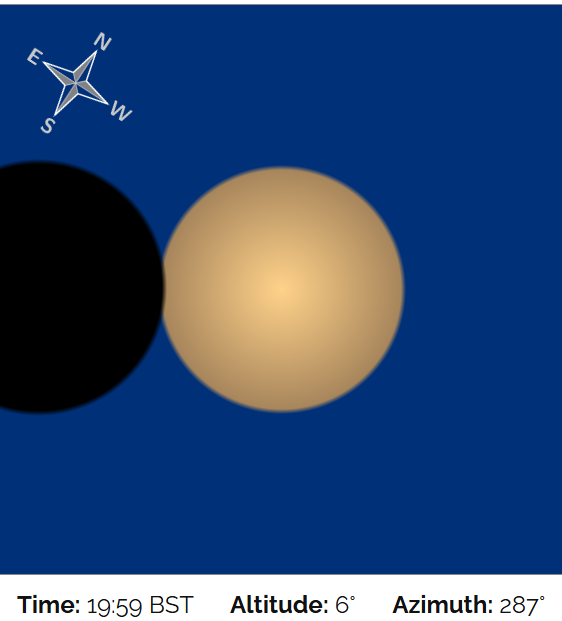
WARNING: THE SUN IS DANGEROUS TO OBSERVE
Never look at the Sun directly with the naked eye and only use equipment certified to do so safely. You will permanently damage your eyesight otherwise.
We will be on Calton Hill with our solar telescopes and free eclipse glasses to give away.
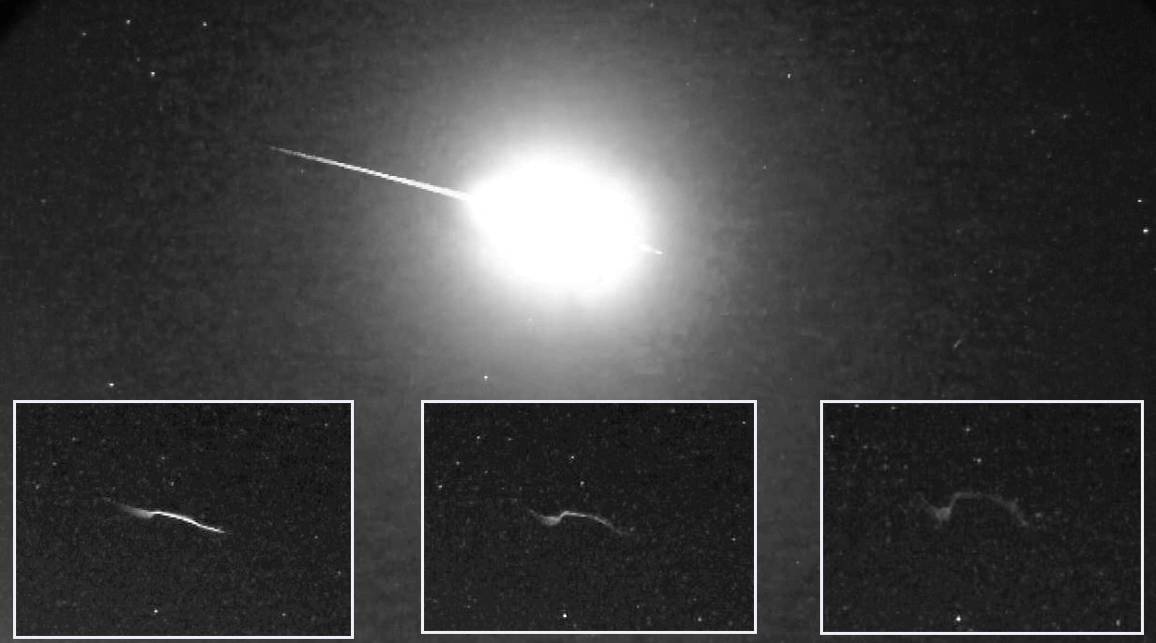
Perseid fireball 2022-0-02 captured by an ASE meteor camera
Perseid meteor shower 2026
The Perseid meteor shower will be active from 17 July to 24 August, producing its peak rate of meteors around 13 August.
From Edinburgh, the radiant of the shower will appear at a peak altitude of 72° above the horizon and you may be able to see up to 140 – 150 meteors per hour at the shower’s peak.
The shower will peak close to new moon, and so moonlight will present minimal interference.
Partial Lunar Eclipse
28 Aug – This will be partially visible from Edinburgh.
– Penumbral phase begins 02:23 BST, altitude 21.4°
– Partial eclipse begins 03:33, altitude 17.1°
– Maximum 05:12, altitude 7.4°
– Moonset 06:20
The Moon is only 7.4° high at maximum, WSW, so you need a low western horizon
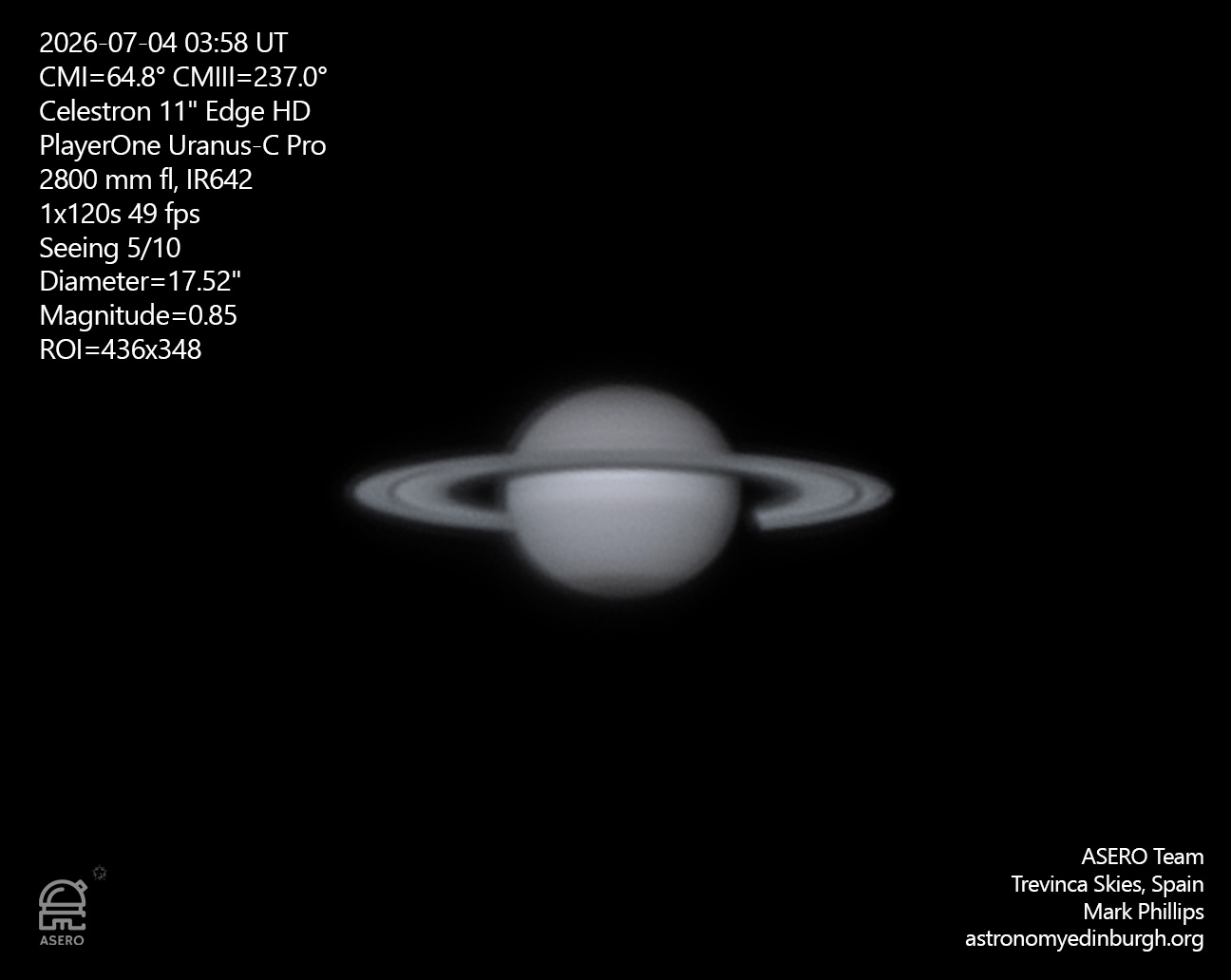
Saturn 2026-07-04 M. Phillips / ASERO
Saturn in the morning
Saturn is the best planet on display and the rings are beginning to open up again. From Edinburgh, it is visible in the morning sky, becoming accessible around 23:32, when it reaches an altitude of 10° above the eastern horizon. It will then reach its highest point in the sky at 04:34, 37° above the southern horizon. It will be lost to dawn twilight around 04:49, 37° above the southern horizon. This disk of the planet is 18″ and mag. 0.35
Early Mars
Mars is currently emerging from behind the Sun. From Edinburgh, it is visible in the dawn sky, rising at 00:58 (BST) and reaching an altitude of 25° above the eastern horizon before fading from view as dawn breaks at around 04:32. It is small at only 4.8″ telescopically and mag. 1.28.
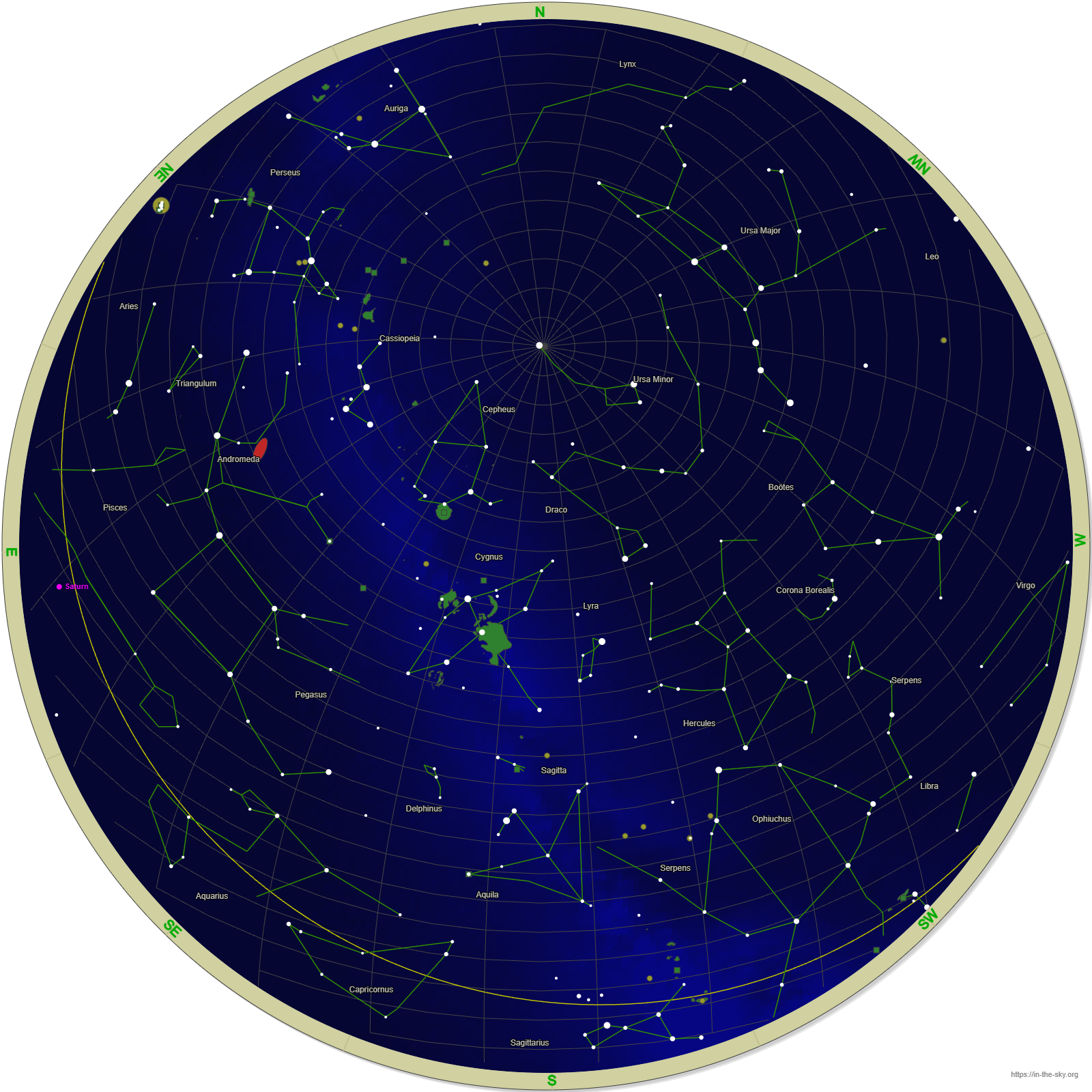
The chart shows the sky at 23:00 BST on 15 Aug 2026.
Click on an item to expand for more information:


Data from in-the-sky.org
| Comet name | Mag | Constellation | Separation from Sun | Trend | Absolute magnitude last updated |
| 10P/Tempel | 7.5 | Capricornus | 156° | Brightening | 1 Apr 2018 |
| C/2026 M3 (MASTER) | 9.8 | Corona Australis | 152° | Brightening | Unknown |
| 88P/Howell | 11.7 | Aries | 76° | Fading | 1 Apr 2018 |
| 78P/Gehrels | 11.9 | Taurus | 43° | Brightening | 30 Sep 2020 |
| 107P/Wilson-Harrington | 12.0 | Libra | 111° | Brightening | Unknown |
| 168P/Hergenrother | 13.1 | Auriga | 41° | Fading | 15 Jan 2013 |
| 63P/Wild | 13.2 | Leo | 37° | Fading | 1 Aug 2013 |
| C/2025 R3 (PANSTARRS) | 13.3 | Canis Major | 35° | Fading | 1 Jul 2026 |
| 260P/McNaught | 13.3 | Aries | 77° | Brightening | 31 Dec 2019 |
| 69P/Taylor | 13.3 | Orion | 47° | Brightening | Unknown |
| D/1884 O1 (Barnard) | 13.7 | Hydra | 94° | Brightening | Unknown |
| C/2025 D1 (Groeller) | 13.8 | Camelopardalis | 63° | Brightening | Unknown |
| P/2010 H2 (Vales) | 13.8 | Sagittarius | 153° | Fading | Unknown |
| 161P/Hartley-IRAS | 13.8 | Eridanus | 78° | Brightening | 31 Jul 2005 |
| 169P/NEAT | 14.0 | Hercules | 132° | Brightening | 1 Jul 2026 |
| 235P/LINEAR | 14.1 | Ophiuchus | 130° | Fading | 3 Jan 2026 |
| P/1999 D1 (Hermann) | 14.1 | Cancer | 10° | Brightening | Unknown |
| C/2023 R1 (PANSTARRS) | 14.1 | Scorpius | 125° | Fading | 1 Jul 2026 |
| P/2006 F4 (Spacewatch) | 14.2 | Ophiuchus | 121° | Fading | Unknown |
| C/2024 J3 (ATLAS) | 14.2 | Lyra | 117° | Brightening | 1 Jul 2026 |
| P/2019 Y2 (Fuls) | 14.7 | Leo | 37° | Fading | Unknown |
| 123P/West-Hartley | 15.0 | Cancer | 12° | Brightening | 3 Jun 2019 |
| 65P/Gunn | 15.2 | Cetus | 106° | Brightening | 1 Aug 2017 |
| 84P/Giclas | 15.5 | Capricornus | 166° | Brightening | 8 Feb 2017 |
| C/2024 T5 (ATLAS) | 15.6 | Eridanus | 55° | Brightening | Unknown |
Perseid meteor shower 2026
The Perseid meteor shower will be active from 17 July to 24 August, producing its peak rate of meteors around 13 August. The radiant point culminates (is highest in the sky) after dawn – at around 07:00 BST – and so the shower is likely produce its best displays shortly before dawn, when its radiant point is highest. The shower is expected to reach peak activity at around 03:00 BST on 13 August 2026.
From Edinburgh, the radiant of the shower will appear at a peak altitude of 72° above your horizon, and on the basis of this, we estimate that you may be able to see up to 143 meteors per hour at the shower’s peak.
The shower will peak close to new moon, and so moonlight will present minimal interference.
The parent body responsible for creating the Perseid shower has been identified as comet 109P/Swift-Tuttle.
| Date | Age of Moon | Sun | Moon | ||||||||
| Rise | Culm | Set | Constellation | Rise | Culm | Set | Constellation | ||||
| 2026 | Jul | 31 | 17 days | 05:13 | 13:17 | 21:20 | Cancer | 22:09 | 03:07 | 08:27 | Aquarius |
| 2026 | Aug | 07 | 24 days | 05:26 | 13:16 | 21:05 | Cancer | –:– | 08:58 | 18:38 | Taurus |
| 2026 | Aug | 14 | 02 days | 05:40 | 13:15 | 20:50 | Leo | 09:31 | 15:31 | 21:12 | Leo |
| 2026 | Aug | 21 | 09 days | 05:54 | 13:14 | 20:33 | Leo | 18:41 | 21:04 | 23:28 | Ophiuchus |
| 2026 | Aug | 31 | 19 days | 06:13 | 13:11 | 20:07 | Leo | 20:49 | 04:04 | 11:54 | Pisces |

Use the chevrons to choose the month:
Much of the material is provided with thanks to Dominic Ford on his excellent site in-the-sky.org.