

Saturn at opposition and close to Moon during lunar eclipse

Author: Alan Pickup
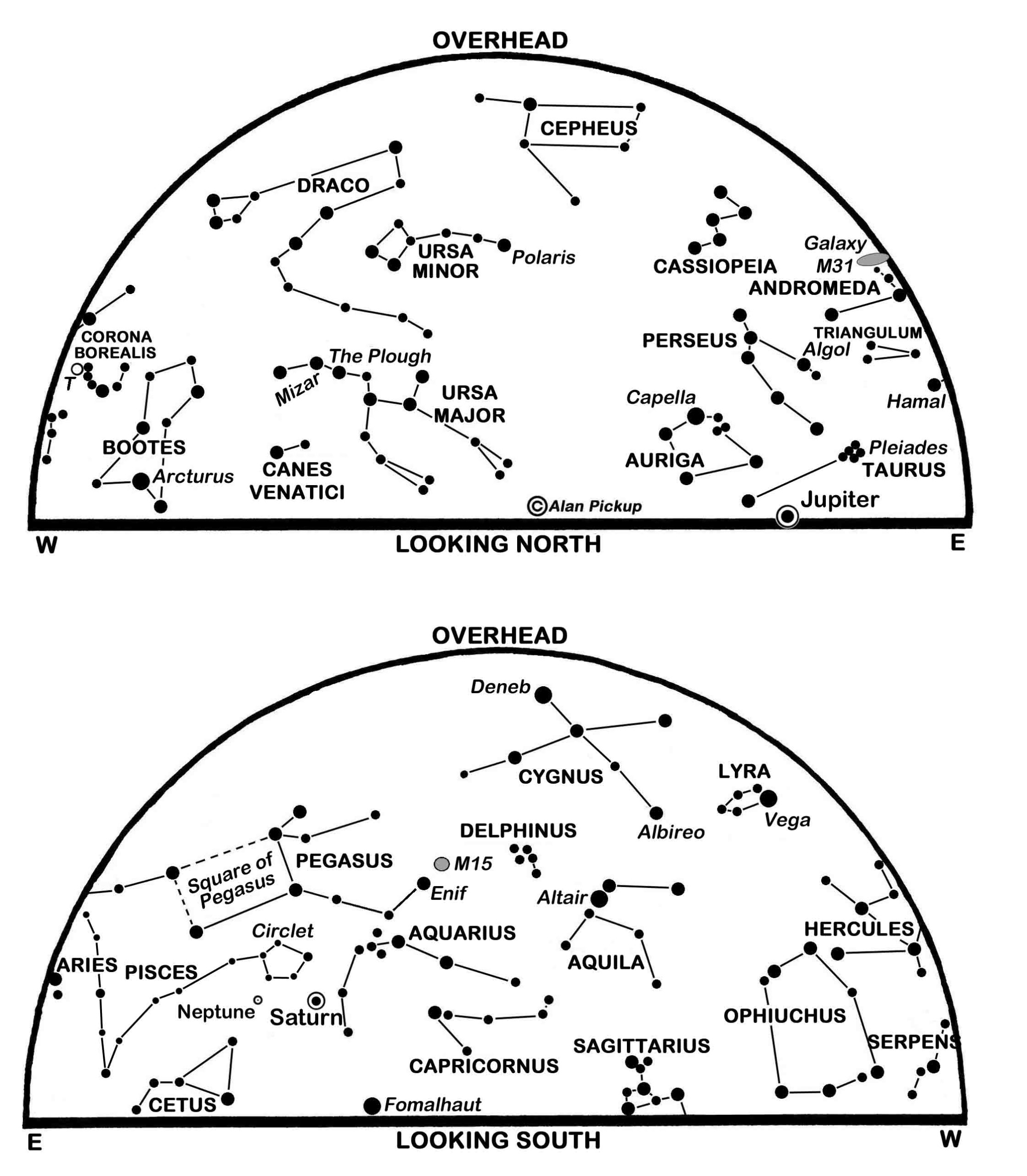
The maps show the sky at 23:00 BST on the 1st, 22:00 on the 16th and 21:00 on the 30th.
Saturn stands at opposition this month, directly opposite the Sun in the sky so that it is highest in the south in the middle of the night and at its best for observation just as its rings appear at their narrowest in years. It is far from the only planet on show, though, and we have rare opportunities to spot all the other ones too given some luck and perseverance. Add a partial eclipse of the Moon, and a surplus of stellar interest, and we should not be disappointed.
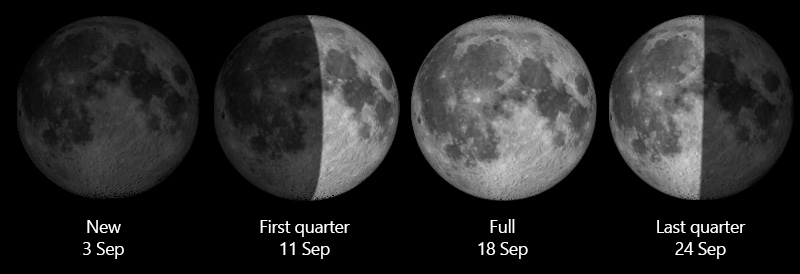
Sunrise/sunset times for Edinburgh change from 06:18/20:06 on the 1st to 07:15/18:50 on the 30th as the Sun sinks 11.5° southwards and crosses the sky’s equator at 13:44 BST on the 22nd, the moment of our autumnal equinox. The Moon is new on the 3rd, at first quarter on the 11th, full on the 18th and at last quarter on the 24th.
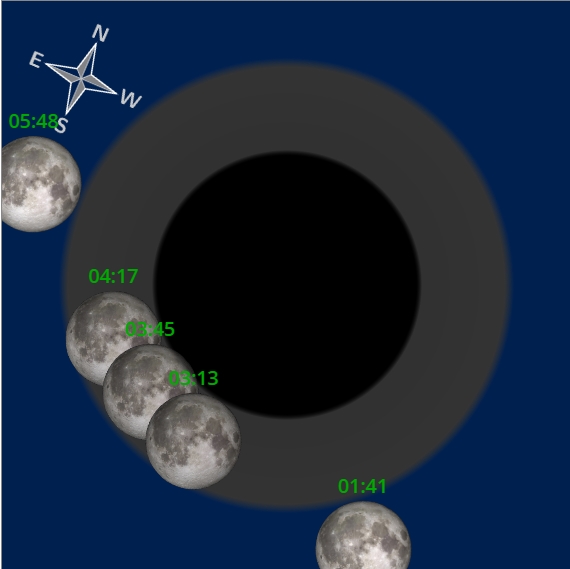
Partial Lunar Eclipse 18 September. Diagram from in.the-sky.org
The full Moon slips through the southern part of the Earth’s shadow on the morning of the 18th in a partial lunar eclipse which we may view from start to finish. The northern edge of the Moon starts to enter the penumbral shadow at 01:41 BST, but we will notice little darkening until it nears the central core of the shadow, the umbra, which it touches at 03:13. For the next 62 minutes a narrow sliver of the umbra darkens up to 8% of the top of the disk. The eclipse ends when the Moon is free of the penumbra at 05:47.
Of all September’s planets, the brightest is probably the most challenging. Venus is brilliant at magnitude -3.9 but stands less than 5° high in the west at sunset at present and no higher in the south-west by the month’s end. We need good weather, an unobstructed horizon and to be on our toes to catch it for it sets less than 45 minutes after the Sun. The 6% illuminated Moon stands a shade lower than Venus and 5° to its left on the evening of the 6th.
Mercury is enjoying its best morning appearance of 2024. It rises for Edinburgh at 04:41 BST on the 1st when it shines at magnitude 0.6 and stands 5° below the slender earthlit Moon, only 3% sunlit. It rises more than one hour before sunrise until the 20th as it brightens to magnitude -1.3 and it tracks eastwards through Leo. It is furthest west of the Sun (18°) on the 5th and passes a Moon’s breadth above the bright star Regulus on the 9th.
Our sky charts show the view facing north and south in the late evening and depict the bright star Deneb in Cygnus close to overhead. Together with the brighter Vega in Lyra, high in the west, and Altair in Aquila, in the middle of our south-west, it completes the long-recognised stellar landmark of the Summer Triangle.
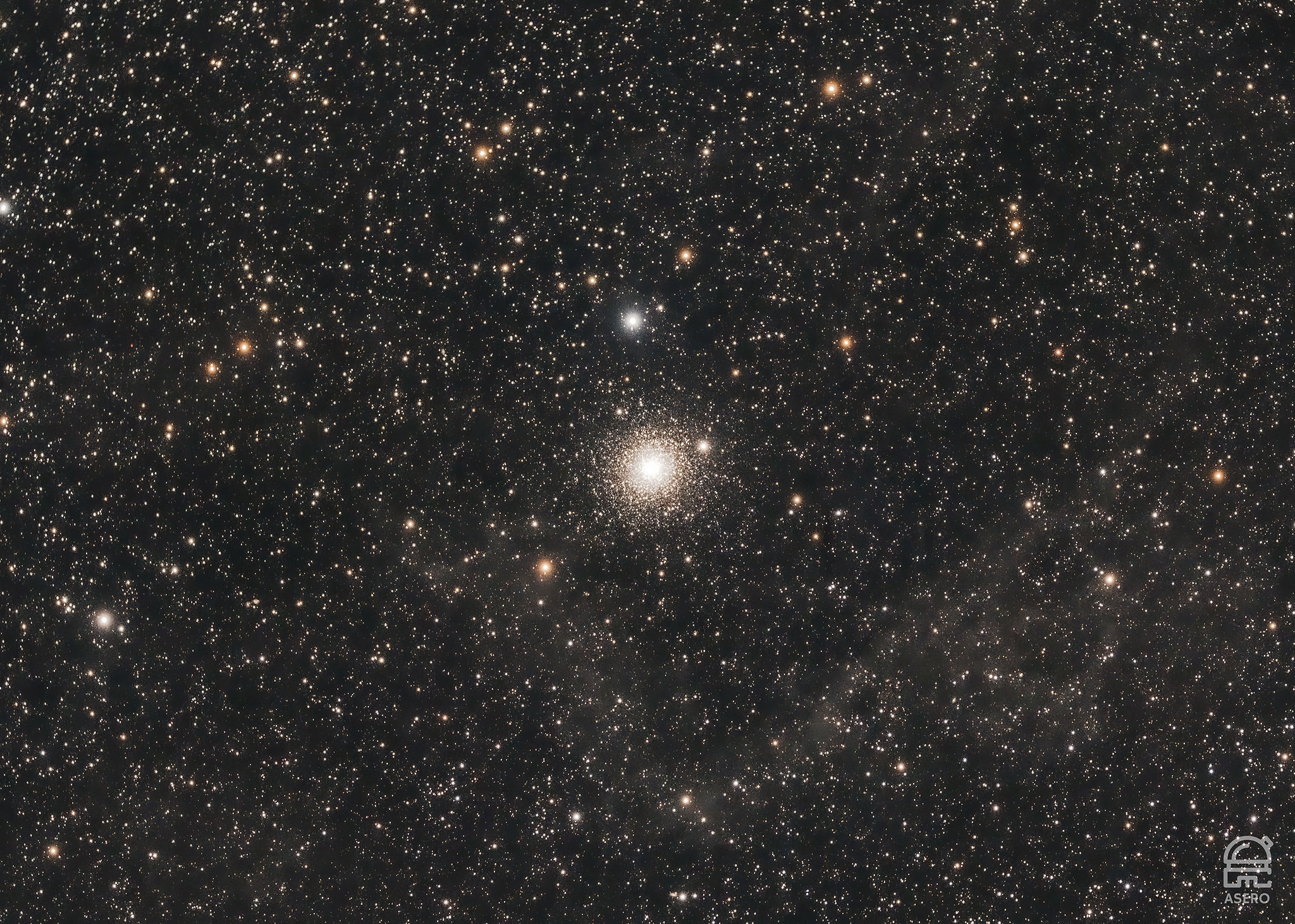
M15 Globular cluster. ASERO-Dalrada telescope, M. Phillips
I touched on some of the features of the Triangle and the neat constellation of Delphinus the Dolphin in recent months. If we use binoculars to look some 12° to the east (left) of Delphinus we may spot the fuzzy blob of the globular star cluster Messier 15 (M15). A densely-packed ball of more than 100,000 stars, it lies 36,000 light years away and appears about half as wide as the Moon. Just 4° south-east of M15 is Enif, the orange supergiant that is the brightest star in Pegasus, the constellation of the flying horse whose famous Square is centred 30° to Enif’s left.
South of the Square of Pegasus is the Circlet, a loop of fainter stars which happens to lie just above the Moon during the lunar eclipse on the 18th. Neptune lies below the left edge of the Circlet and is visible through binoculars (when the Moon is not nearby) at magnitude 7.8. The furthest planet stands 4,322 million km away at opposition on the 21st.
The brightest object in the area, though, is Saturn which reaches opposition on the 8th as a magnitude 0.6 object edging westwards in Aquarius where it sits 10° below-right of the Moon during the eclipse. Moving from low in the east as our evening twilight fades, it climbs to pass highest in the south at around 27° two hours after our map times before sinking into the west during morning twilight.
Through a telescope at opposition, Saturn shows a flattened disk 19 arcseconds wide, with its rings spanning 43 arcseconds but with their north face tipped at only 3.8° to our view. Telescopes also show several of the larger Saturnian moons, the largest of which, Titan, takes 16 days to orbit the planet.
Jupiter rises in the north-east at our map times to be conspicuous between the horns of Taurus, about 10° to the left of Aldebaran. Tracking 2° eastwards this month, it brightens slightly between magnitude -2.3 and -2.5. Look for it near the Moon on the 23rd-24th when a telescope shows its cloud-banded disk to be 41 arcseconds wide.
Mars lies 9° east of Jupiter as September opens and brightens from magnitude 0.7 to 0.5 as it speeds 17° further eastwards into the middle of Gemini by the month’s end. Viewed telescopically, it swells to 7.5 arcseconds and telescopes begin to show dusky markings on its ochre surface, and its icy north polar region as the latter begins to tilt Earthwards.
Our final planet, Uranus, is a magnitude 5.7 binocular object in Taurus, 5° south-west of the Pleiades.
Back in May, I speculated that the star T Coronae Borealis, the recurrent nova that is also called the Blaze Star, might be on the verge of a major outburst, flaring up to naked-eye prominence at magnitude 2 or 3 for the first time since 1946. Astronomers are monitoring it continuously, but it remains stubbornly near the tenth magnitude as it dips lower into our western evening sky (see chart). Could their vigil be over any day now?
Diary for 2024 September
Times are BST
- 1st 10h Moon 5° N of Mercury
- 3rd 03h New Moon
- 5th 03h Mercury furthest W of Sun (18°)
- 5th 11h Moon 1.2° S of Venus
- 8th 06h Saturn at opposition at distance of 1,295m km
- 8th 21h Mars 0.9° S of star cluster M35 in Gemini
- 9th 08h Mercury 0.5° N of Regulus
- 10th 14h Moon 0.1° S of Antares
- 11th 07h First quarter
- 17th 11h Moon 0.3° N of Saturn
- 17th 14h Venus 2.6° N of Spica
- 18th 04h Full Moon and partial lunar eclipse
- 21st 01h Neptune at opposition at distance of 4,322m km
- 22nd 12h Moon 0.2° N of Pleiades star cluster
- 22nd 13:44 Autumnal equinox
- 24th 00h Moon 6° N of Jupiter
- 24th 20h Last quarter
- 25th 13h Moon 5° N of Mars
- 26th 12h Moon 1.7° S of Pollux
- 27th 13h Moon 3° N of Praesepe star cluster
- 29th 09h Moon 3° N of Regulus
- 30th 22h Mercury in superior conjunction on far side of Sun
This is an extended version, with added diary, of Alan’s article published in The Scotsman on 31 August 2024, with thanks to the newspaper for permission to republish here.