

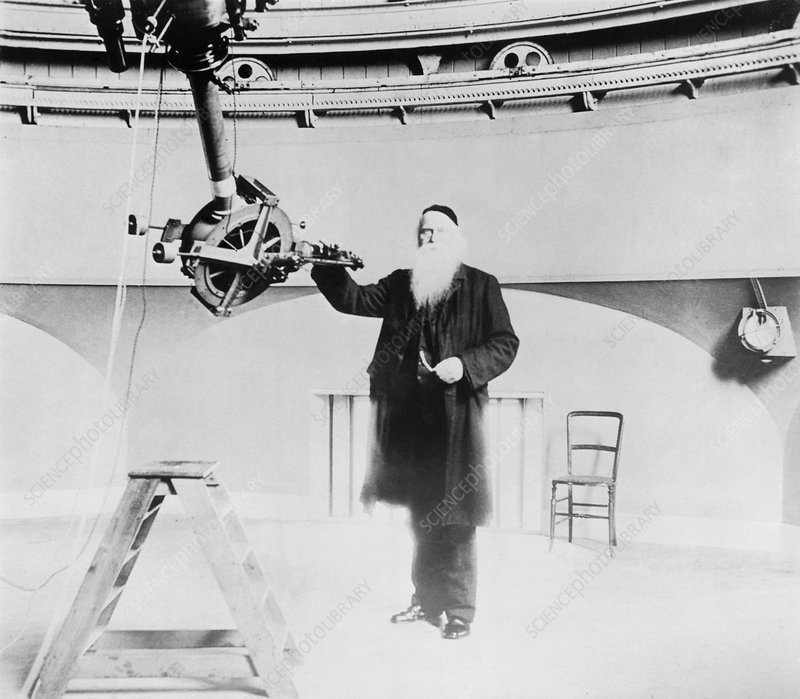
Charles Piazzi Smyth’s resignation was in part related to the Government’s desire to end financial support for astronomical research on Calton Hill.
However, Lord Crawford, who owned a substantial private observatory at Dunecht in Aberdeenshire, stepped in and made a gift of all his instruments and a valuable library of books on the basis that Government would continue to support a Royal Observatory in Edinburgh.
The Government accepted this offer and Ralph Copeland (1837- 1905) was appointed as the third Astronomer Royal in January 1889. His first task was to secure a new site for an extended observatory. He chose Blackford Hill to the south of the city. The new observatory was completed in 1896 and the Calton Hill one was given to the City of Edinburgh Council.
In the period leading up to 1896 Copeland used the Calton Hill observatory principally as a laboratory to teach practical astronomy to his University students.
However, in March 1894 he installed a Bifilar Pendulum on Calton Hill. It was designed by Horace Darwin, a son of the celebrated Charles Darwin, who set up a company in Cambridge to build and sell these instruments. This instrument was an early Seismograph and Copeland proceeded to record many earthquakes. The instrument was moved to Blackford Hill in 1896 where it continued to record earthquakes, including the famous one in San Francisco, in 1906.
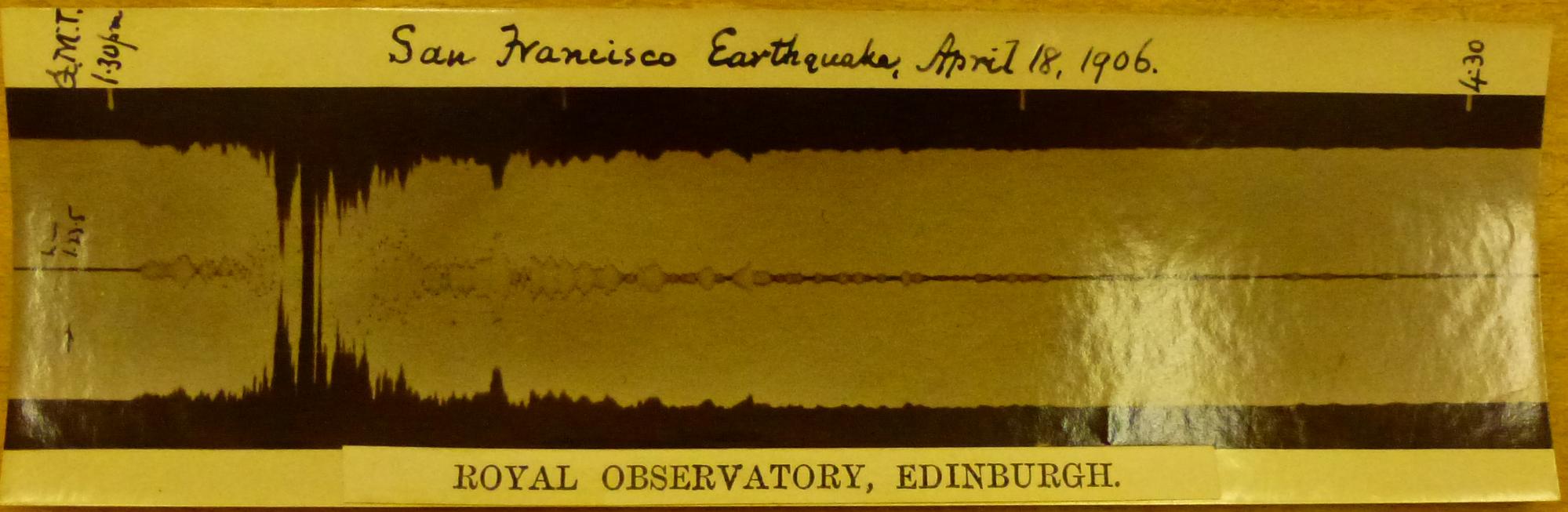
San Francisco Earthquake as recorded on Blackford Hill
The Royal Observatory on Blackford Hill is carrying on the tradition as a premier world research establishment.
Dr Bruce Vickery