

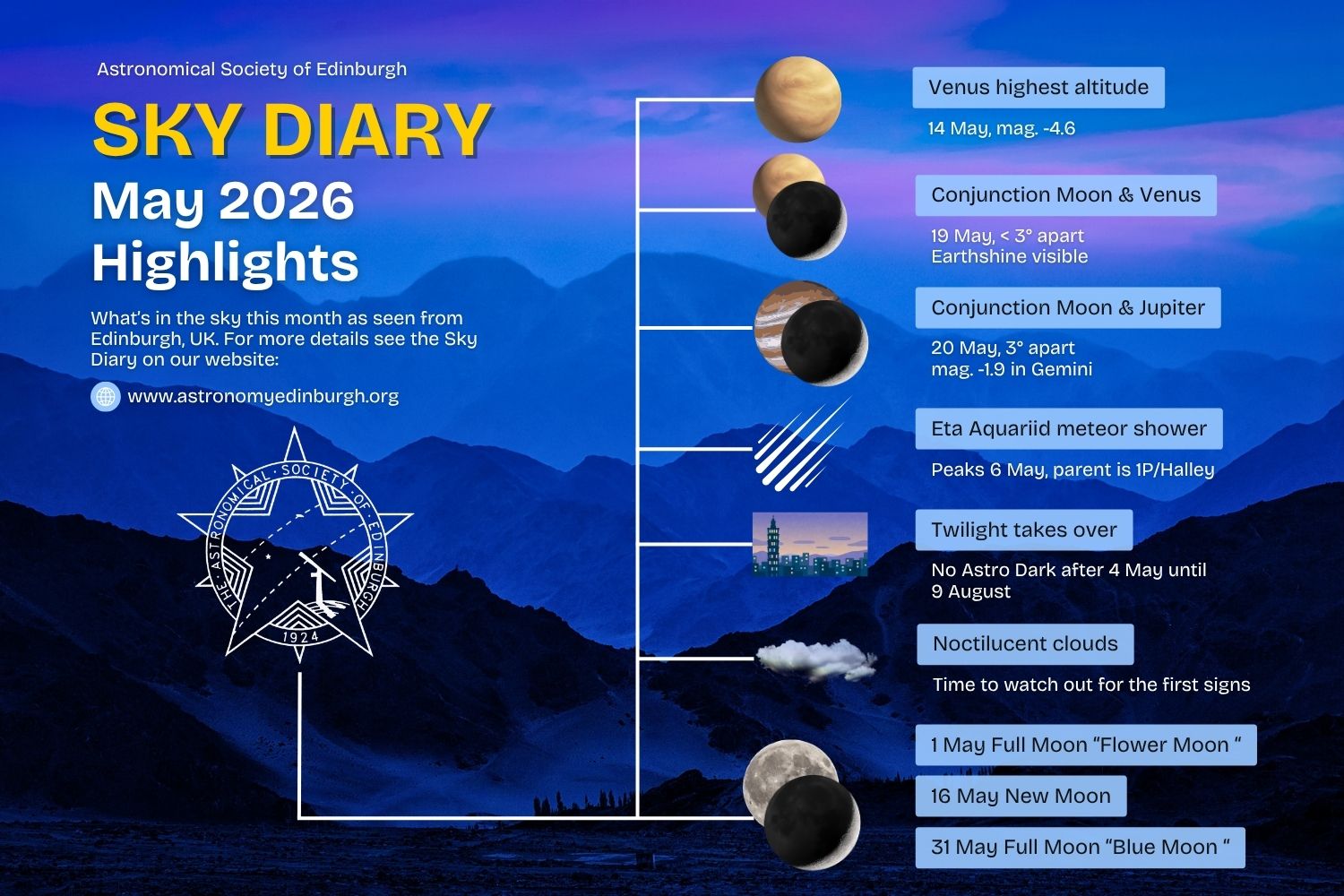
Venus & Jupiter and the Crescent Moon, Halley’s Comet meteors and a Blue Moon
by Mark Phillips
Using data from Dominic Ford’s in-the-sky.org and other sources
You can watch Mark Phillips’ Sky in May talk on YouTube from the meeting on 1 May.
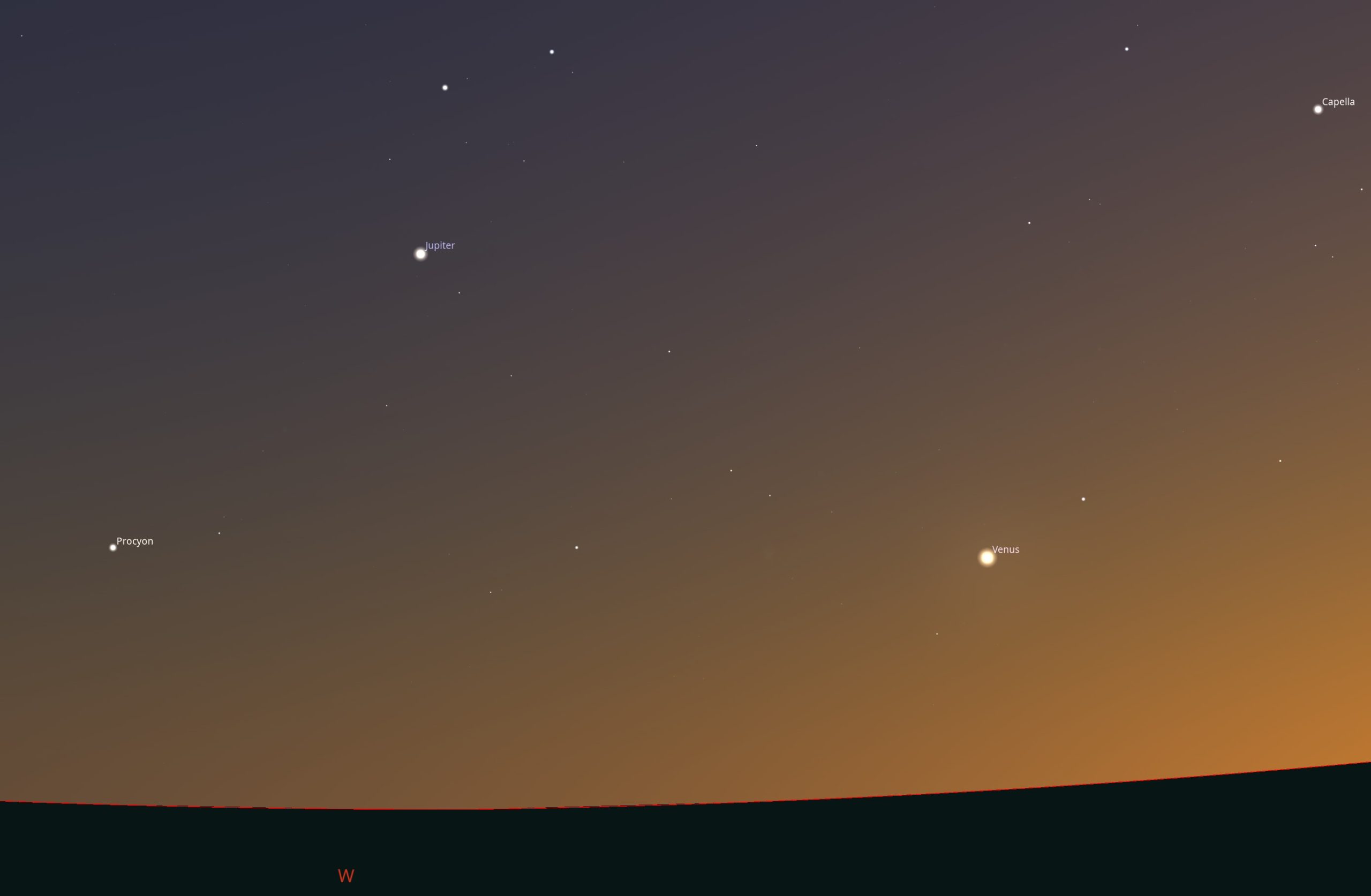 Venus at highest altitude in evening sky
Thu, 14 May 2026
As seen from Edinburgh, Venus will reach its highest point in the sky in its 2026 evening apparition. It will be shining brightly at mag -4.3.
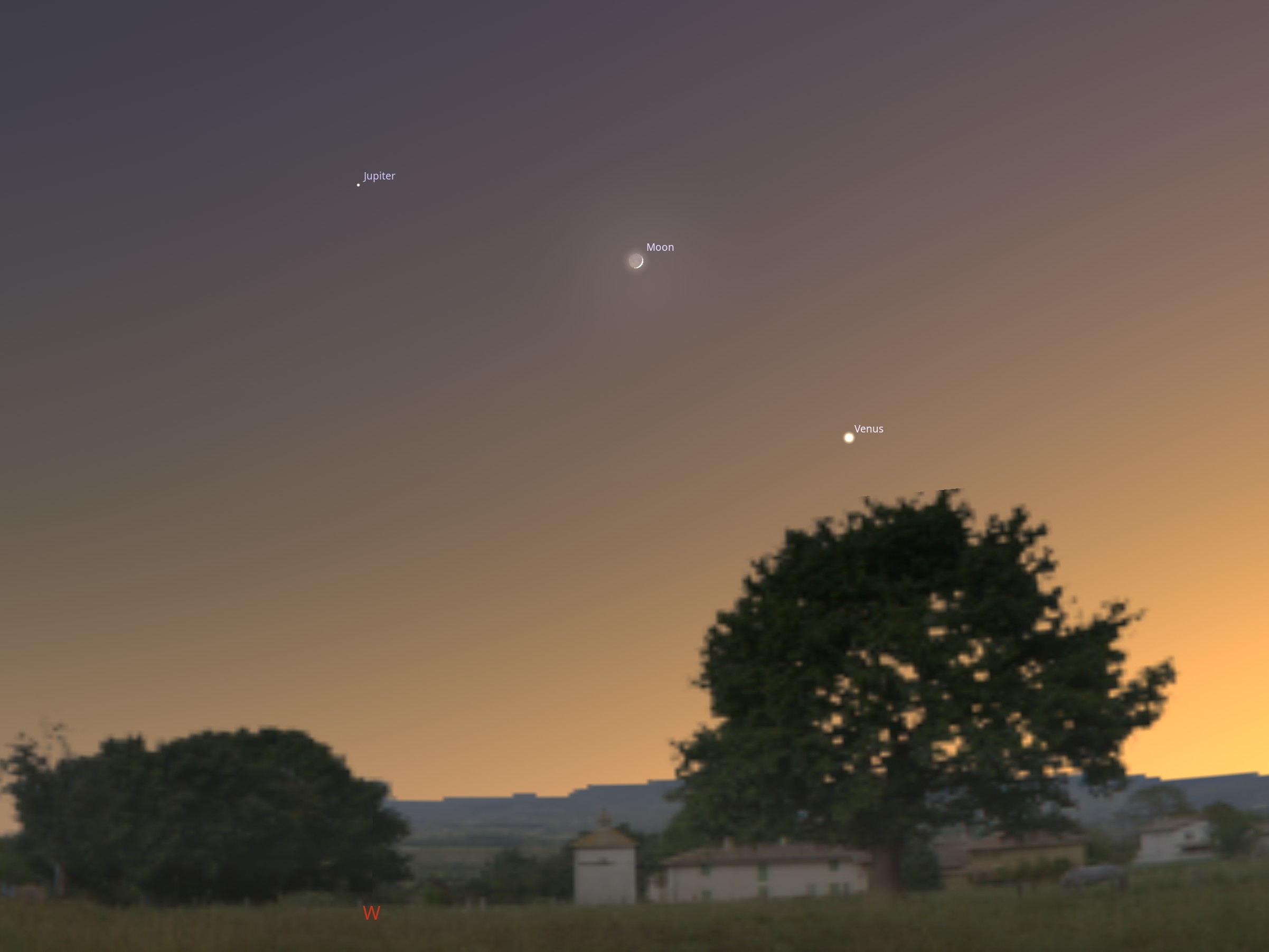 Close approach of the Moon, Venus and Jupiter
Tue, 19 May 2026
The Moon and Venus will make a close approach, passing within 2°56′ of each other, with Jupiter not far behind. The Moon will be 3 days old.
The Moon will be at mag -10.0, Venus will be at mag -4.0 and Jupiter -1.9.
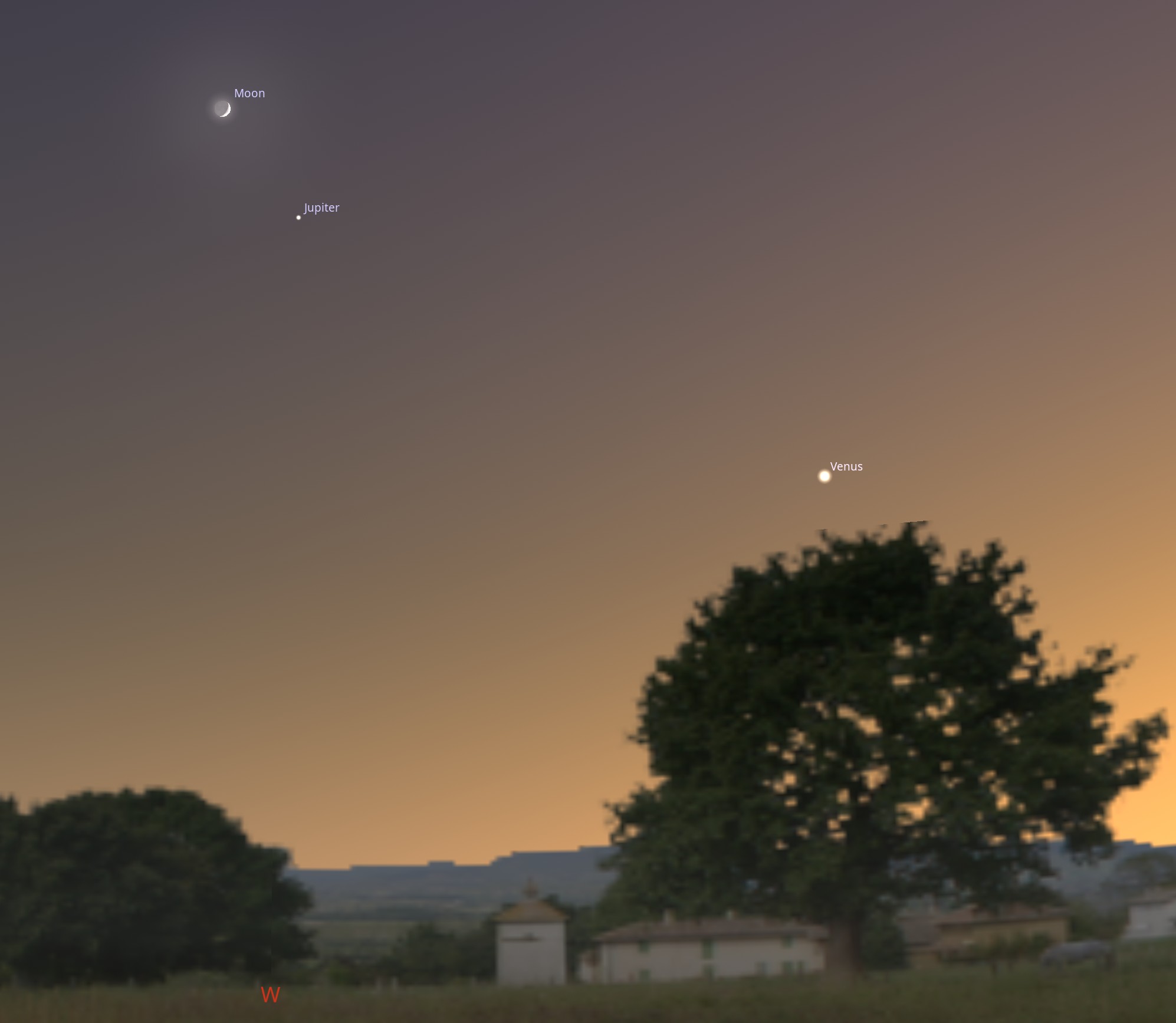 Close approach of the Moon and Jupiter
Wed, 20 May 2026
The Moon and Jupiter will make a close approach, passing within 3°00′ of each other. The Moon will be 4 days old.
From Edinburgh , the pair will become visible at around 21:58 (BST), 25° above your western horizon, as dusk fades to darkness. They will then sink towards the horizon, setting 3 hours and 59 minutes after the Sun at 01:26.
The Moon will be at mag -11.0; and Jupiter will be at mag -1.9. Both objects will lie in the constellation Gemini.
η-Aquariid meteor shower 2026
Wed, 06 May 2026
The η-Aquariid meteor shower will be active from 19 April to 28 May.
The shower is expected to reach peak activity at around 10:00 BST on 6 May 2026, and so the best displays might be seen before dawn on 6 May and after the radiant rises on 6 May.
At its peak, the shower is expected to produce a nominal rate of around 40 meteors per hour (ZHR). From Edinburgh, the radiant of the shower will appear at a peak altitude of 13° above your horizon, and on the basis of this, we estimate that you are only likely to see only around 9 meteors per hour, even at the shower’s peak, since the radiant will be relatively low in the sky.
The Moon, in Sagittarius, will be around last quarter phase at the shower’s peak, presenting significant interference in the pre-dawn sky after it rises at 02:08.
The parent body responsible for creating the η-Aquariid shower has been identified as comet 1P/Halley.
Moon phases
There will be a second full moon of May 2026, making it a blue moon. With New Moon around the time of Lunar perigee, this means it will a Super New Moon.
And as the second Full Moon occurs around apogee is will be a Micro Full Moon. Neither of these terms are as often used as the much-hyped Supermoon.
Full Moon
1 May “Flower Moon”
31 May “Blue Moon”
New Moon
16 May


Aristoteles and Eudoxus by Mike Christie
Twilight and Noctilucent clouds
Twilight begins to take over and there is no true Astro dark after 4 May until 9 August.
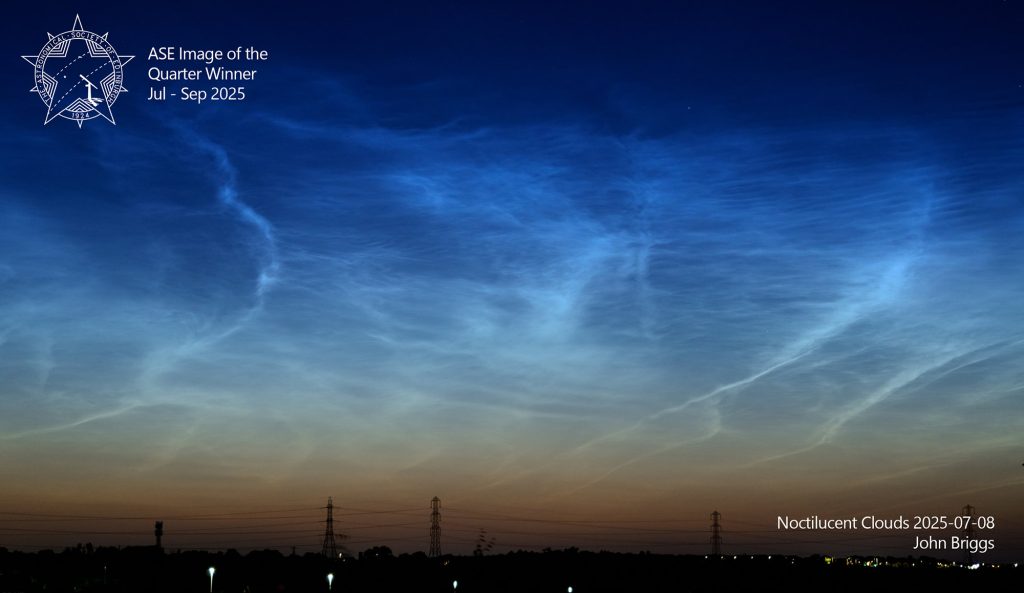
Noctilucent clouds are possible from mid-May so keep an eye open for the very earliest signs (more usual from June).
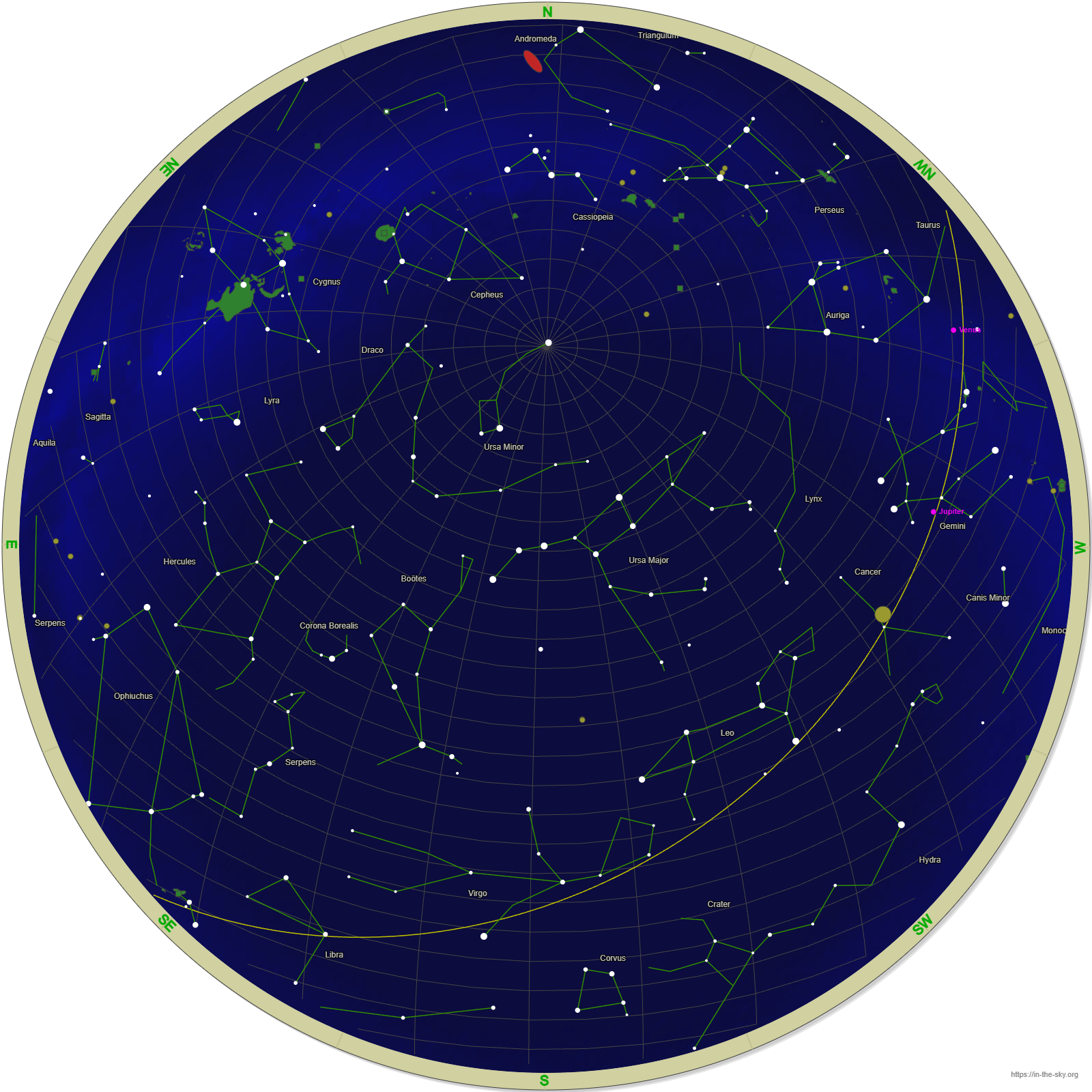
The chart shows the sky at 22:30 BST on 15 May 2026.
Click on an item to expand for more information:

Data from in-the-sky.org
| Comet name | Mag | Constellation | Separation from Sun | Trend | Absolute magnitude last updated |
| 88P/Howell | 9.6 | Aquarius | 44° | Fading | 1 Apr 2018 |
| 141P-A/Machholz | 10.5 | Cetus | 5° | Fading | Unknown |
| C/2026 A1 (MAPS) | 10.9 | Taurus | 35° | Fading | 31 Mar 2026 |
| 10P/Tempel | 11.1 | Aquila | 108° | Brightening | 1 Apr 2018 |
| 141P-D/Machholz | 11.8 | Pisces | 18° | Brightening | Unknown |
| 78P/Gehrels | 12.4 | Pisces | 10° | Brightening | 30 Sep 2020 |
| 63P/Wild | 13.0 | Gemini | 74° | Brightening | 1 Aug 2013 |
| 168P/Hergenrother | 13.0 | Cetus | 28° | Brightening | 15 Jan 2013 |
| C/2024 E1 (Wierzchos) | 13.1 | Taurus | 48° | Fading | 3 Feb 2026 |
| C/2025 A6 (Lemmon) | 13.3 | Centaurus | 127° | Fading | 3 Mar 2026 |
| P/2006 F4 (Spacewatch) | 13.4 | Ophiuchus | 142° | Brightening | Unknown |
| A/2025 Y1 | 13.5 | Virgo | 159° | Brightening | Unknown |
| P/2010 H2 (Vales) | 13.8 | Sagittarius | 112° | Brightening | Unknown |
| 107P/Wilson-Harrington | 14.0 | Ophiuchus | 144° | Brightening | Unknown |
| 69P/Taylor | 14.1 | Cetus | 16° | Brightening | Unknown |
| C/2025 D1 (Groeller) | 14.2 | Draco | 78° | Brightening | Unknown |
| P/2019 Y2 (Fuls) | 14.3 | Gemini | 80° | Fading | Unknown |
| C/2024 J3 (ATLAS) | 14.5 | Delphinus | 82° | Brightening | Unknown |
| 24P/Schaumasse | 14.7 | Virgo | 161° | Fading | 31 Mar 2026 |
| C/2026 B2 (Sun-Gao) | 14.9 | Andromeda | 34° | Fading | Unknown |
| 93P/Lovas | 15.0 | Aries | 11° | Brightening | 18 Nov 2007 |
| D/1884 O1 (Barnard) | 15.1 | Hydra | 163° | Brightening | Unknown |
| C/2023 R1 (PANSTARRS) | 15.1 | Aquila | 105° | Brightening | 1 Aug 2025 |
| 240P/NEAT | 15.3 | Auriga | 55° | Fading | 3 Jan 2026 |
| P/1999 D1 (Hermann) | 15.4 | Perseus | 39° | Brightening | Unknown |
η-Aquariid meteor shower 2026
The η-Aquariid meteor shower will be active from 19 April to 28 May, producing its peak rate of meteors around 6 May.
Seen from Edinburgh , the shower will not be visible before around 02:49 each night, when its radiant point rises above your eastern horizon. It will then remain active until dawn breaks around 04:30.
The radiant point culminates (is highest in the sky) after dawn – at around 09:00 BST – and so the shower is likely produce its best displays shortly before dawn, when its radiant point is highest.
From Edinburgh, the radiant of the shower will appear at a peak altitude of 13° above your horizon, and on the basis of this, we estimate that you are only likely to see only around 9 meteors per hour, even at the shower’s peak, since the radiant will be relatively low in the sky.
The Moon, in Sagittarius, will be around last quarter phase at the shower’s peak, presenting significant interference in the pre-dawn sky after it rises at 02:08.
The parent body responsible for creating the η-Aquariid shower has been identified as comet 1P/Halley.
You can see any meteors captured by our cameras on the Meteorcams page.
| Date | Age of Moon | Sun | Moon | ||||||||
| Rise | Culm | Set | Constellation | Rise | Culm | Set | Constellation | ||||
| 2026 | Apr | 30 | 13 days | 05:27 | 13:08 | 20:50 | Aries | 21:26 | 00:30 | 04:42 | Virgo |
| 2026 | May | 07 | 20 days | 05:12 | 13:07 | 21:04 | Aries | 03:01 | 06:13 | 09:34 | Sagittarius |
| 2026 | May | 14 | 27 days | 04:58 | 13:07 | 21:18 | Taurus | 03:59 | 11:43 | 19:56 | Pisces |
| 2026 | May | 21 | 05 days | 04:46 | 13:07 | 21:30 | Taurus | 10:56 | 18:51 | 02:09 | Cancer |
| 2026 | May | 31 | 15 days | 04:32 | 13:09 | 21:46 | Taurus | –:– | 01:37 | 04:05 | Ophiuchus |
Use the chevrons to choose the month:
Much of the material is provided with thanks to Dominic Ford on his excellent site in-the-sky.org.