

All the things we cannot see, Jupiter still the highlight
by Mark Phillips
Using data from Dominic Ford’s in-the-sky.org and other sources
Watch Bryan Lawrence’s guide to the February night sky recorded at our meeting on 6 february 2026.
First, some things we can see:
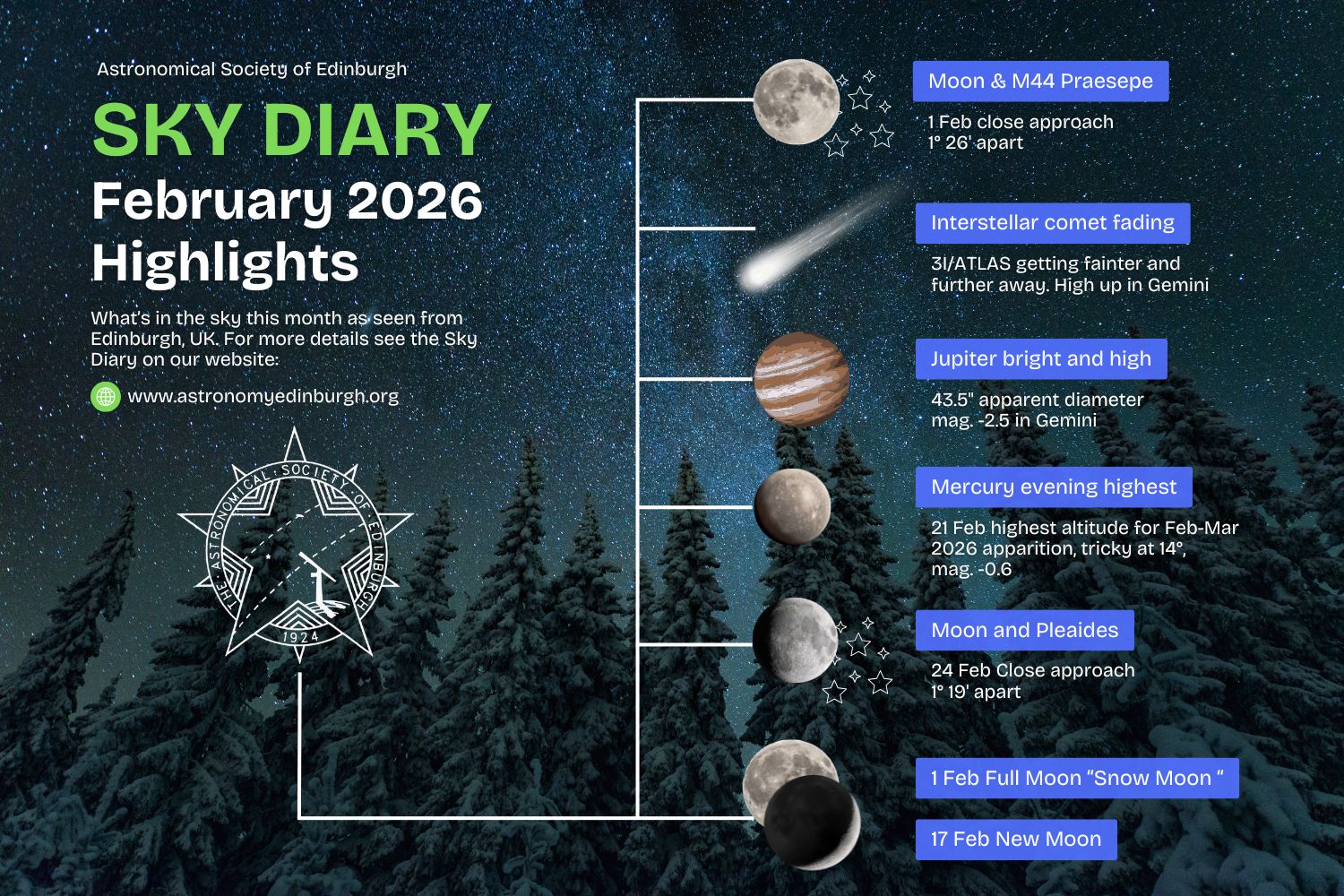
Jupiter continues to be the standout object in the sky, bright at mag. -2.5 presenting a disk of 43.5″ by mid-month. It is 4.4355 AU from earth on 15 Feb and getting further away, having passed opposition in January. It is unmistakable high up in the sky in Gemini.
On 1 Feb The Moon and M44 (Praesepe) will make a close approach, passing within 1°26′ of each other. The Moon will be 14 days old.
On 21 Feb Mercury reaches its highest altitude in evening sky for the Feb–Mar 2026 evening apparition at mag -0.6. It will be tricky to observe, reaching a peak altitude of 14° above the horizon at sunset on 22 Feb 2026.
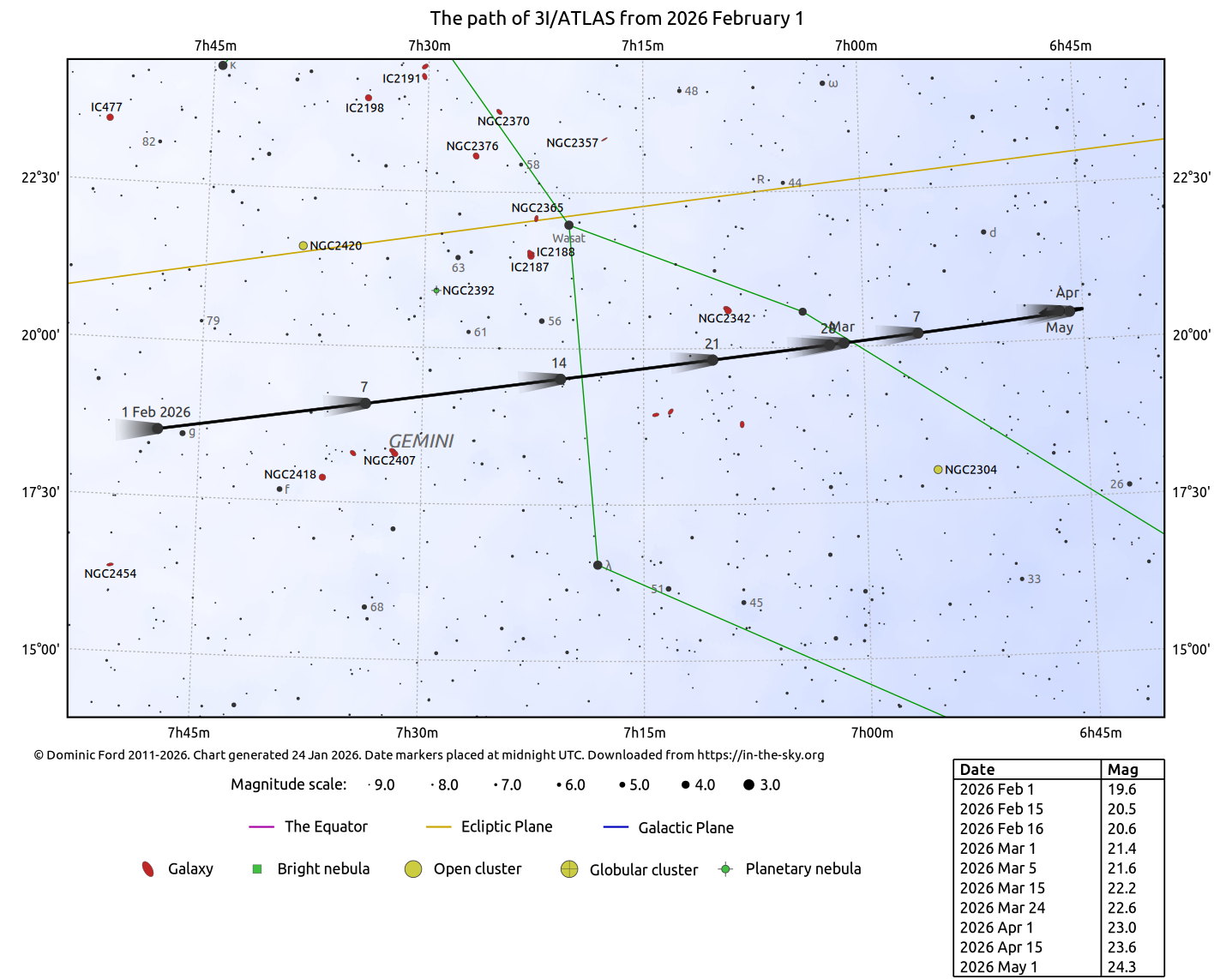
3I/ATLAS finder chart Feb 2026
Our interstellar visitor comet 3I/ATLAS continues to fade and you will need a more serious telescope to capture it now, but in the constellation of Gemini it is well placed in the evenings.
This month many of the interesting events are just not visible from Edinburgh. Here are a few we sadly won’t be seeing:
- 17 Feb Annular solar eclipse, visible from Antarctica
- 17 Feb Comet C/2024 E1 (Wierzchos) passes perigee
- 18 Feb Lunar occultation of Mercury
Jupiter
Jupiter is still very nicely placed for us in Scotland, due South and at its highest mid month by around 21:30 GMT. High up in the sky in Gemini, it allows us to look at it through much less atmosphere than when lower down, helping make the image steadier. With its ever changing cloud patterns and the dance of its 4 bright Galilean satellites (Io, Europa, Ganymede and Callisto) it makes for a fascinating study.
Here are some recent images by ASE members (click on an image for a larger view):
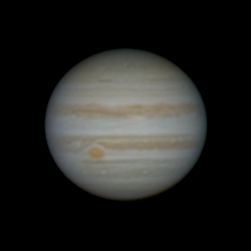
Jupiter 2026-01-05 Matt Finch
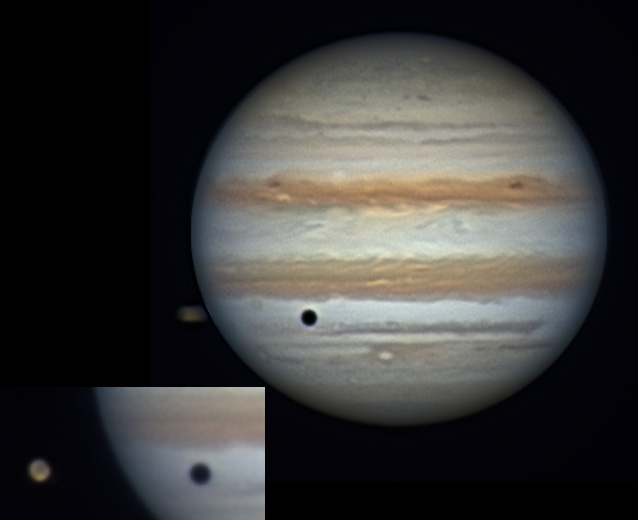
Jupiter and Ganymede shadow transit, 30 Dec 2025 M. Phillips
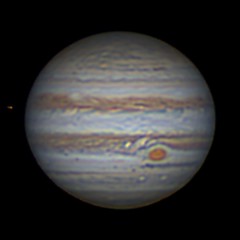
Jupiter and Io 2026-01-15 M. Christie
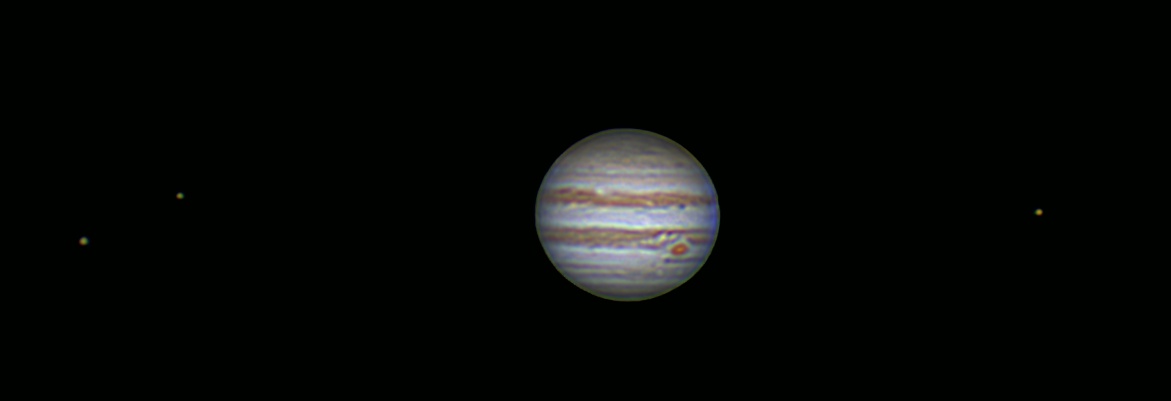
Jupiter Ganymede, Europa, Io 2026-01-13 M. Christie
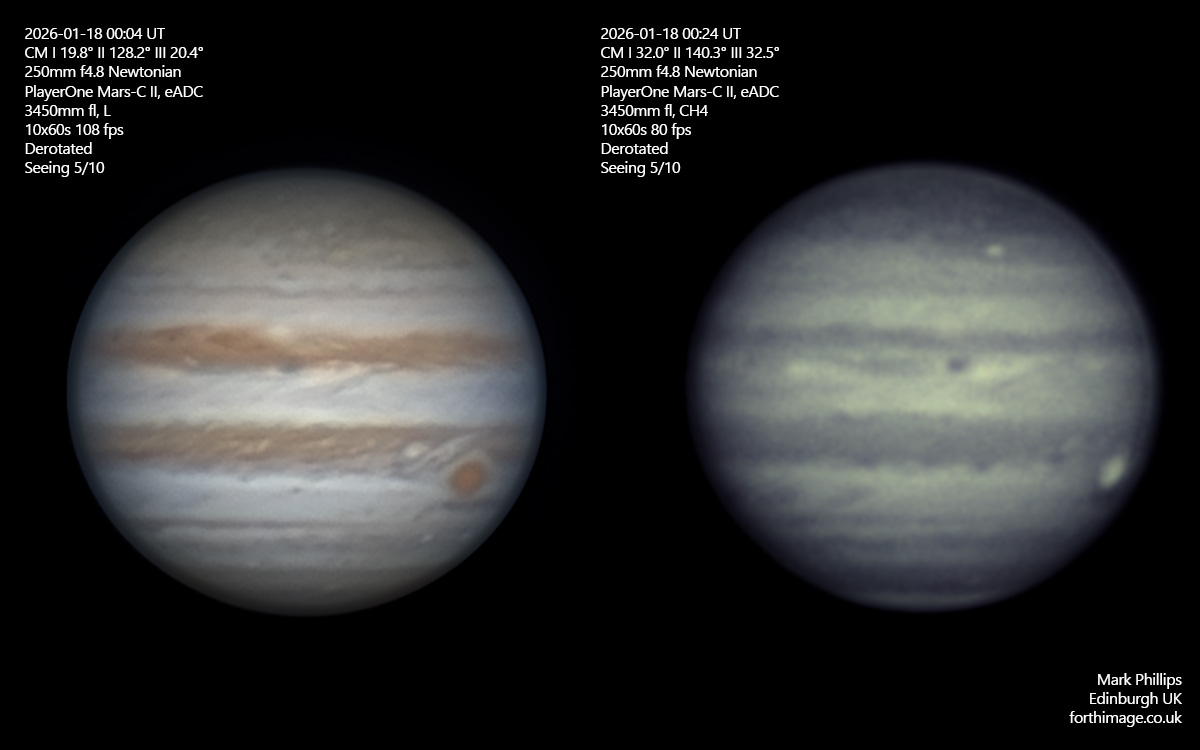
Jupiter in RGB and Methane, 2026-01-17 M. Phillips
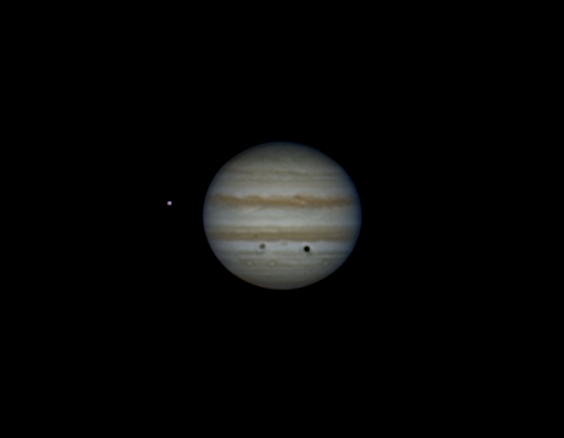
Jupiter and Ganymede 2025-12-30 Matt Finch
One of the images shows Jupiter imaged through a Methane (CH4) filter. This allows us to see the features at the top of the atmosphere such as high-altitude clouds, hazes, and active convection. The Great Red Spot shows up really brightly in Methane.
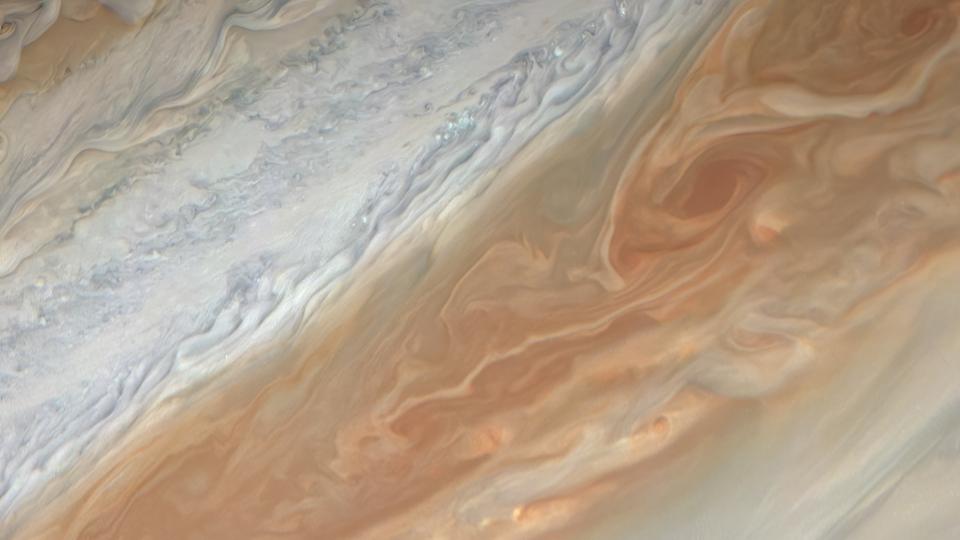
Credit : NASA/JPL-Caltech/SwRI/MSSS/Kevin M. Gill
Juno at Jupiter
Jupiter is the undoubted “star” of our night skies at the moment and it’s worth remembering that there is still an active probe in orbit around the planet. Juno has been there for more than 9 years now, capturing some amazing images and data!
Highlights:
- 1 Feb – Full Moon, known as the “Snow Moon”
- 1 Feb Moon and M44 (Praesepe) close approach, 1°26′ apart
- Jupiter the standout object, mag. -2.5 and 43.5″ mid-month
- 17 Feb – New Moon
- 21 Feb – Mercury at highest altitude in evening sky
- 24 Feb – 7-day old Moon and M45 (Pleaides) close approach, 1°10′ apart
- Constellations at mid-month around 21:30 GMT:
- Orion and Taurus are heading Westwards
- Gemini with Jupiter are high in the South
- Cancer and Leo following behind, getting higher in the East
- Summer constellations of Cygnus and Lyra are at their lowest due North
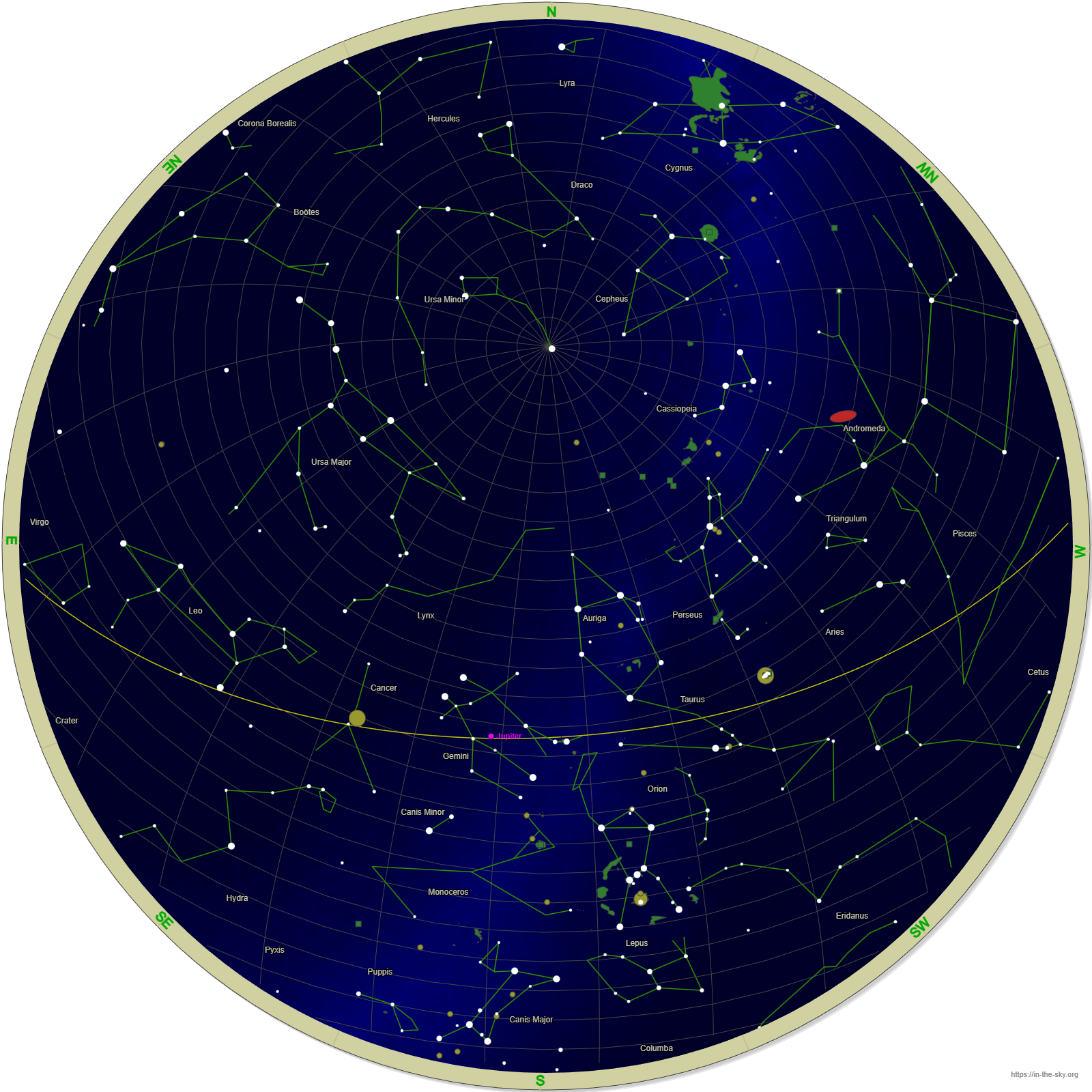
The chart shows the sky at 21:00 GMT on 15 February 2026.
Click on an item to expand for more information:

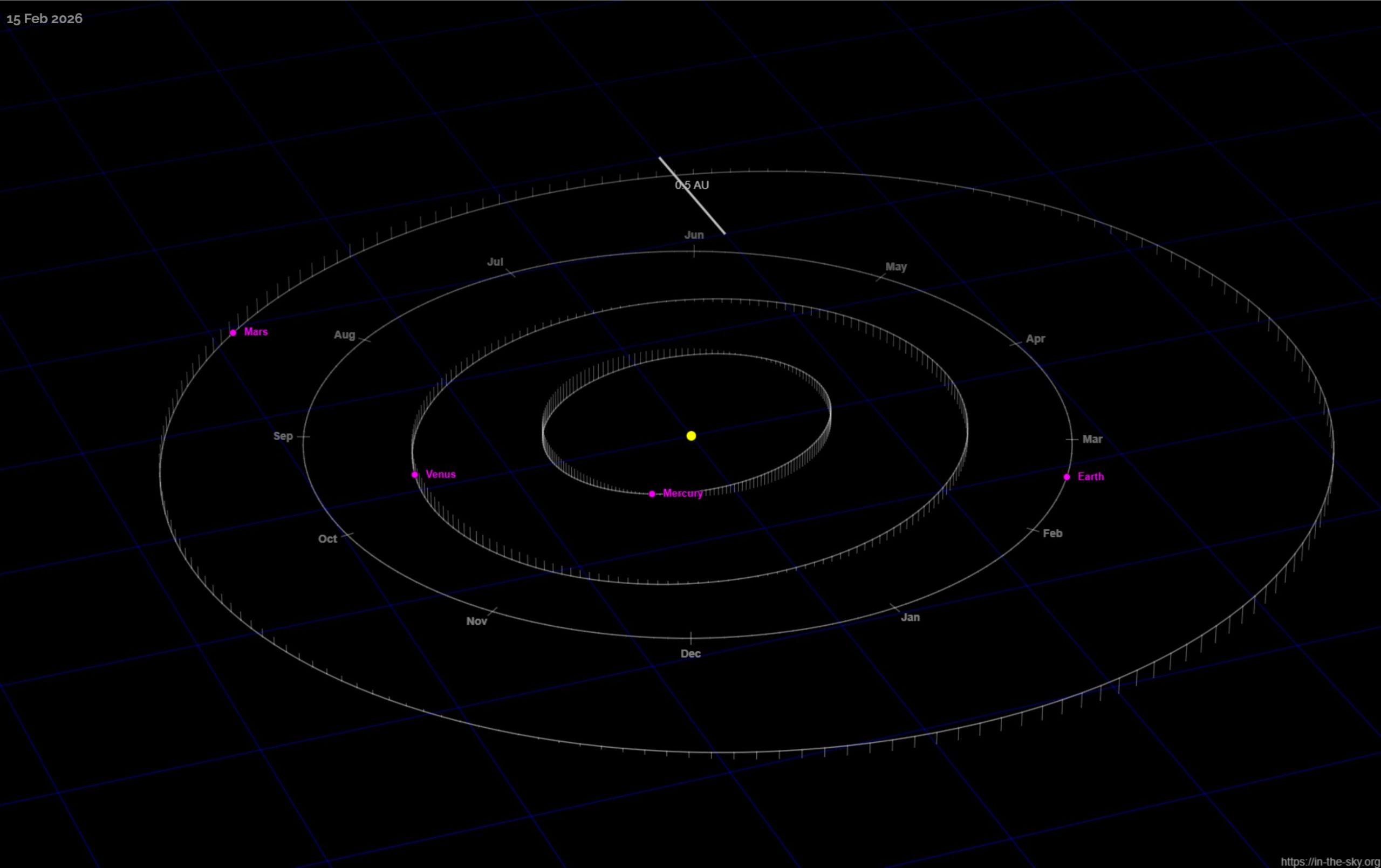
Inner planets
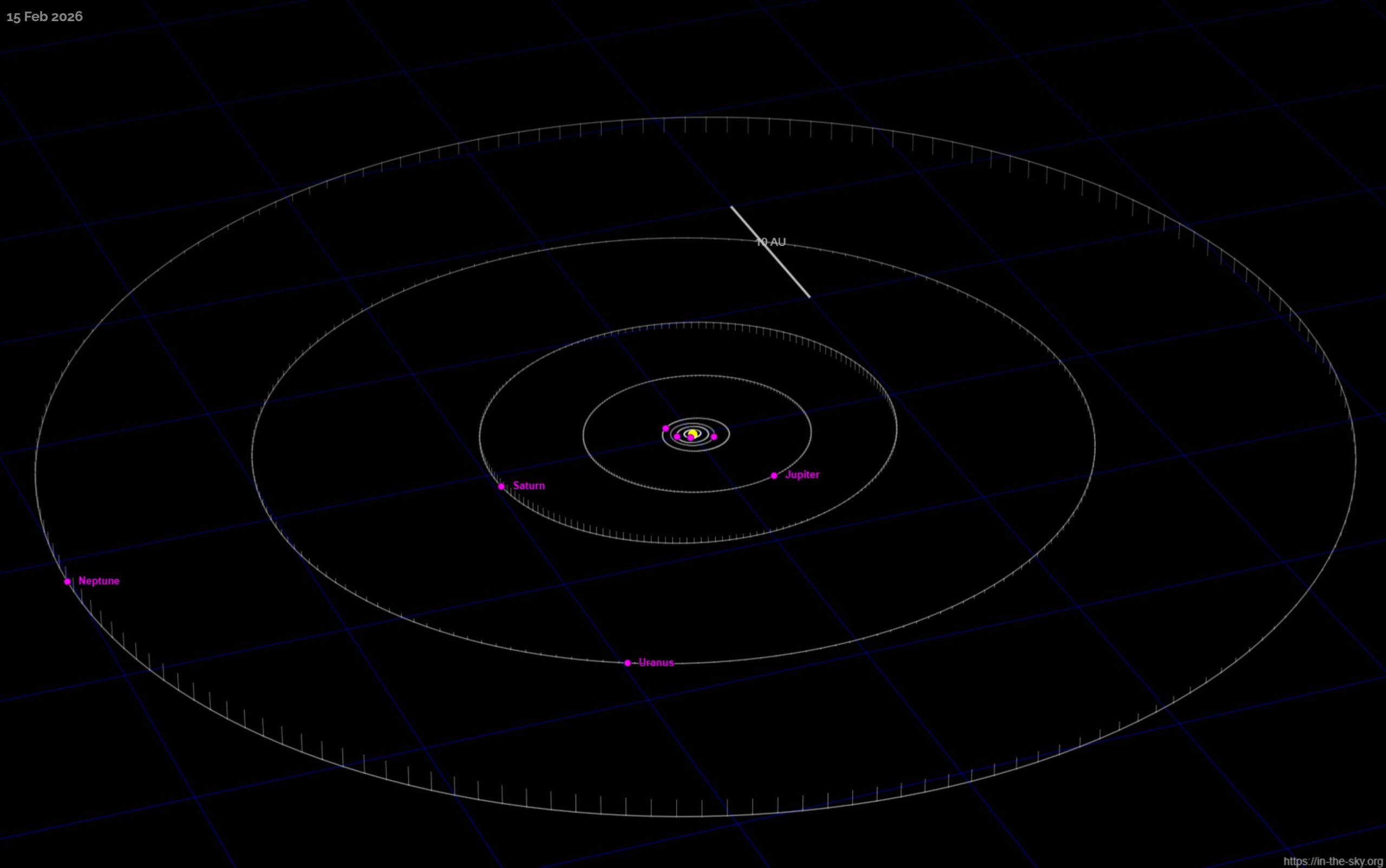
Outer planets
Shown for 15 Feb 2026
Mercury recently passed behind the Sun at superior solar conjunction. From Edinburgh, however, it will become visible at around 17:40 (GMT), 8° above your south-western horizon, as dusk fades to darkness. It will then sink towards the horizon, setting 1 hour and 36 minutes after the Sun at 18:51.
08 Dec 2025 – Mercury at greatest elongation west
19 Feb 2026 – Mercury at greatest elongation east
21 Feb 2026 – Mercury at highest altitude in evening sky
18 Mar 2026 – Mercury at highest altitude in morning sky
Venus recently passed behind the Sun at superior solar conjunction.
19 Aug 2025 – Venus at highest altitude in morning sky
14 May 2026 – Venus at highest altitude in evening sky
14 Aug 2026 – Venus at greatest elongation east
04 Dec 2026 – Venus at highest altitude in morning sky
Mars will soon pass behind the Sun at solar conjunction.
24 Feb 2025 – Mars ends retrograde motion
10 Jan 2027 – Mars enters retrograde motion
19 Feb 2027 – Mars at opposition
20 Feb 2027 – Mars at perigee
Jupiter recently passed opposition. From Edinburgh, it is visible in the evening sky, becoming accessible around 17:39 (GMT), 35° above your eastern horizon, as dusk fades to darkness. It will then reach its highest point in the sky at 21:37, 56° above your southern horizon. It will continue to be observable until around 05:00, when it sinks below 7° above your north-western horizon.
10 Jan 2026 – Jupiter at opposition
11 Mar 2026 – Jupiter ends retrograde motion
13 Dec 2026 – Jupiter enters retrograde motion
11 Feb 2027 – Jupiter at opposition
Saturn will soon pass behind the Sun at solar conjunction. From Edinburgh, it will become visible at around 18:08 (GMT), 17° above your south-western horizon, as dusk fades to darkness. It will then sink towards the horizon, setting 3 hours and 9 minutes after the Sun at 20:24.
28 Nov 2025 – Saturn ends retrograde motion
26 Jul 2026 – Saturn enters retrograde motion
04 Oct 2026 – Saturn at opposition
11 Dec 2026 – Saturn ends retrograde motion
Data from in-the-sky.org
| Comet name | Mag | Constellation | Separation from Sun | Trend | Absolute magnitude last updated |
| C/2024 E1 (Wierzchos) | 7.1 | Microscopium | 23° | Brightening | 3 Jan 2026 |
| 141P-G/Machholz | 7.5 | Cetus | 62° | Fading | Unknown |
| 141P-F/Machholz | 8.1 | Pisces | 40° | Brightening | Unknown |
| 141P-E/Machholz | 8.7 | Aquarius | 30° | Brightening | Unknown |
| 24P/Schaumasse | 10.2 | Bootes | 94° | Fading | 3 Jan 2026 |
| 88P/Howell | 10.3 | Sagittarius | 30° | Brightening | 1 Apr 2018 |
| C/2025 A6 (Lemmon) | 10.9 | Ara | 47° | Fading | 3 Nov 2025 |
| D/1884 O1 (Barnard) | 12.0 | Capricornus | 13° | Fading | Unknown |
| 141P-B/Machholz | 12.6 | Capricornus | 4° | Brightening | Unknown |
| 167P/CINEOS | 13.1 | Sagittarius | 27° | Brightening | Unknown |
| 63P/Wild | 13.2 | Auriga | 139° | Brightening | 1 Aug 2013 |
| C/2025 T1 (ATLAS) | 13.3 | Aquarius | 15° | Fading | 3 Jan 2026 |
| 240P/NEAT | 13.4 | Aries | 111° | Fading | 3 Jan 2026 |
| 78P/Gehrels | 13.4 | Aquarius | 30° | Brightening | 30 Sep 2020 |
| 235P/LINEAR | 13.4 | Libra | 69° | Brightening | 3 Jan 2026 |
| D/1895 Q1 (Swift) | 13.5 | Cetus | 83° | Fading | Unknown |
| C/1996 X3 (SOHO) | 13.7 | Sagittarius | 24° | Fading | Unknown |
| C/2002 S7 (SOHO) | 13.7 | Sagittarius | 24° | Fading | Unknown |
| C/2008 N4 (SOHO) | 13.8 | Sagittarius | 24° | Fading | Unknown |
| A/2025 Y1 | 14.0 | Virgo | 105° | Brightening | Unknown |
| P/2010 H2 (Vales) | 14.3 | Ophiuchus | 39° | Brightening | Unknown |
| 217P/LINEAR | 14.4 | Cancer | 174° | Fading | 2 Jul 2025 |
| 69P/Taylor | 14.5 | Cetus | 50° | Brightening | Unknown |
| 168P/Hergenrother | 14.5 | Sagittarius | 13° | Brightening | 15 Jan 2013 |
| C/2025 D1 (Groeller) | 14.6 | Draco | 92° | Brightening | Unknown |
Nothing of note this month.
You can see any meteors captured by our cameras on the our Meteorcams page.
| Date | Age of Moon | Sun | Moon | ||||||||
| Rise | Culm | Set | Constellation | Rise | Culm | Set | Constellation | ||||
| 2026 | Feb | 01 | 13 days | 08:06 | 12:24 | 16:44 | Capricornus | 16:09 | –:– | 08:14 | Cancer |
| 2026 | Feb | 08 | 20 days | 07:51 | 12:25 | 16:59 | Capricornus | 00:45 | 05:02 | 09:07 | Virgo |
| 2026 | Feb | 15 | 27 days | 07:36 | 12:25 | 17:15 | Capricornus | 07:32 | 10:51 | 14:19 | Sagittarius |
| 2026 | Feb | 22 | 04 days | 07:20 | 12:24 | 17:30 | Aquarius | 08:26 | 16:24 | –:– | Pisces |
| 2026 | Mar | 01 | 11 days | 07:02 | 12:23 | 17:45 | Aquarius | 15:14 | 23:13 | 06:35 | Cancer |

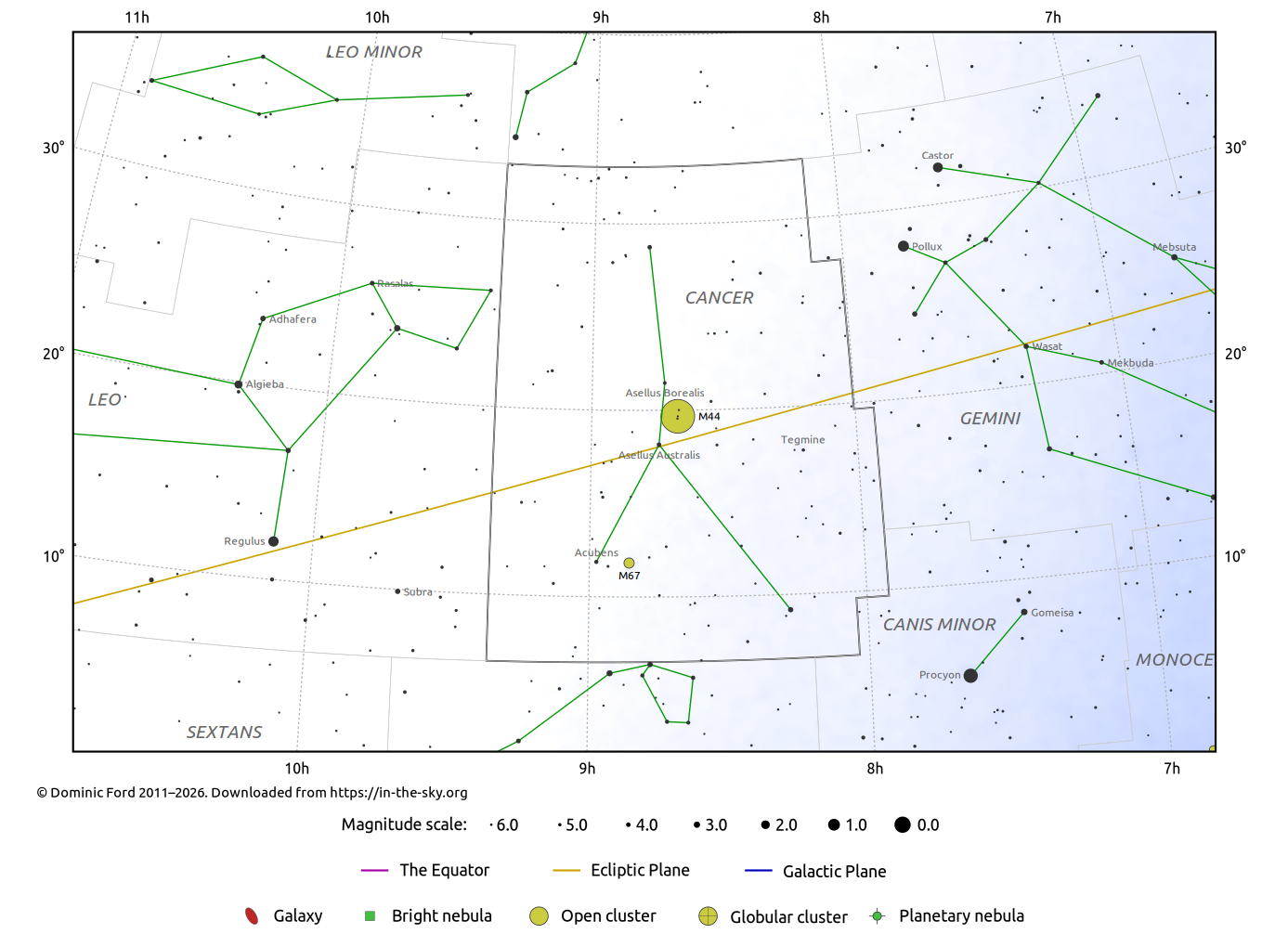
by Dominic Ford
Cancer is a moderately sized constellation visible in the northern sky around February, and one of the twelve members of the zodiac.
Despite this, it is not particularly conspicuous. Its brightest star has a magnitude of only 3.5.
It is best known for its deep sky objects, and in particular the open cluster M44, the Beehive cluster or Praesepe. This can be found near the center of the constellation.
Cancer is Latin for ‘crab’ and is identified with a rather inconsequential event in Greek mythology. The crab in question appeared while Hercules was fighting the Hydra, and bit his foot. Hercules then crushed it, and that was the end of the crab.
The constellation gives its name to the Tropic of Cancer, the line at a latitude of 23.5°N where the Sun is overhead at the June solstice. In ancient times the Sun lay in the constellation at the time of the solstice, though this is no longer the case. The precession of the equinoxes means the Sun now lies in Taurus on June 21.
| Stars | Open Clusters | Globular Clusters | Galaxies |
| β-Cnc (mag 3.5) | Messier 44 (mag 3.1) | NGC 2775 (mag 10.3) | |
| Asellus Australis (mag 3.9) | Messier 67 (mag 6.9) | NGC 2513 (mag 11.6) | |
| ι-Cnc (mag 4.0) | NGC 2664 | NGC 2672 (mag 11.6) | |
| Acubens (mag 4.3) | NGC 2678 | NGC 2749 (mag 11.8) | |
| Asellus Borealis (mag 4.7) | NGC 2554 (mag 12.0) | ||
| HIP 41325 (mag 5.1) | NGC 2608 (mag 12.2) | ||
| χ-Cnc (mag 5.1) | NGC 2563 (mag 12.3) | ||
| 8-Cnc (mag 5.1) | NGC 2595 (mag 12.4) | ||
| ξ-Cnc (mag 5.2) | NGC 2577 (mag 12.4) | ||
| κ-Cnc (mag 5.2) | NGC 2545 (mag 12.4) | ||
| O¹-Cnc (mag 5.2) | NGC 2750 (mag 12.6) | ||
| σ³-Cnc (mag 5.2) | NGC 2535 (mag 12.7) | ||
| ρ²-Cnc (mag 5.2) | NGC 2648 (mag 12.7) | ||
| ζ²-Cnc (mag 5.3) | NGC 2619 (mag 12.7) | ||
| μ-Cnc (mag 5.3) | NGC 2673 (mag 12.9) | ||
| η-Cnc (mag 5.3) | NGC 2764 (mag 12.9) | ||
| θ-Cnc (mag 5.4) | NGC 2804 (mag 12.9) | ||
| π-Cnc (mag 5.4) | NGC 2562 (mag 13.0) | ||
| τ-Cnc (mag 5.4) | NGC 2575 (mag 13.0) | ||
| σ²-Cnc (mag 5.4) | NGC 2558 (mag 13.0) | ||
| ν-Cnc (mag 5.4) | NGC 2809 (mag 13.0) | ||
| 60-Cnc (mag 5.5) | NGC 2789 (mag 13.1) | ||
| φ¹-Cnc (mag 5.6) | NGC 2582 (mag 13.1) | ||
| BP Cnc (mag 5.6) | NGC 2794 (mag 13.2) | ||
| 3-Cnc (mag 5.6) | IC 509 (mag 13.2) | ||
| BM Cnc (mag 5.6) | IC 2378 (mag 13.2) | ||
| BI Cnc (mag 5.6) | NGC 2560 (mag 13.3) | ||
| Tegmine (mag 5.6) | IC 2421 (mag 13.3) | ||
| A¹-Cnc (mag 5.6) | NGC 2599 (mag 13.4) | ||
| σ¹-Cnc (mag 5.7) | NGC 2744 (mag 13.4) |
Use the chevrons to choose the month:
Much of the material is provided with thanks to Dominic Ford on his excellent site in-the-sky.org.