

Close approaches, Supermoon, Leonid meteors, Comets, Saturn and Jupiter
by Mark Phillips
Data from Dominic Ford’s in-the-sky.org and other sources
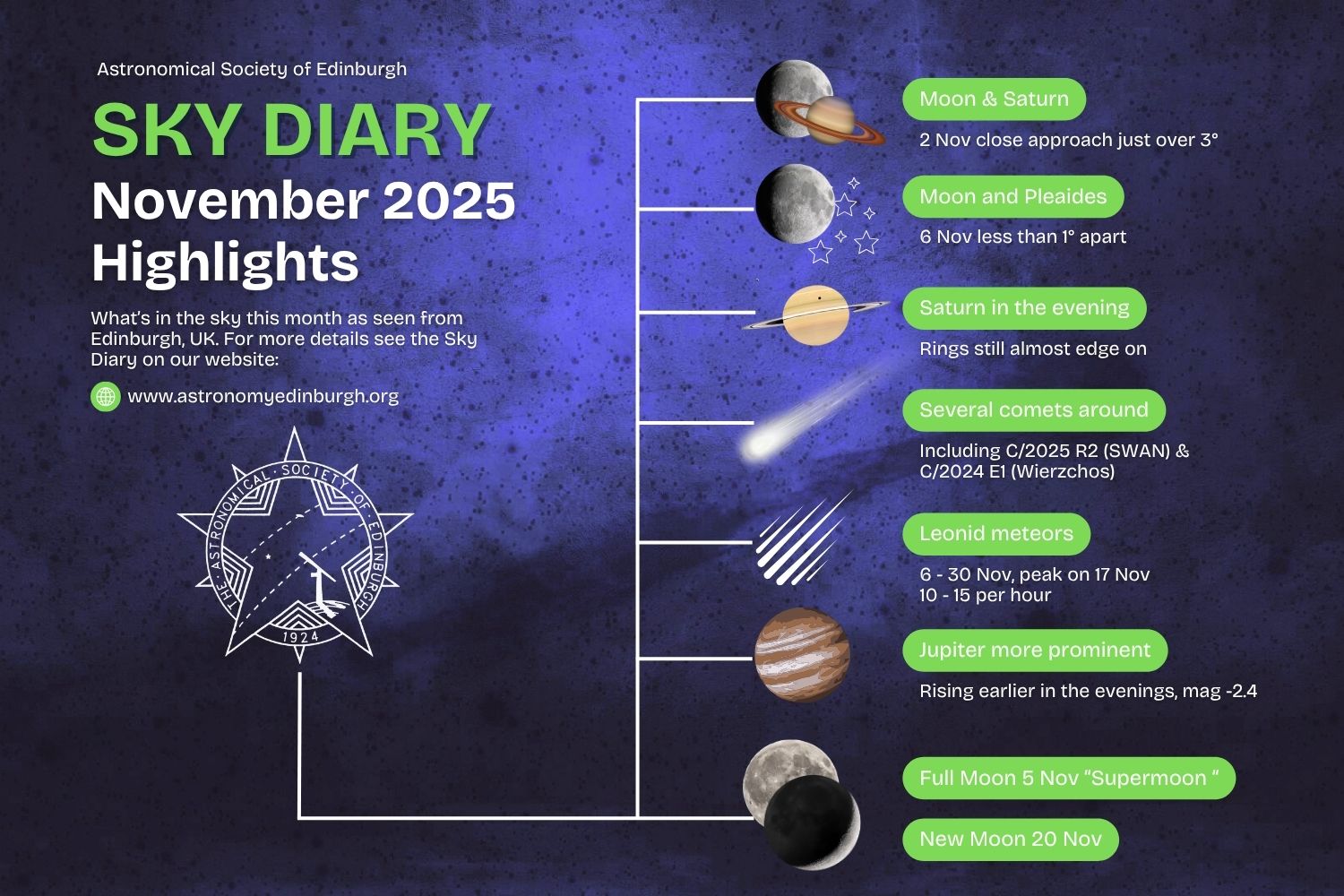
This month we have a supermoon (see what that means later), still some interesting comets, some close encounters with the Moon, Saturn is an evening object with Jupiter rising later at night, and the Leonid meteor shower peaks.
Saturn is always an impressive object, even with its rings almost closed as they are now, but it doesn’t get very high as seen from Edinburgh so not one of its best years. Jupiter however, is getting easier to see as it now rises well before midnight. At mag. -2.4 and reaching an altitude of abut 55° it’s going to become a more accessible and interesting evening target over the next few months as it approaches opposition in Jan 2026.
The Leonids are not normally the most spectacular of meteor showers apart from every 33 years or so when they can produce storms. A storm isn’t expected this year (next in 2033-34) but you never know with meteor showers; they can and do suprise us!
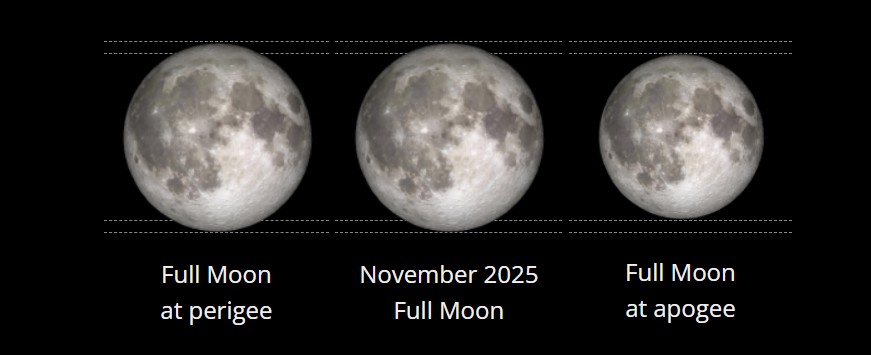
There’s a lot of hype about supermoons but what are they? A supermoon occurs when we get a full Moon when the Moon is at perigee – the closest point in its orbit to Earth. So the Moon can appear a little bigger. But when seen in the sky it’s rarely that obvious unless close to the horizon. Here’s a graphic from in-the-sky.org showing just how much bigger it will appear this month:
Highlights:
- 2 Nov – Close approach of the 89% Moon and Saturn, just over 3° apart
- 5 Nov – Full Moon, supermoon, known as the “Hunter’s Moon”
- 6 Nov – Close approach of the 96% Moon and the Pleiades, less than 1° apart
- 10 Nov – Close approach of the 64% waning gibbous Moon and Jupiter, 3°50′ apart. Jupiter will be mag. -2.4
- 17 Nov – peak of the Leonid meteor shower, active between 6 – 30 Nov. Possibly 10 – 15 per hour just before dawn.
- Observe Saturn in the evening, 29° altitude
- Observe Jupiter late night, early morning, maximum 55° altitude around 04:00 GMT
- 20 Nov – New Moon
- Comet C/2025 A5 (Lemmon) getting too low now
- Comet C/2025 R2 (Swan) fading but getting higher in the sky
- Comet C/2024 E1 (Wierzchos) brightnening to peak in Jan 2026 but getting lower
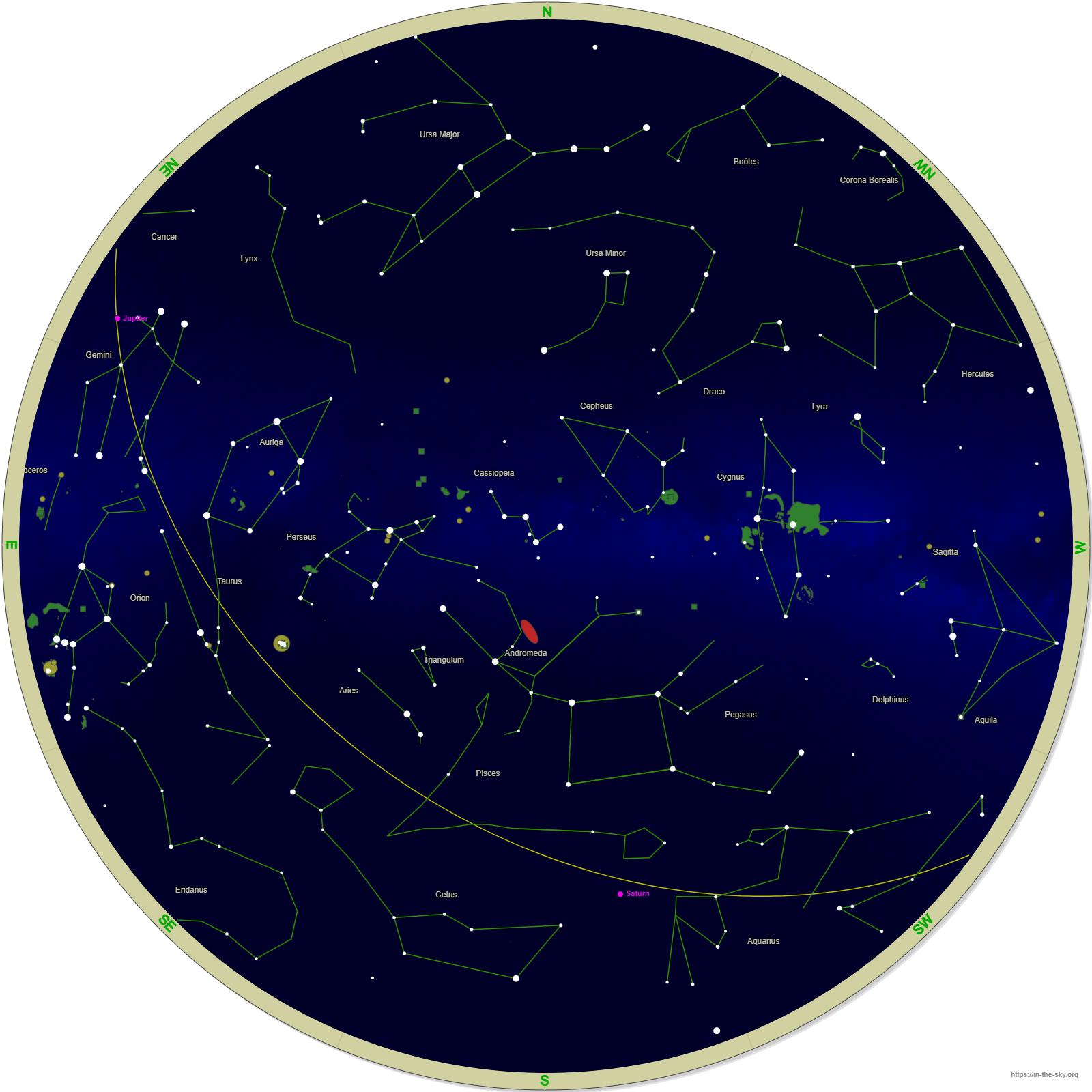
The chart shows the sky at 21:00 GMT on 15 November 2025.
Comets
We’ve been very lucky to have several bright and interesting comets around recently. C/2025 A6 (Lemmon) has been putting on an impressive display but is getting too low for us to see in Edinburgh now. Finder chart
C/2025 R2 (SWAN) was good in October but is now fading fast. It is getting higher and easier to observe in the SW in the evenings though. Finder chart
We’ve been following C/2024 E1 (Wierzchos) for some time and it is getting brighter, probably peaking about mag. 7 in January 2026. It will be visible at the start of the month but as the month progresses it will be getting too low for us and will soon disappear from our skies. Finder chart
29P/Schwassmann-Wachmann is beginning its next apparition just before dawn, currently still faint round about mag 17. This is a comet that we follow along with the BAA Mission 29P campaign. It is an interesting comet undergoing many outbursts and always worth watching. See the video of Richard Miles’ talk at one of our recent meetings.
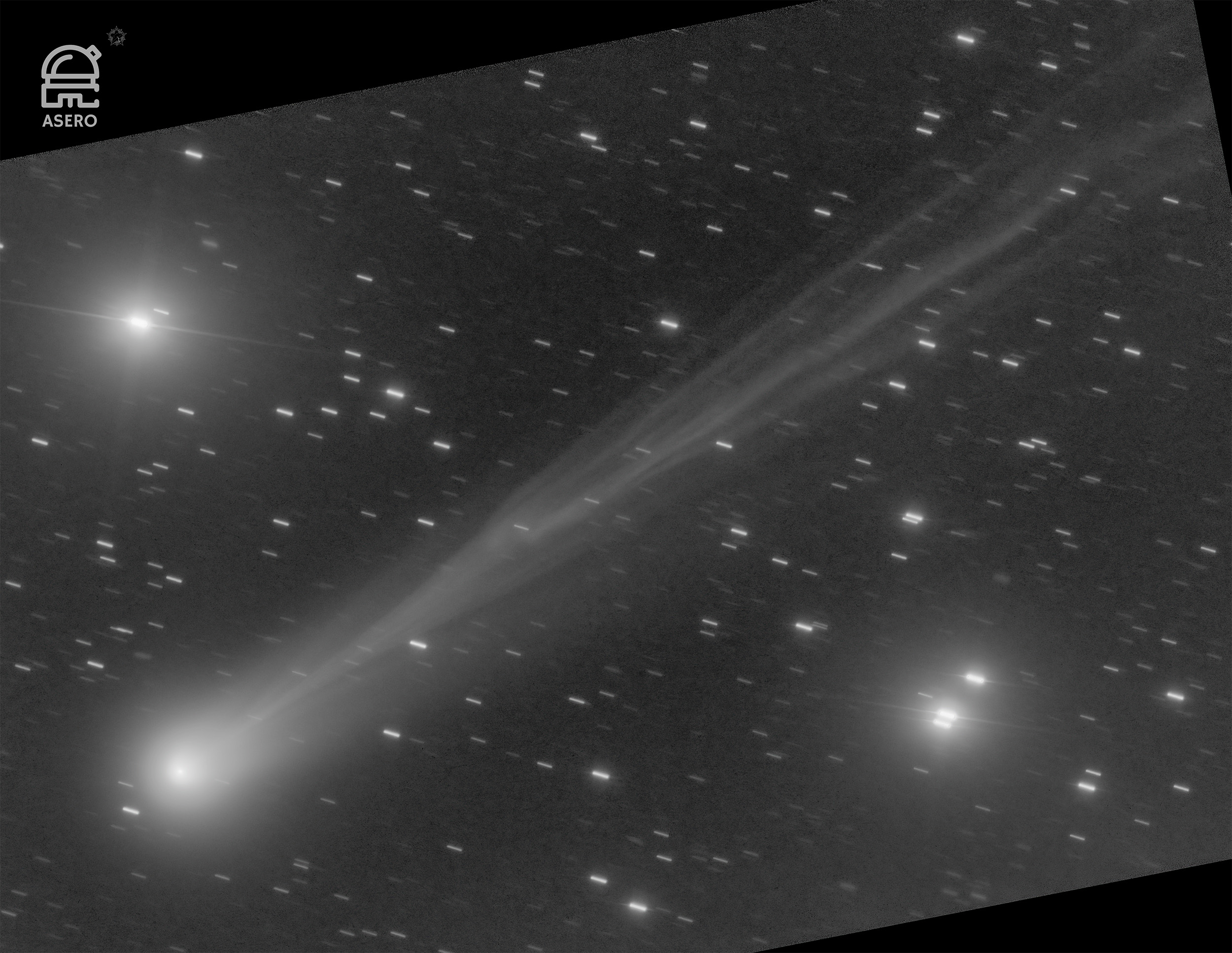
C/2025 A6 (Lemmon), ASERO / Mark Phillips
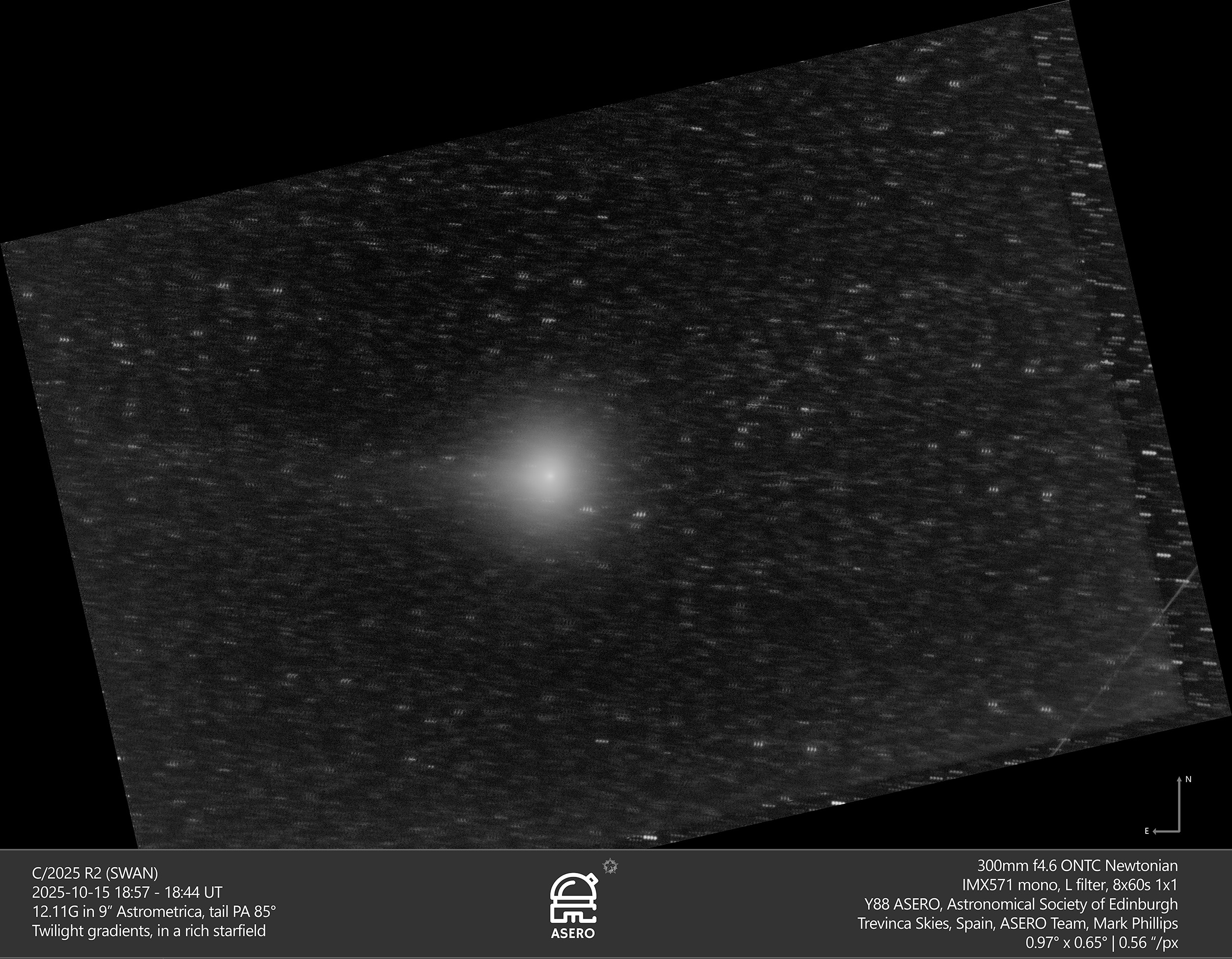
C/2025 R2 (SWAN), ASERO / Mark Phillips
Click on an item to expand for more information:

Showing for 15 November 2025
Bwill soon pass in front of the Sun at inferior solar conjunction.
05 Nov 2025 – Mercury at highest altitude in evening sky
04 Dec 2025 – Mercury at highest altitude in morning sky
08 Dec 2025 – Mercury at greatest elongation west
19 Feb 2026 – Mercury at greatest elongation east
Venus will soon pass behind the Sun.
19 Aug 2025 – Venus at highest altitude in morning sky
14 May 2026 – Venus at highest altitude in evening sky
14 Aug 2026 – Venus at greatest elongation east
04 Dec 2026 – Venus at highest altitude in morning sky
Mars will soon pass behind the Sun at solar conjunction.
24 Feb 2025 – Mars ends retrograde motion
10 Jan 2027 – Mars enters retrograde motion
19 Feb 2027 – Mars at opposition
20 Feb 2027 – Mars at perigee
Jupiter is currently visible as a morning object. From Edinburgh, it is visible in the morning sky, becoming accessible around 21:09, when it reaches an altitude of 7° above your north-eastern horizon. It will then reach its highest point in the sky at 04:21, 55° above your southern horizon. It will be lost to dawn twilight around 07:20, 42° above your south-western horizon.
11 Nov 2025 – Jupiter enters retrograde motion
10 Jan 2026 – Jupiter at opposition
11 Mar 2026 – Jupiter ends retrograde motion
13 Dec 2026 – Jupiter enters retrograde motion
Saturn is currently an early evening object. From Edinburgh, it is visible in the evening sky, becoming accessible around 16:59 (BST), 17° above your south-eastern horizon, as dusk fades to darkness. It will then reach its highest point in the sky at 20:17, 29° above your southern horizon. It will continue to be observable until around 00:25, when it sinks below 11° above your south-western horizon.
21 Sep 2025 – Saturn at opposition
28 Nov 2025 – Saturn ends retrograde motion
26 Jul 2026 – Saturn enters retrograde motion
04 Oct 2026 – Saturn at opposition
Data from in-the-sky.org
| Comet name | Mag | Constellation | Separation from Sun | Trend | Absolute magnitude last updated |
| C/2025 A6 (Lemmon) | 5.3 | Bootes | 40° | Brightening | 15 Oct 2025 |
| C/2025 R2 (SWAN) | 7.4 | Aquila | 84° | Fading | 15 Oct 2025 |
| C/2025 K1 (ATLAS) | 11.4 | Virgo | 28° | Fading | 1 Oct 2025 |
| 210P/Christensen | 11.8 | Scorpius | 56° | Brightening | 28 Mar 2009 |
| 24P/Schaumasse | 12.3 | Gemini | 96° | Brightening | 1 Mar 2018 |
| C/2024 E1 (Wierzchos) | 13.0 | Hercules | 48° | Brightening | 1 Aug 2025 |
| 240P/NEAT | 13.2 | Taurus | 142° | Brightening | 2 Sep 2025 |
| 47P/Ashbrook-Jackson | 13.6 | Aquarius | 128° | Fading | 29 Feb 2012 |
| 48P/Johnson | 14.0 | Taurus | 147° | Fading | 31 Oct 2018 |
| 217P/LINEAR | 14.1 | Cancer | 76° | Fading | 2 Jul 2025 |
| 78P/Gehrels | 14.2 | Sagittarius | 91° | Brightening | 30 Sep 2020 |
| C/2022 N2 (PANSTARRS) | 14.2 | Taurus | 150° | Brightening | 2 Sep 2025 |
| 69P/Taylor | 14.3 | Sculptor | 122° | Fading | Unknown |
| 40P/Vaisala | 14.5 | Virgo | 25° | Brightening | 14 Sep 2017 |
| 65P/Gunn | 14.7 | Sagittarius | 75° | Fading | 1 Aug 2017 |
| C/2022 E2 (ATLAS) | 15.0 | Lacerta | 128° | Fading | 3 Mar 2025 |
| 63P/Wild | 15.1 | Lynx | 106° | Brightening | 1 Aug 2013 |
| C/2021 G2 (ATLAS) | 15.2 | Serpens Caput | 33° | Fading | 2 Sep 2025 |
| C/2023 C2 (ATLAS) | 15.3 | Cepheus | 119° | Fading | 5 Sep 2024 |
| 60P/Tsuchinshan | 15.5 | Virgo | 22° | Fading | 3 Oct 2020 |
| 168P/Hergenrother | 15.6 | Scorpius | 45° | Brightening | 15 Jan 2013 |
| C/2017 K2 (PANSTARRS) | 15.6 | Auriga | 114° | Brightening | 2 Dec 2023 |
| 43P/Wolf-Harrington | 15.6 | Sextans | 57° | Brightening | 4 Dec 2018 |
| C/2023 R1 (PANSTARRS) | 15.8 | Aquila | 84° | Fading | 1 Aug 2025 |
| C/2023 A3 (Tsuchinshan-ATLAS) | 16.0 | Hercules | 67° | Fading | 3 Dec 2024 |
The Leonid meteor shower will be active from 6 November to 30 November, producing its peak rate of meteors around 17 November.
The radiant point culminates (is highest in the sky) after dawn – at around 07:00 GMT – and so the shower is likely produce its best displays shortly before dawn, when its radiant point is highest.
The shower is expected to reach peak activity at around 18:00 GMT on 17 November 2025, and so the best displays might be seen after the radiant rises on 17 November.
From Edinburgh, the radiant of the shower will appear at a peak altitude of 56° above your horizon, and on the basis of this, we estimate that you may be able to see up to 12 meteors per hour at the shower’s peak.
The shower will peak close to new moon, and so moonlight will present minimal interference.
The parent body responsible for creating the Leonid shower has been identified as comet 55P/Tempel-Tuttle.
Keep an eye on our Meteor Cameras page to see what we capture.
| Date | Age of Moon | Sun | Moon | ||||||||
| Rise | Culm | Set | Constellation | Rise | Culm | Set | Constellation | ||||
| 2025 | Nov | 01 | 11 days | 07:17 | 11:54 | 16:31 | Libra | 15:16 | 20:44 | 01:00 | Aquarius |
| 2025 | Nov | 08 | 18 days | 07:31 | 11:55 | 16:17 | Libra | 17:46 | 02:25 | 12:10 | Taurus |
| 2025 | Nov | 15 | 25 days | 07:46 | 11:55 | 16:04 | Libra | 02:19 | 08:28 | 14:19 | Virgo |
| 2025 | Nov | 22 | 02 days | 08:00 | 11:57 | 15:53 | Libra | 11:22 | 13:42 | 16:02 | Ophiuchus |
| 2025 | Dec | 01 | 11 days | 08:17 | 12:00 | 15:43 | Ophiuchus | 13:43 | 20:59 | 03:04 | Pisces |

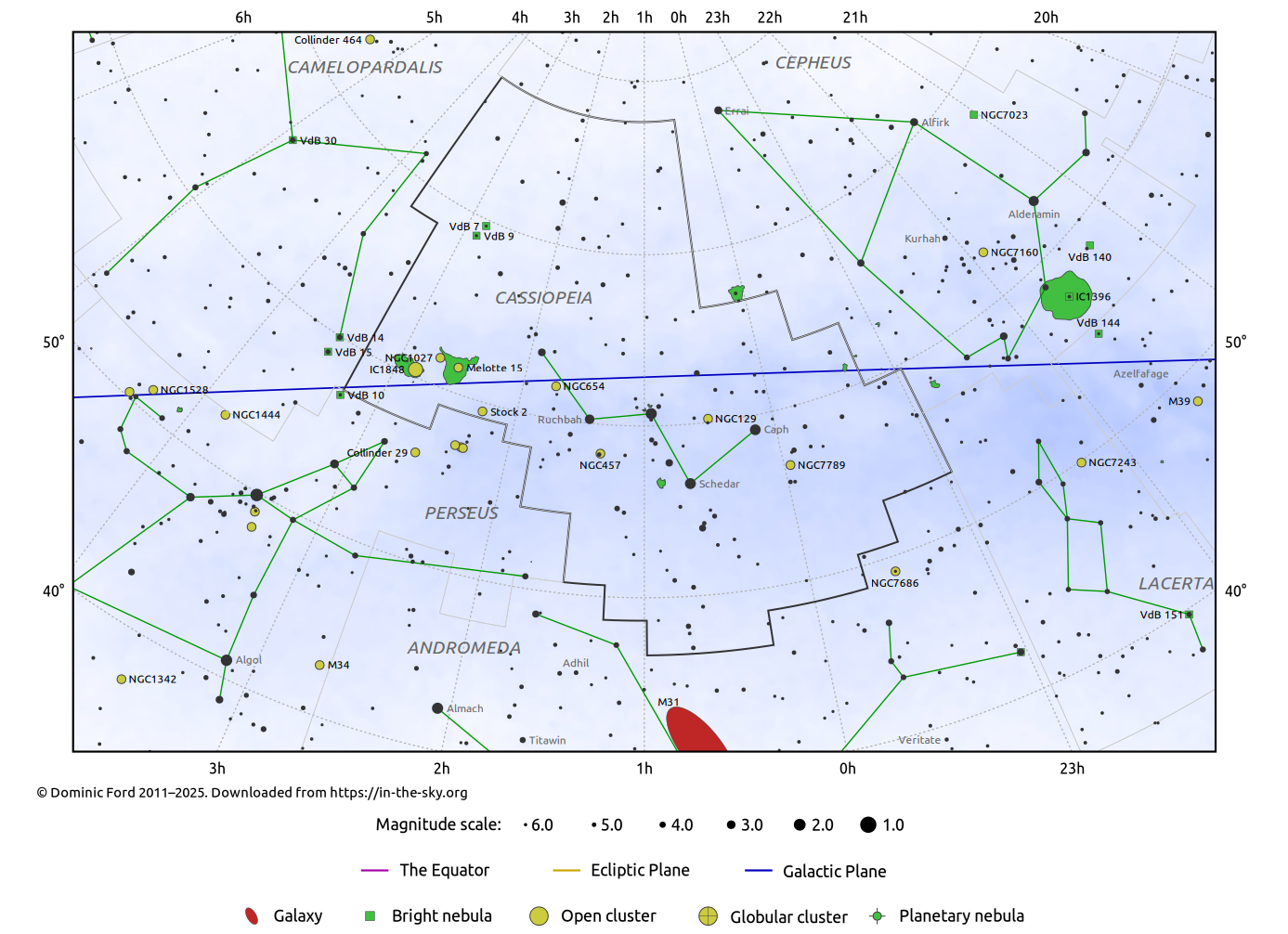
Cassiopeia is one of the most recognisable of the constellations, a distinctive ‘W’ shape in the far northern sky. It is highest in the sky at midnight in the months around September.
The plane of the Milky Way runs through the middle of the ‘W’ asterism, making it a particularly rich area of the sky to view through binoculars. It contains more than twenty open clusters exceeding tenth magnitude, and a similar number of fifth magnitude stars.
| Stars | Open Clusters | Globular Clusters | Galaxies |
| γ-Cas (mag 2.2) | NGC 457 (mag 6.4) | NGC 185 (mag 9.2) | |
| Schedar (mag 2.2) | NGC 129 (mag 6.5) | NGC 147 (mag 9.3) | |
| Caph (mag 2.3) | NGC 654 (mag 6.5) | IC 10 (mag 10.3) | |
| Ruchbah (mag 2.7) | NGC 1027 (mag 6.7) | NGC 278 (mag 10.8) | |
| ε-Cas (mag 3.4) | NGC 7789 (mag 6.7) | NGC 1343 (mag 12.4) | |
| η-Cas (mag 3.5) | IC 1848 (mag 6.8) | ||
| ζ-Cas (mag 3.7) | Messier 52 (mag 6.9) | ||
| NGC771 (mag 4.0) | NGC 225 (mag 7.0) | ||
| 50-Cas (mag 4.0) | NGC 663 (mag 7.1) | ||
| κ-Cas (mag 4.2) | Messier 103 (mag 7.4) | ||
| θ-Cas (mag 4.3) | IC 1590 (mag 7.4) | ||
| O-Cas (mag 4.5) | NGC 659 (mag 7.9) | ||
| ρ-Cas (mag 4.5) | IC 1805 (mag 7.9) | ||
| ι-Cas (mag 4.6) | NGC 637 (mag 8.2) | ||
| υ²-Cas (mag 4.6) | NGC 7790 (mag 8.5) | ||
| A-Cas (mag 4.6) | NGC 189 (mag 8.8) | ||
| χ-Cas (mag 4.7) | NGC 436 (mag 8.8) | ||
| ψ-Cas (mag 4.7) | NGC 146 (mag 9.1) | ||
| λ-Cas (mag 4.7) | NGC 381 (mag 9.3) | ||
| ξ-Cas (mag 4.8) | NGC 133 (mag 9.4) | ||
| HIP 4151 (mag 4.8) | NGC 7788 (mag 9.4) | ||
| υ¹-Cas (mag 4.8) | NGC 559 (mag 9.5) | ||
| HIP 14862 (mag 4.8) | NGC 103 (mag 9.8) | ||
| 1-Cas (mag 4.8) | NGC 609 (mag 11.0) | ||
| τ-Cas (mag 4.9) | NGC 136 (mag 11.3) | ||
| AR Cas (mag 4.9) | IC 166 (mag 11.7) | ||
| ν-Cas (mag 4.9) | NGC 366 (mag 12.0) | ||
| π-Cas (mag 5.0) | NGC 110 | ||
| ω-Cas (mag 5.0) | NGC 433 | ||
| 4-Cas (mag 5.0) | NGC 657 |
Use the chevrons to choose the month:
Much of the material is provided with thanks to Dominic Ford on his excellent site in-the-sky.org.