

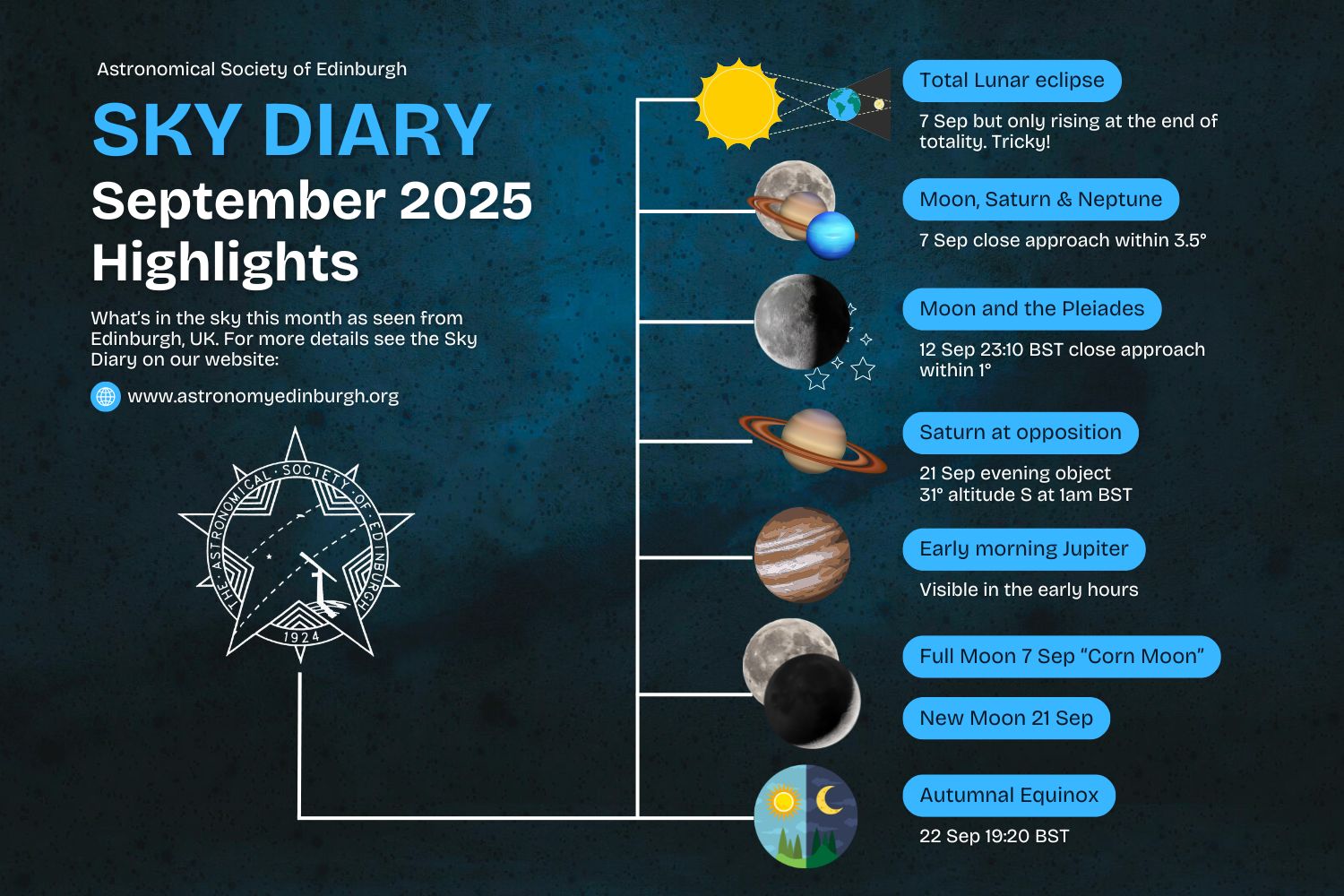
A tricky Lunar eclipse, Saturn at opposition, interesting comets and the Autumnal Equinox
by Mark Phillips using data from Dominic Ford’s in-the-sky.org and other sources
With astronomical darkness well and truly back, there should be lots of opportunities to observe, weather-permitting. This month there is a total Lunar eclipse but it only rises as seen from Edinburgh a the end of totality. So if you want to see it then you’ll need a very good eastern horizon. There are a couple of interesting conjunctions and Saturn reaches opposition, although with its rings almost closed it won’t be quite as beautiful as at other times. Jupiter is an early hours of the morning target and will become better placed as the year progresses. There are also 2 more Titan shadow transits across Saturn’s surface (see previous months for more info). Only 1 left in October before you have to wait another 15 years for the next set.
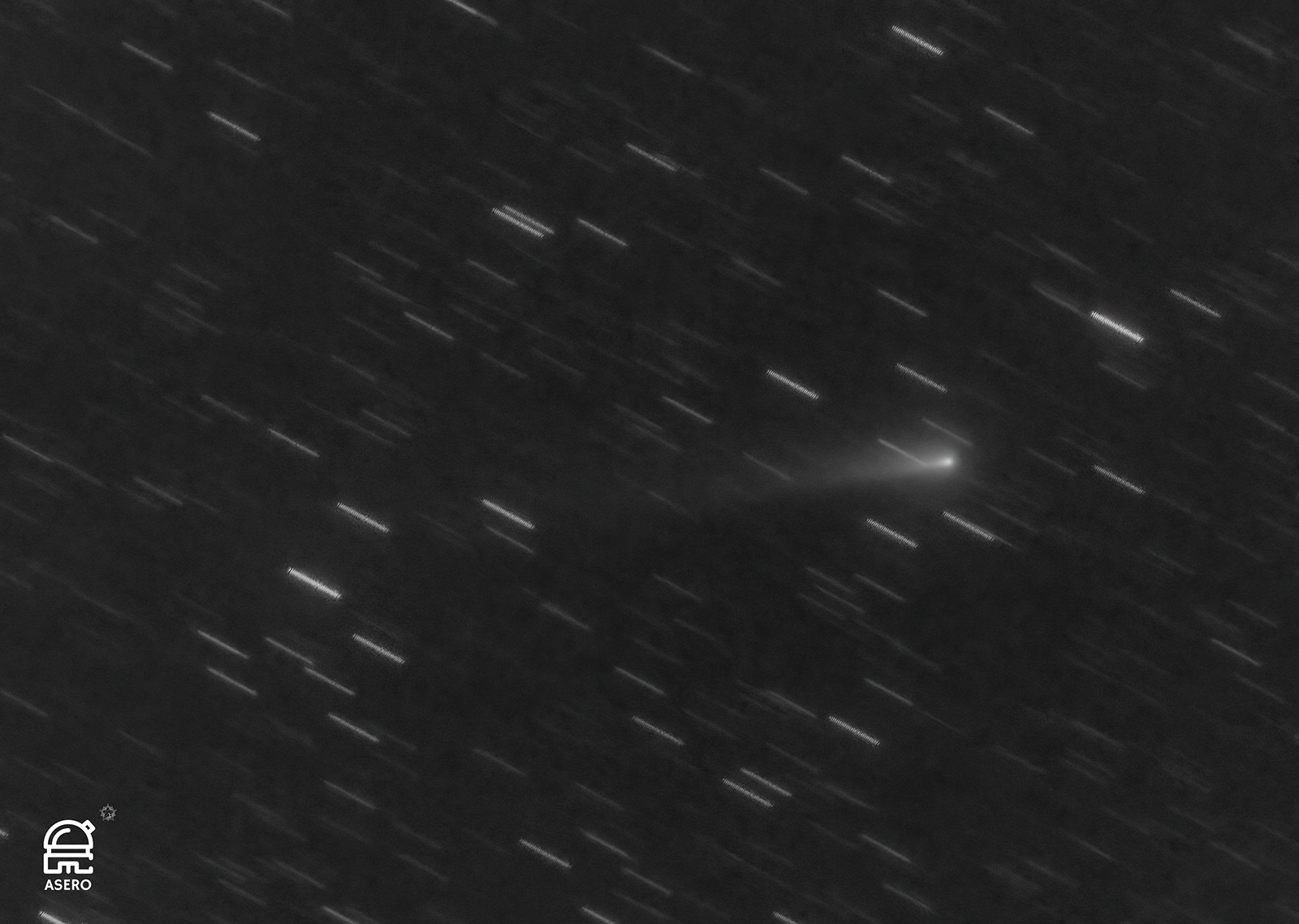
C2025 K1 (ATLAS) imaged with our ASERO-Murrell telescope in Spain.
There are several comets of interest and we’re following these as they could become quite bright over the next months.
- C/2024 E1 (Wierzchos) – currently around magnitude 14 but could reach 6 – 8 in January 2026.
- C/2025 K1 (ATLAS) – only around mag, 13 but with a nice tail, this could should peak in November at no more than mag 12, but a nice looking comet.
- C/2025 A6 (Lemmon) – this one had a recent surge and looks like it could become quite bright in October (around mag. 5 possibly?).
Highlights:
- 4 Sep Titan shadow transit 05:25 – 08:50 UT
- 7 Sep Total Lunar eclipse
- 7 Sep Full Moon, known as the “Corn Moon”
- 8 Sep Close approach of the Moon, Saturn and Neptune, within 3.5°
- 12 Sep Close approach of the Moon and M45
- 20 Sep Titan shadow transit 05:09 – 07:34 UT
- 21 Sep New Moon
- 21 Sep Saturn at opposition
- Jupiter becoming visible in the early hours of the morning
- 22 Sep Autumnal Equinox 19:20 BST – everywhere on Earth has almost exactly 12 hours of day and night
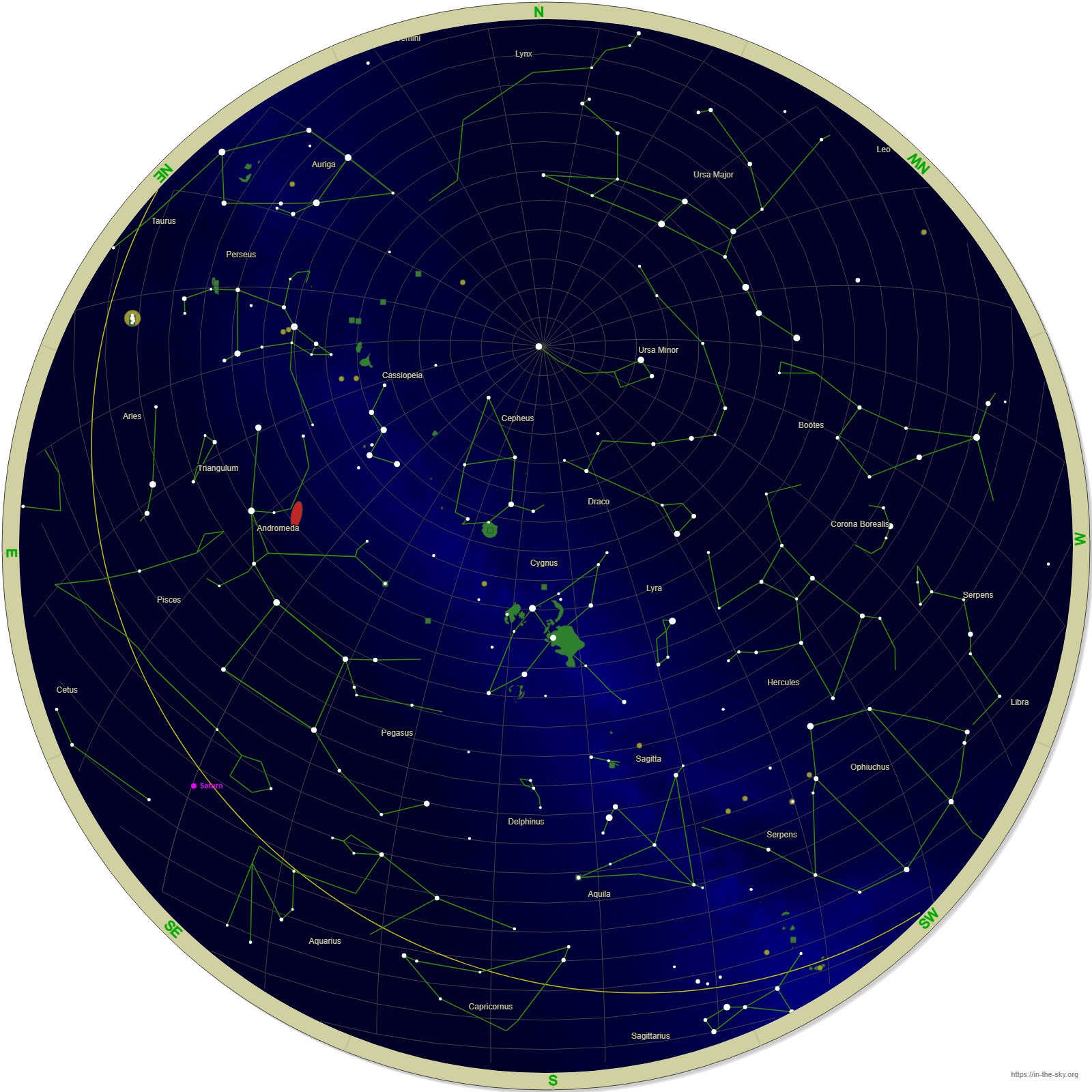
The chart shows the sky at 22:00 BST on 15 September 2025.
Conjunctions
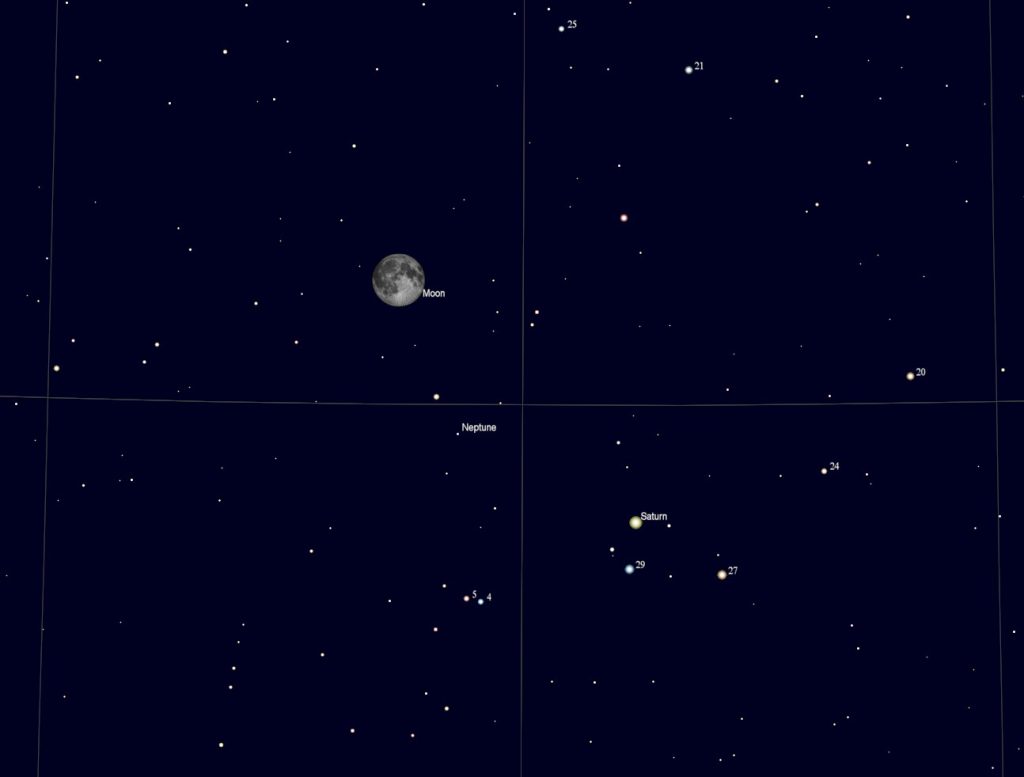
Moon, Saturn and Neptune
7 Sep – Close approach of the Moon, Saturn and Neptune. The trio will be arouind 15° altitude and 3.5° apart at around 22:00 BST. The Moon will be just past full at 97% making it tricky to see Neptune.
Moon and the Pleiades
12 Sep – 23:10 BST Close approach of the Moon and M45. Passing within less than 1° of each other. The Moon will be a 61% illuminated waning gibbous phase. The sunlit portion of the Moon may overpower the stars.
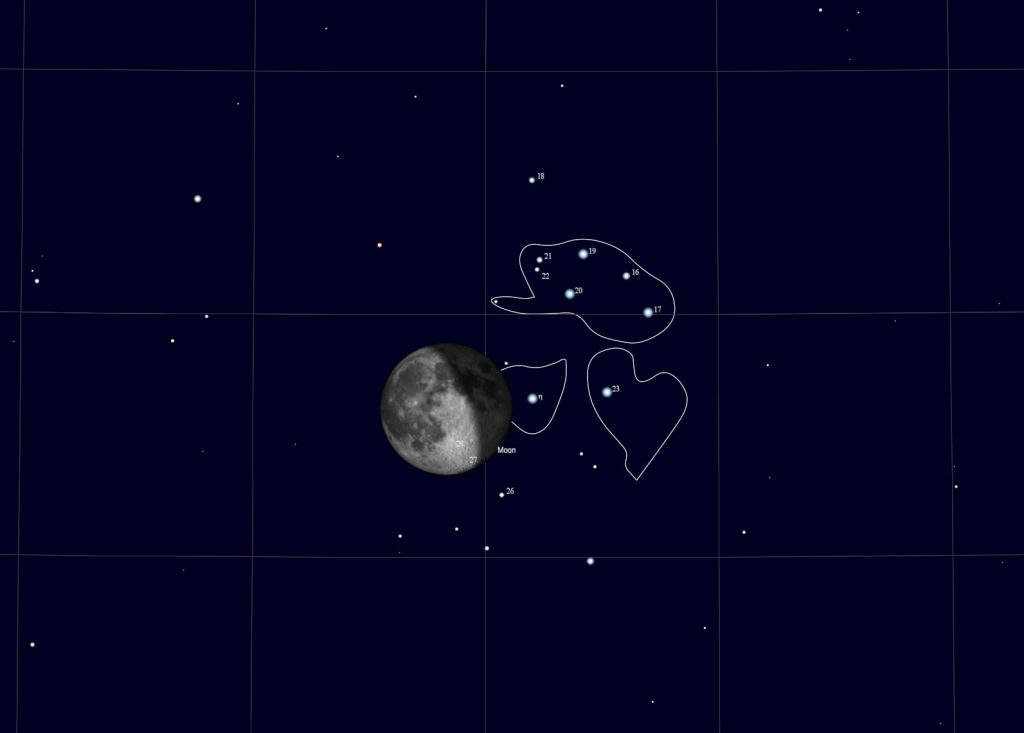
Tricky total Lunar Eclipse 7 September 2025
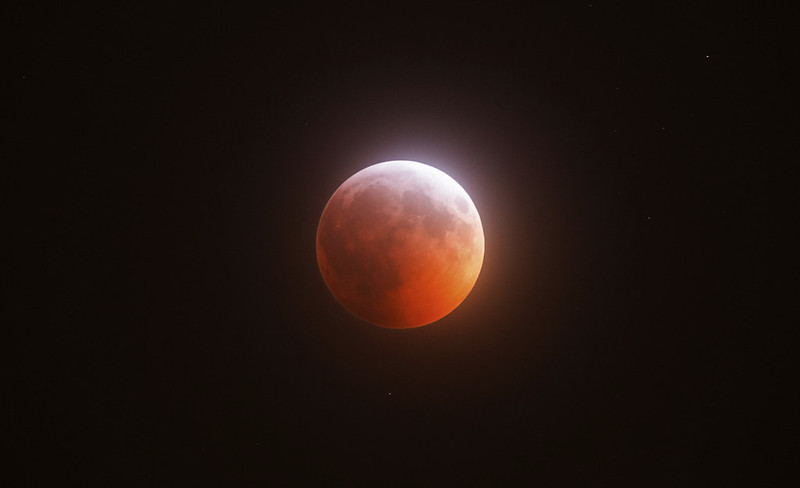
2019 Lunar eclipse by Jon Watson
The total eclipse will last from 18:31 until 19:53 BST. The Moon will be partially eclipsed between 17:27 and 20:56 BST. Unfortunately the Moon does not rise as seen from Edinburgh until 19:48 BST and will only achieve an altitude of 0.3° as the total eclipse ends, 8.4° as the partial eclipse ends, and 15.4° as the penumbral eclipse finishes. So you will need a very good eastern horizon to see it.
These are the eclipse timings:
| Local time | UTC | Altitude | |
| 16:29 | 15:29 | Moon begins to enter the Earth’s penumbra | |
| 17:27 | 16:27 | Moon begins to enters the Earth’s umbra. Partial eclipse begins. | |
| 18:31 | 17:31 | Moon fully within Earth’s umbra. Total eclipse begins. | |
| 19:12 | 18:12 | Midpoint of eclipse | |
| 19:53 | 18:53 | Moon begins to leave the Earth’s umbra. Total eclipse ends. | 0.3° |
| 20:56 | 19:56 | Moon fully outside the Earth’s umbra. Partial eclipse ends. | 8.4° |
| 21:55 | 20:55 | Moon leaves the Earth’s penumbra | 15.4° |
Click on an item to expand for more information:

Showing for 15 September 2025
Mercury recently passed behind the Sun at superior solar conjunction.
22 Aug 2025 – Mercury at highest altitude in morning sky
29 Oct 2025 – Mercury at greatest elongation east
05 Nov 2025 – Mercury at highest altitude in evening sky
04 Dec 2025 – Mercury at highest altitude in morning sky
Venus remains just about visible as a morning object, now well past greatest elongation west and returning closer to the Sun. From Edinburgh, it is visible in the dawn sky, rising at 03:48 (BST) – 2 hours and 53 minutes before the Sun – and reaching an altitude of 19° above the eastern horizon before fading from view as dawn breaks at around 06:18.
19 Aug 2025 – Venus at highest altitude in morning sky
14 May 2026 – Venus at highest altitude in evening sky
14 Aug 2026 – Venus at greatest elongation east
04 Dec 2026 – Venus at highest altitude in morning sky
Mars will soon pass behind the Sun at solar conjunction.
24 Feb 2025 – Mars ends retrograde motion
10 Jan 2027 – Mars enters retrograde motion
19 Feb 2027 – Mars at opposition
20 Feb 2027 – Mars at perigee
Jupiter is currently emerging from behind the Sun. From Edinburgh, it is visible in the dawn sky, rising at 00:28 (BST) and reaching an altitude of 44° above the south-eastern horizon before fading from view as dawn breaks at around 06:18.
04 Feb 2025 – Jupiter ends retrograde motion
11 Nov 2025 – Jupiter enters retrograde motion
10 Jan 2026 – Jupiter at opposition
11 Mar 2026 – Jupiter ends retrograde motion
Saturn is currently approaching opposition. From Edinburgh, it is visible between 21:14 and 05:55. It will become accessible at around 21:14, when it rises to an altitude of 11° above your eastern horizon. It will reach its highest point in the sky at 01:34, 31° above your southern horizon. It will become inaccessible at around 05:55 when it sinks below 11° above your south-western horizon.
13 Jul 2025 – Saturn enters retrograde motion
21 Sep 2025 – Saturn at opposition
28 Nov 2025 – Saturn ends retrograde motion
26 Jul 2026 – Saturn enters retrograde motion
Uranus is currently emerging from behind the Sun. From Edinburgh, it is visible in the dawn sky, rising at 21:14 (BST) and reaching an altitude of 53° above the southern horizon before fading from view as dawn breaks at around 05:10.
06 Sep 2025 – Uranus enters retrograde motion
21 Nov 2025 – Uranus at opposition
04 Feb 2026 – Uranus ends retrograde motion
10 Sep 2026 – Uranus enters retrograde motion
Neptune is currently approaching opposition. From Edinburgh, it is visible between 22:36 and 04:44. It will become accessible at around 22:36, when it rises to an altitude of 21° above your south-eastern horizon. It will reach its highest point in the sky at 01:40, 33° above your southern horizon. It will become inaccessible at around 04:44 when it sinks below 21° above your south-western horizon.
04 Jul 2025 – Neptune enters retrograde motion
23 Sep 2025 – Neptune at opposition
10 Dec 2025 – Neptune ends retrograde motion
07 Jul 2026 – Neptune enters retrograde motion
| Comet name | Mag | Constellation | Separation from Sun | Trend | Absolute magnitude last updated |
| 240P/NEAT | 12.7 | Eridanus | 90° | Brightening | 1 Mar 2018 |
| 210P/Christensen | 13.3 | Sagittarius | 160° | Brightening | 28 Mar 2009 |
| 47P/Ashbrook-Jackson | 13.4 | Aquarius | 154° | Brightening | 29 Feb 2012 |
| 217P/LINEAR | 13.6 | Gemini | 40° | Fading | 2 Jul 2025 |
| C/2025 K1 (ATLAS) | 13.9 | Serpens Caput | 112° | Brightening | 2 Jul 2025 |
| 48P/Johnson | 14.0 | Taurus | 87° | Brightening | 31 Oct 2018 |
| 65P/Gunn | 14.0 | Sagittarius | 131° | Fading | 1 Aug 2017 |
| 69P/Taylor | 14.4 | Sculptor | 145° | Brightening | Unknown |
| 78P/Gehrels | 14.5 | Sagittarius | 158° | Brightening | 30 Sep 2020 |
| C/2022 N2 (PANSTARRS) | 14.5 | Aries | 88° | Brightening | 3 Dec 2024 |
| C/2024 E1 (Wierzchos) | 14.6 | Corona Borealis | 83° | Brightening | 1 Aug 2025 |
| C/2021 G2 (ATLAS) | 14.7 | Serpens Caput | 84° | Fading | 2 Jul 2025 |
| C/2022 E2 (ATLAS) | 14.7 | Cassiopeia | 96° | Brightening | 3 Mar 2025 |
| 88P/Howell | 14.9 | Virgo | 33° | Brightening | 1 Apr 2018 |
| C/2023 C2 (ATLAS) | 15.0 | Cassiopeia | 105° | Fading | 5 Sep 2024 |
| C/2023 A3 (Tsuchinshan-ATLAS) | 15.1 | Hercules | 116° | Fading | 3 Dec 2024 |
| C/2023 R1 (PANSTARRS) | 15.6 | Delphinus | 140° | Brightening | 1 Aug 2025 |
| C/2017 K2 (PANSTARRS) | 15.6 | Gemini | 48° | Fading | 2 Dec 2023 |
| 43P/Wolf-Harrington | 15.7 | Cancer | 22° | Brightening | 4 Dec 2018 |
| 168P/Hergenrother | 15.8 | Centaurus | 91° | Brightening | 15 Jan 2013 |
| 12P/Pons-Brooks | 15.9 | Lupus | 97° | Fading – in outburst | 3 Oct 2024 |
| 24P/Schaumasse | 16.2 | Taurus | 71° | Brightening | 1 Mar 2018 |
| 63P/Wild | 16.3 | Auriga | 58° | Brightening | 1 Aug 2013 |
| C/2021 S3 (PANSTARRS) | 16.4 | Andromeda | 115° | Fading | 1 May 2024 |
| C/2024 G3 (ATLAS) | 16.5 | Mensa | 101° | Fading | 3 Mar 2025 |
No major meteor showers this month. Keep an eye on our Meteor Cameras page to see what we capture though.
| Date | Age of Moon | Sun | Moon | ||||||||
| Rise | Culm | Set | Constellation | Rise | Culm | Set | Constellation | ||||
| 2025 | Sep | 01 | 09 days | 06:14 | 13:11 | 20:07 | Leo | 17:55 | 20:10 | 22:25 | Ophiuchus |
| 2025 | Sep | 08 | 16 days | 06:27 | 13:09 | 19:48 | Leo | 19:59 | 01:21 | 07:09 | Aquarius |
| 2025 | Sep | 15 | 23 days | 06:41 | 13:06 | 19:30 | Leo | 23:14 | 07:49 | 17:28 | Auriga |
| 2025 | Sep | 22 | 01 days | 06:55 | 13:04 | 19:11 | Virgo | 07:44 | 13:29 | 18:57 | Virgo |
| 2025 | Oct | 01 | 10 days | 07:12 | 13:01 | 18:47 | Virgo | 17:34 | 20:39 | 23:54 | Sagittarius |

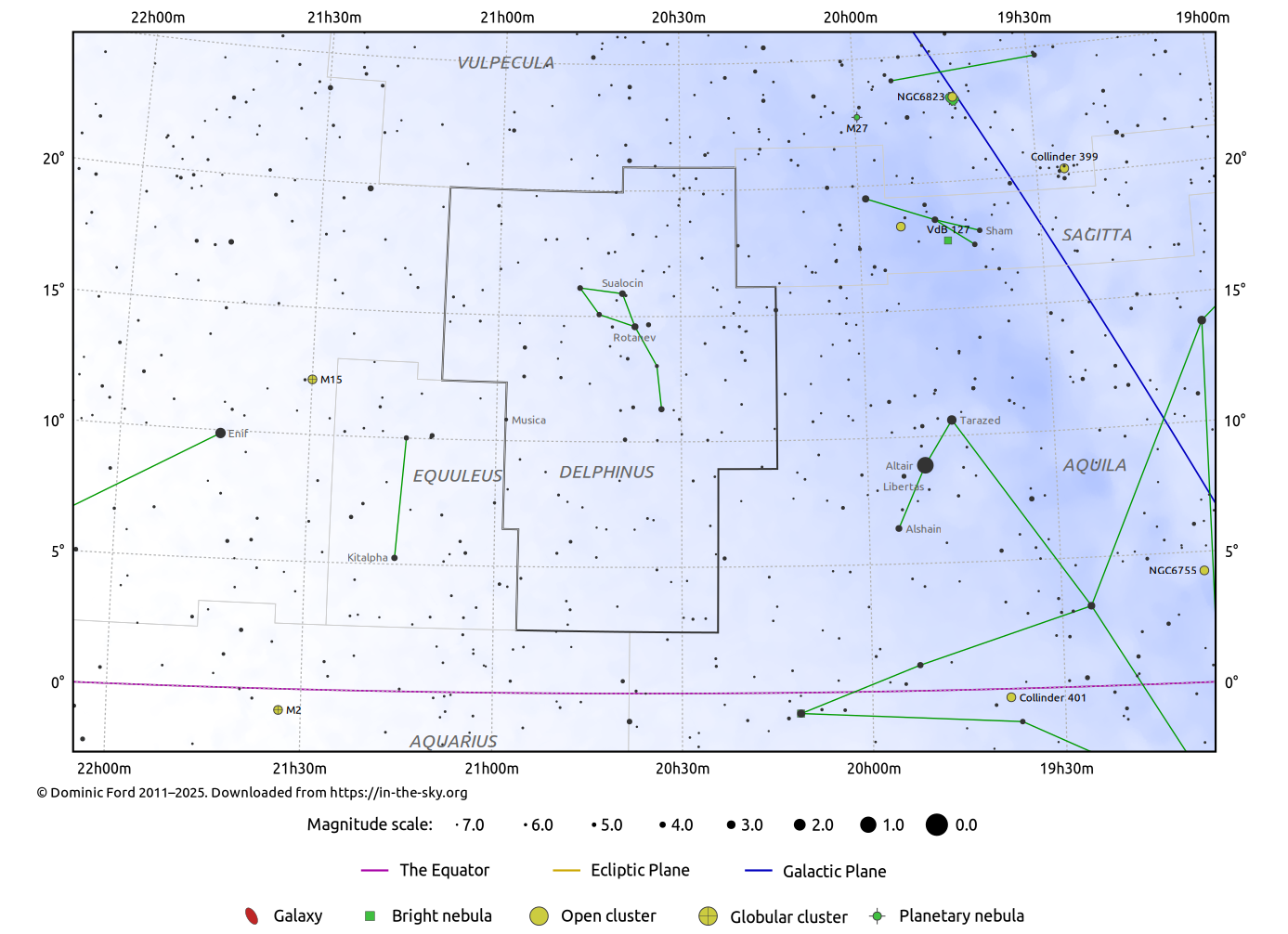
Delphinus is a moderately small and faint constellation which lies close to the southern vertex of the Summer Triangle asterism, near the star Altair in Aquila. It is highest in the evening sky in the months around July.
At its center is a grouping of fourth-magnitude stars, forming an asterism sometimes known as Job’s Coffin because of its box-like shape.
The name ‘Delphinus’ is Latin for ‘dolphin’, usually identified as the messenger of Poseidon, sent to entreat the sea nymph Amphitrite to marry him.
The constellation’s two brightest stars are sometimes called Rotanev and Sualocin. These strange names first appeared in the Palermo Catalogue of 1814. Together, they spell out the name Nicolaus Venator backwards, which is the Latinized form of Niccolo Cacciatore, an observing assistant. They are the only example of stars named after a real person.
Delphinus is home to a number of notable deep sky objects, including the globular cluster NGC 6934 and the planetary nebula NGC 6891.
| Stars | Open Clusters | Globular Clusters | Galaxies |
| Rotanev (mag 3.6) | NGC 6950 | NGC 6934 (mag 8.9) | NGC 6928 (mag 12.6) |
| Sualocin (mag 3.8) | NGC 7006 (mag 10.6) | NGC 6930 (mag 12.9) | |
| ε-Del (mag 4.0) | NGC 6954 (mag 13.2) | ||
| γ²-Del (mag 4.2) | NGC 6956 (mag 13.4) | ||
| δ-Del (mag 4.4) | NGC 6969 (mag 13.5) | ||
| ζ-Del (mag 4.7) | NGC 6944 (mag 13.7) | ||
| ρ-Aql (mag 4.9) | NGC 7003 (mag 13.8) | ||
| γ¹-Del (mag 5.0) | NGC 7025 (mag 14.0) | ||
| κ-Del (mag 5.1) | NGC 6972 (mag 14.0) | ||
| 17-Del (mag 5.2) | NGC 6917 (mag 14.2) | ||
| η-Del (mag 5.4) | IC 1320 (mag 14.4) | ||
| ι-Del (mag 5.4) | NGC 6927 (mag 14.5) | ||
| Musica (mag 5.5) | NGC 6971 (mag 14.7) | ||
| 16-Del (mag 5.5) | IC 1359 (mag 14.7) | ||
| 13-Del (mag 5.6) | NGC 7028 (mag 14.8) | ||
| θ-Del (mag 5.7) | NGC 6988 (mag 14.8) | ||
| HIP 103675 (mag 5.7) | NGC 6955 (mag 15.3) | ||
| HIP 100256 (mag 5.9) | NGC 6957 (mag 15.3) | ||
| HIP 101909 (mag 6.0) | IC 5080 (mag 15.3) | ||
| 15-Del (mag 6.0) | |||
| 10-Del (mag 6.0) | |||
| HIP 100511 (mag 6.2) | |||
| HIP 100274 (mag 6.2) | |||
| HIP 102833 (mag 6.2) | |||
| 1-Del (mag 6.2) | |||
| HIP 100969 (mag 6.2) | |||
| HIP 101213 (mag 6.2) | |||
| HIP 100208 (mag 6.2) | |||
| HIP 100807 (mag 6.2) | |||
| HIP 100953 (mag 6.2) |
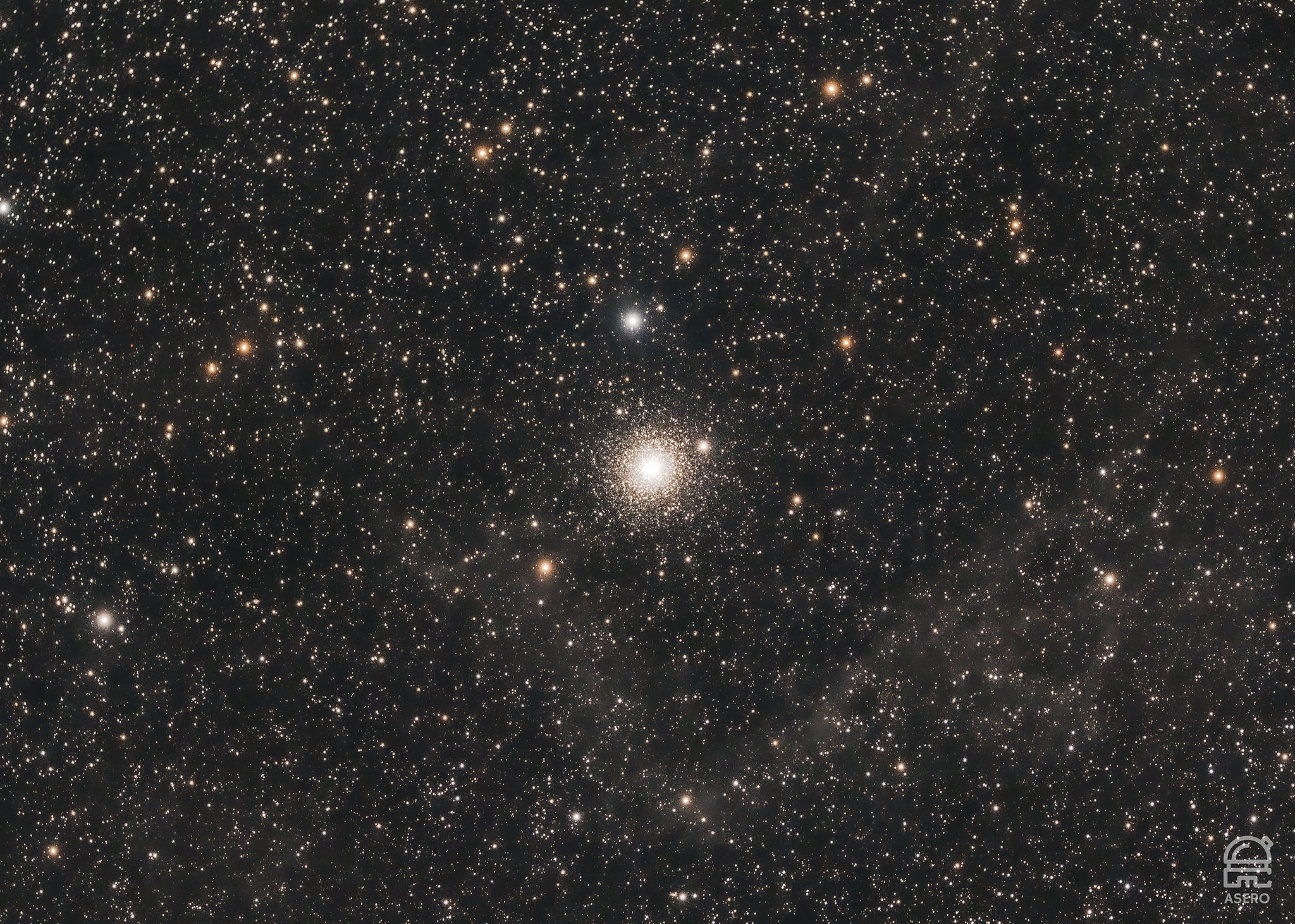
Globular Cluster M15 taken using ASERO, processed by Mark Phillips
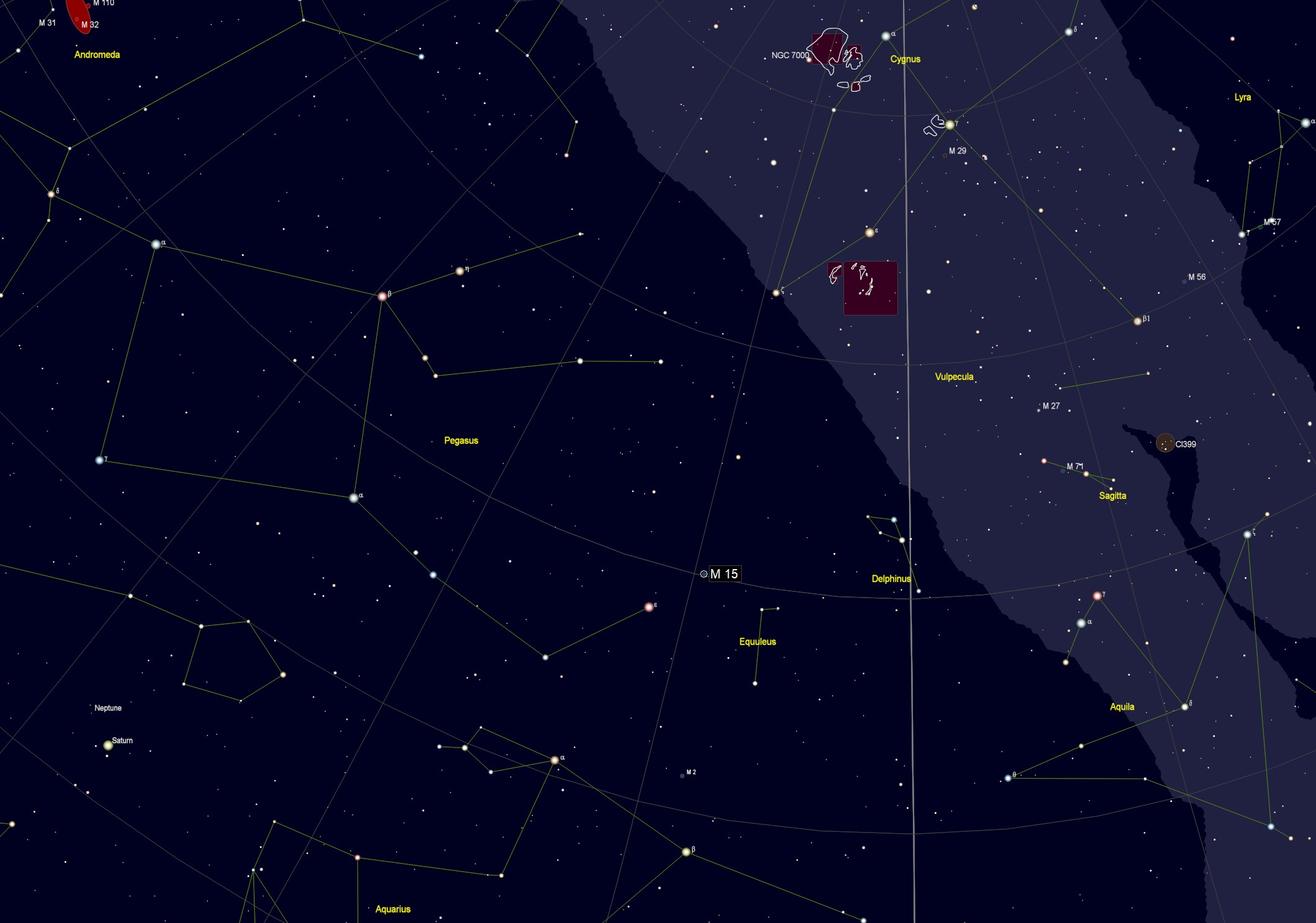
M15 is a globular cluster in the constellation of Pegasus and will be well-placed in the south in the evenings of September. It is just beyond naked eye visiblity but you should be able to see it in binoculars or a small telescope. Long exposure images with larger instruments show a dense cluster of thousands of stars.
Messier 15 or M15 (also designated NGC 7078 and sometimes known as the Great Pegasus Cluster) is a globular cluster in the constellation Pegasus. It was discovered by Jean-Dominique Maraldi in 1746 and included in Charles Messier’s catalogue of comet-like objects in 1764. At an estimated 12.5±1.3 billion years old, it is one of the oldest known globular clusters.
M15 is about 35,700 light-years from Earth, and 175 light-years in diameter. It has an absolute magnitude of −9.2, which translates to a total luminosity of 360,000 times that of the Sun. Messier 15 is one of the most densely packed globulars known in the Milky Way galaxy. Its core has undergone a contraction known as “core collapse” and it has a central density cusp with an enormous number of stars surrounding what may be a central black hole.
Home to over 100,000 stars, the cluster is notable for containing a large number of variable stars (112) and pulsars (8), including one double neutron star system, M15-C. It also contains Pease 1, the first planetary nebula discovered within a globular cluster in 1928. Just three others have been found in globular clusters since then.
Wikipedia
| Object | Right Ascension | Declination | Constellation | Magnitude | Angular Size |
| M15 | 21h29m50s | 12°10’N | Pegasus | 6.3 | 11’06” |
Use the chevrons to choose the month:
Much of the material is provided with thanks to Dominic Ford on his excellent site in-the-sky.org.