

The famous Perseid meteor shower, Jupiter and Venus get close and more Titan shadow transits
by Mark Phillips using data from Dominic Ford’s in-the-sky.org and other sources
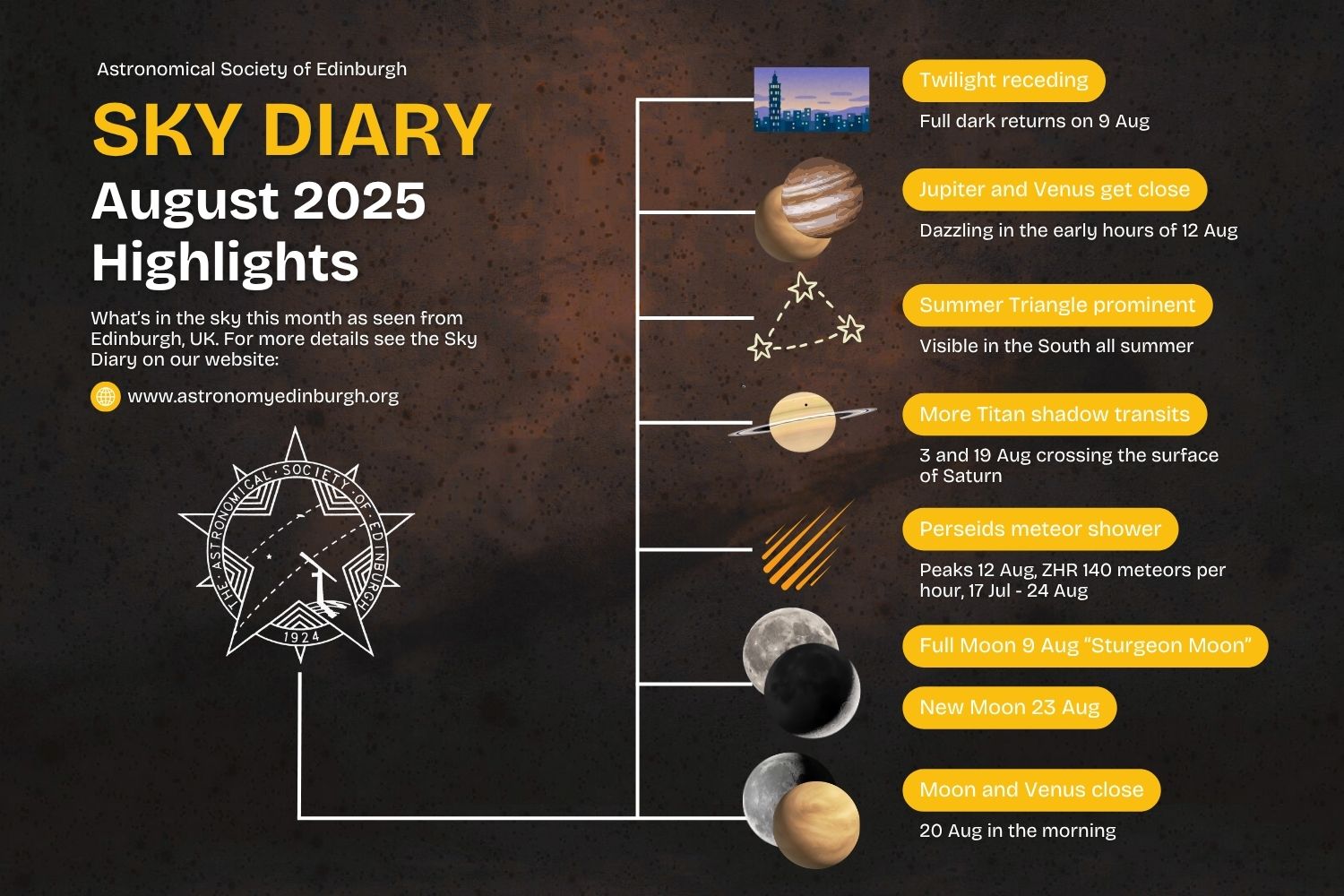
Darkness returns to Edinburgh on 9 August, giving us a grand total of 54 minutes of full dark. By the end of the month that has increased to 5h 12m with far more opportunities for observation. One of the best meteor showers of the year, the Perseids, peaks on 12 August and you can stay up a little longer to watch Jupiter and Venus making a dazzling close couple in the early hours. There are 2 more Titan shadow transits this month; still tricky during daylight hours but possible to capture with the right equipment.
Highlights:
- Darkness returns 9 Aug
- 6 Aug Conjunction of Saturn and Neptune
- 12 Aug Close approach of Venus and Jupiter
- Rare Titan shadow transits across Saturn’s surface on 3 and 19 Aug. Telescope needed.
- Full Moon on 9 Aug, known as the “Sturgeon Moon”
- Perseid meteor shower peaks 12 Aug
- 20 Aug Moon and Venus close together
- New Moon on 23 Aug
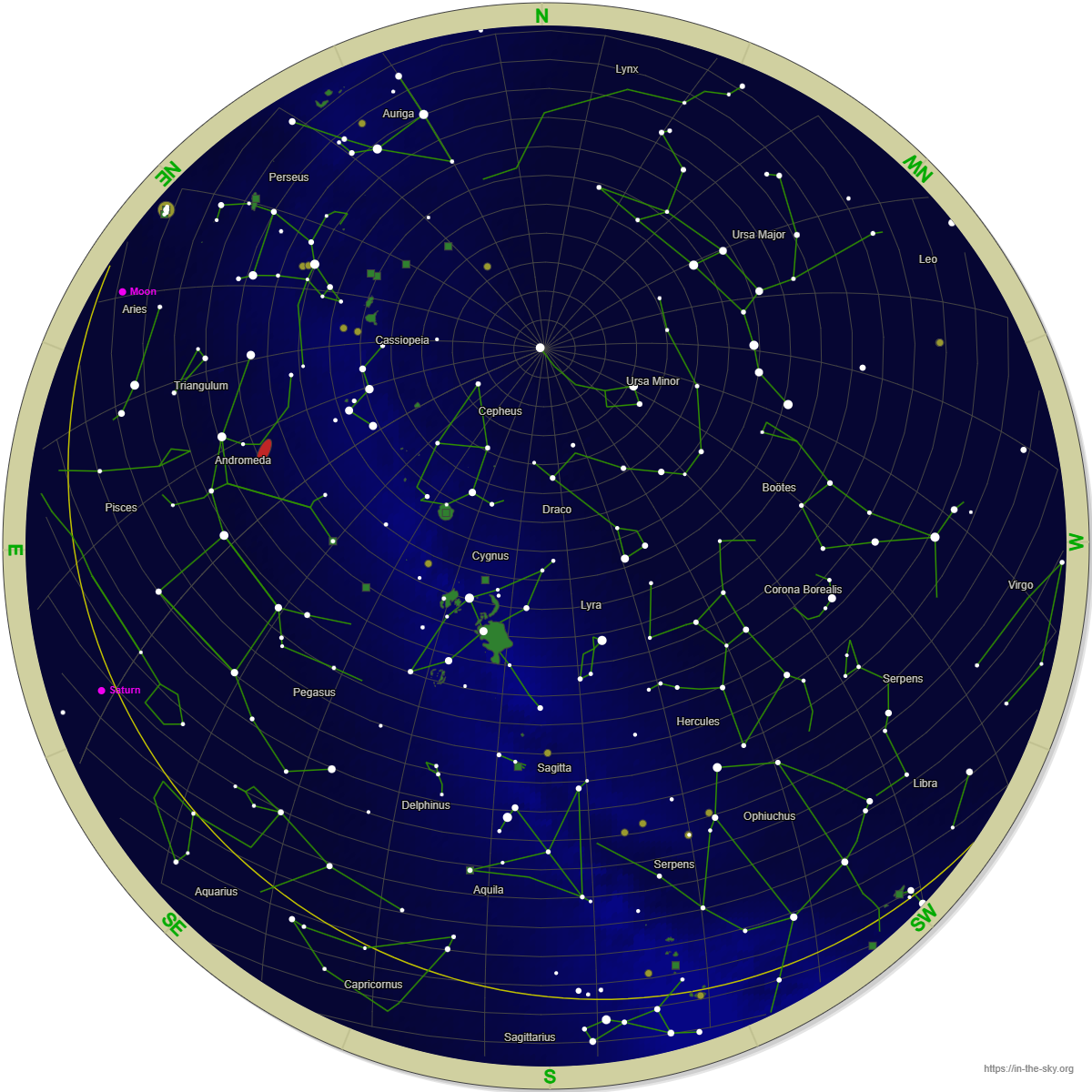
The chart shows the sky at 23:00 BST on 15 August 2025.
Conjunctions
6 Aug – Saturn (mag. 0.6) and Neptune (mag. 7.8) will be within about 1° of each other in the early hours of 6 Aug. Probably the best time to observe will be in the pre-dawn sky on 6th Aug.
12 Aug – Venus (mag. -4.0) and Jupiter (mag. -1.9) will be less than 1° apart (51′) on the morning of 12 Aug, rising at 02:09 BST. Should make for a dazzling sight.
20 Aug – The Moon (mag. -10.1) and Venus (mag. -4.0) make a close pass, within about 5°, rising at 02:34 BST. Not as close as Jupiter and Venus were but should still make a nice sight.
Rare Titan shadow transits
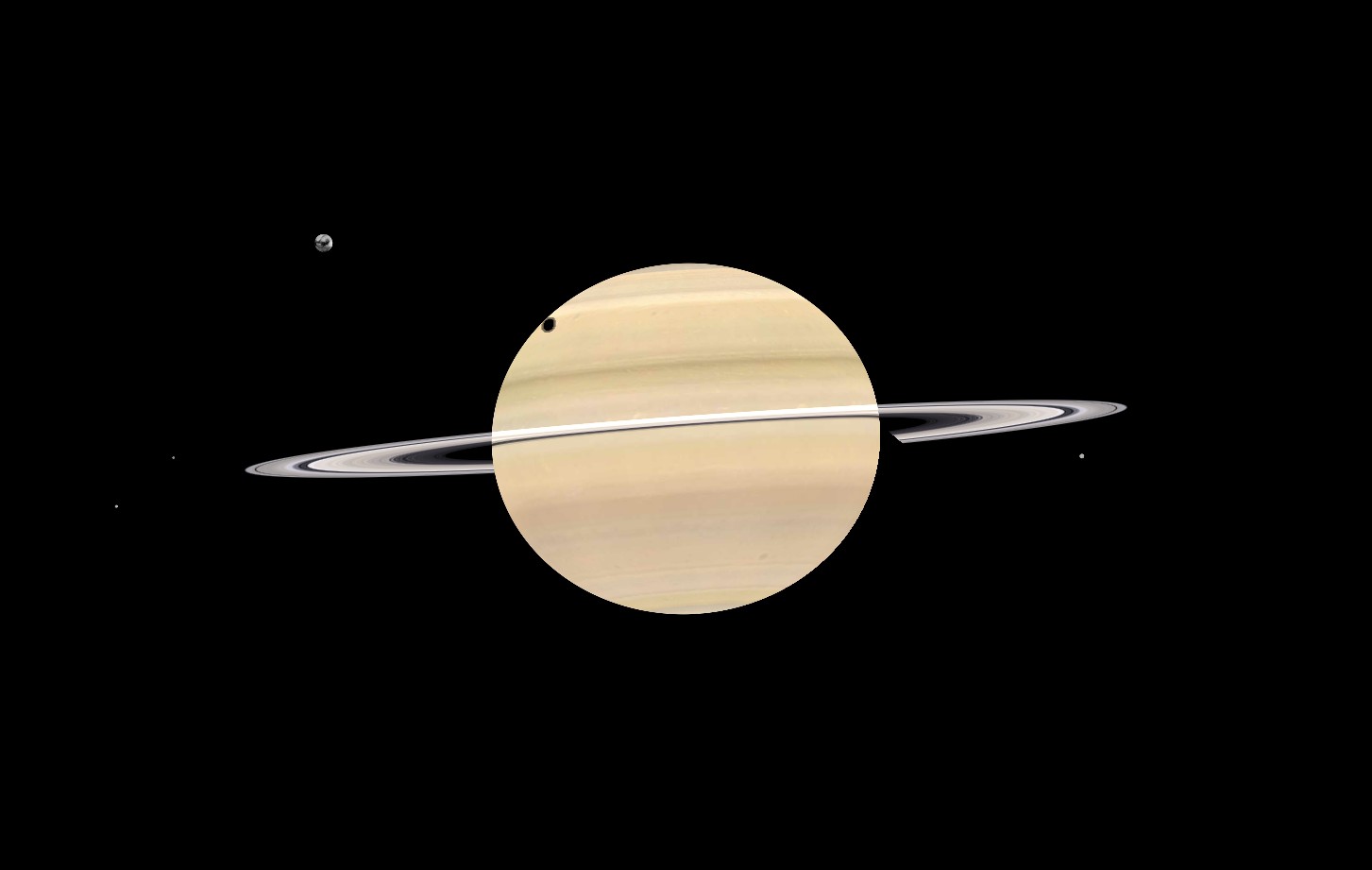
Titan shadow transit 19 August 2025 06:52 BST
There are two more events this month:
- 3 Aug 06:25 UT, mid transit 08:52 UT, end transit 11:04 UT
- 19 Aug 05:52 UT, mid 08:01 UT, end 10:00 UT
Unfortunately the Sun will be in the sky on both of these occasions so you will need to be very carful not to accidentally get the Sun in your field of view. Ideally, you will probably need:
- an already-aligned goto mount to find Saturn in the daytime sky (and avoid the Sun)
- a fast frame-rate planetary camera to capture the planet
- an infrared filter, which helps to reduce sky glow and provide contrast
Perseid Meteor Shower
Although the Perseid meteor shower is active from 17 July to 24 August, the best nights to watch are around the peak on 12 August. You can expect to see up to 150 meteors per hour under ideal conditions – which they rarely are. This year the waning gibbous Moon will interfere but you should still see good numbers.
Although the meteors appear to all diverge from one point – the radiant, they can be seeninany part of the sky, so don’t just look in the area of Perseus where the radiant is.
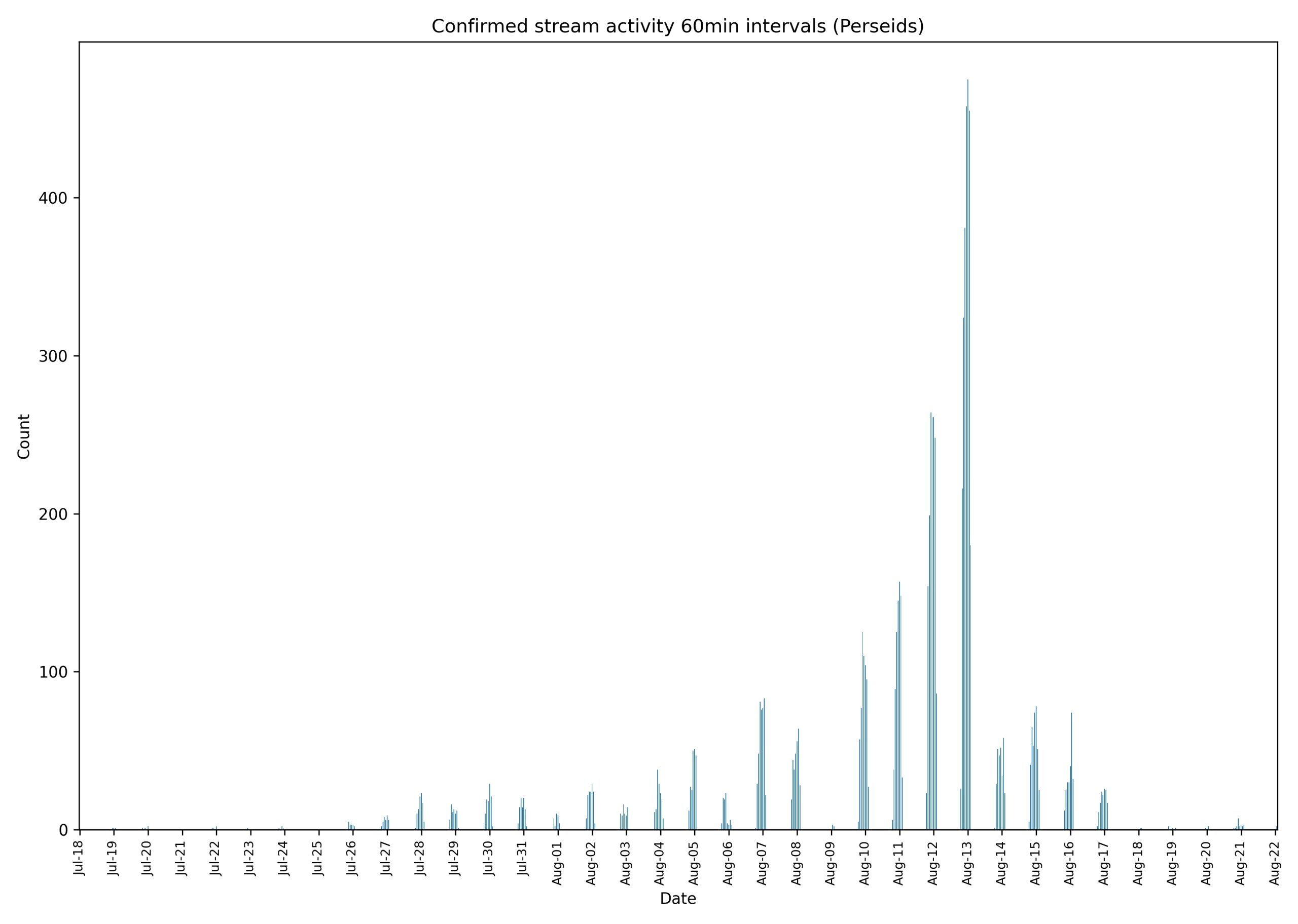
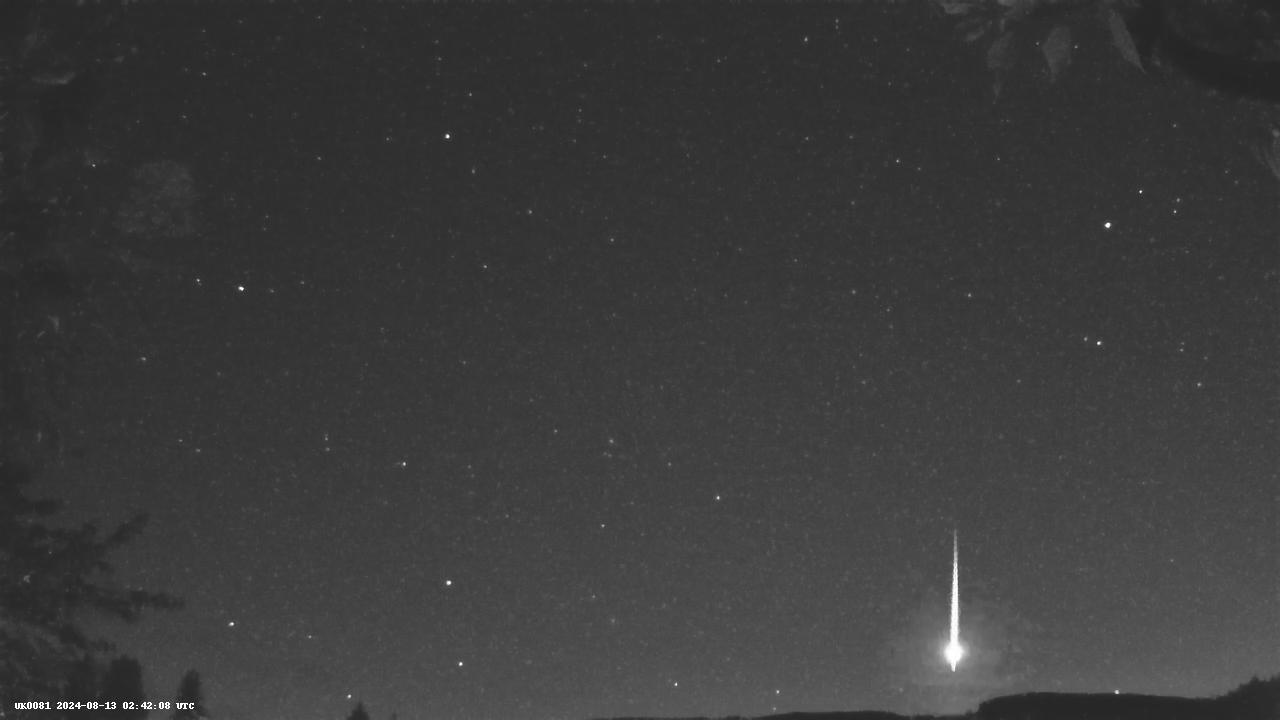
You can see from this UK Meteors plot the distribution of Perseids in 2024. There is a sharp peak at maximum but Persieds are visible for a few weeks. This is one of the best Perseids captured by our cameras in 2024.
You can see all the meteors captured by our cameras on the ASE Meteor Cameras page.
Click on an item to expand for more information:

Showing for 15 August 2025
Mercury is emerging into the morning sky as it approaches greatest elongation west.
04 Jul 2025 – Mercury at greatest elongation east
19 Aug 2025 – Mercury at greatest elongation west
22 Aug 2025 – Mercury at highest altitude in morning sky
29 Oct 2025 – Mercury at greatest elongation east
Venus is visible as a morning object, having recently passed greatest elongation west. From Edinburgh, it is visible in the dawn sky, rising at 02:20 (BST) – 3 hours and 20 minutes before the Sun – and reaching an altitude of 21° above the eastern horizon before fading from view as dawn breaks at around 05:14.
31 May 2025 – Venus at greatest elongation west
19 Aug 2025 – Venus at highest altitude in morning sky
14 May 2026 – Venus at highest altitude in evening sky
14 Aug 2026 – Venus at greatest elongation east
Mars will soon pass behind the Sun at solar conjunction.
24 Feb 2025 – Mars ends retrograde motion
10 Jan 2027 – Mars enters retrograde motion
19 Feb 2027 – Mars at opposition
20 Feb 2027 – Mars at perigee
Jupiter recently passed behind the Sun at solar conjunction. From Edinburgh, it is visible in the dawn sky, rising at 02:00 (BST) – 3 hours and 40 minutes before the Sun – and reaching an altitude of 23° above the eastern horizon before fading from view as dawn breaks at around 05:14.
04 Feb 2025 – Jupiter ends retrograde motion
11 Nov 2025 – Jupiter enters retrograde motion
10 Jan 2026 – Jupiter at opposition
11 Mar 2026 – Jupiter ends retrograde motion
Saturn is currently approaching opposition and is visible as a morning object. From Edinburgh, it is visible in the morning sky, becoming accessible around 23:18, when it reaches an altitude of 11° above your eastern horizon. It will then reach its highest point in the sky at 03:44, 32° above your southern horizon. It will be lost to dawn twilight around 04:46, 30° above your southern horizon.
13 Jul 2025 – Saturn enters retrograde motion
21 Sep 2025 – Saturn at opposition
28 Nov 2025 – Saturn ends retrograde motion
26 Jul 2026 – Saturn enters retrograde motion
Data from in-the-sky.org
| Comet name | Mag | Constellation | Separation from Sun | Trend | Absolute magnitude last updated |
| 217P/LINEAR | 13.1 | Taurus | 33° | Fading | 2 Jul 2025 |
| 240P/NEAT | 13.6 | Eridanus | 75° | Brightening | 1 Mar 2018 |
| 65P/Gunn | 13.6 | Sagittarius | 159° | Fading | 1 Aug 2017 |
| 47P/Ashbrook-Jackson | 13.8 | Aquarius | 126° | Brightening | 29 Feb 2012 |
| 48P/Johnson | 14.0 | Cetus | 70° | Brightening | 31 Oct 2018 |
| C/2021 G2 (ATLAS) | 14.3 | Libra | 108° | Fading | 2 Jul 2025 |
| C/2023 A3 (Tsuchinshan-ATLAS) | 14.4 | Lyra | 128° | Fading | 3 Dec 2024 |
| C/2022 E2 (ATLAS) | 14.7 | Cassiopeia | 73° | Brightening | 3 Mar 2025 |
| C/2022 N2 (PANSTARRS) | 14.8 | Aries | 67° | Brightening | 3 Dec 2024 |
| C/2023 C2 (ATLAS) | 14.9 | Cassiopeia | 91° | Fading | 5 Sep 2024 |
| 69P/Taylor | 14.9 | Aquarius | 122° | Brightening | Unknown |
| 210P/Christensen | 14.9 | Capricornus | 150° | Brightening | 28 Mar 2009 |
| 78P/Gehrels | 15.0 | Capricornus | 164° | Brightening | 30 Sep 2020 |
| 60P/Tsuchinshan | 15.0 | Cancer | 4° | Brightening | 3 Oct 2020 |
| C/2025 K1 (ATLAS) | 15.2 | Pegasus | 128° | Brightening | 2 Jul 2025 |
| 12P/Pons-Brooks | 15.3 | Lupus | 122° | Fading – in outburst | 3 Oct 2024 |
| 21P/Giacobini-Zinner | 15.3 | Monoceros | 22° | Fading | 4 Feb 2019 |
| C/2024 E1 (Wierzchos) | 15.4 | Draco | 93° | Brightening | 2 Jul 2025 |
| C/2024 G3 (ATLAS) | 15.5 | Hydrus | 98° | Fading | 3 Mar 2025 |
| C/2017 K2 (PANSTARRS) | 15.6 | Gemini | 23° | Fading | 2 Dec 2023 |
| 88P/Howell | 15.7 | Leo | 50° | Brightening | 1 Apr 2018 |
| 43P/Wolf-Harrington | 15.8 | Gemini | 9° | Brightening | 4 Dec 2018 |
| 168P/Hergenrother | 15.9 | Centaurus | 114° | Brightening | 15 Jan 2013 |
| C/2021 S3 (PANSTARRS) | 16.3 | Andromeda | 95° | Fading | 1 May 2024 |
| 110P/Hartley | 16.5 | Sagittarius | 167° | Fading | 29 Feb 2012 |
The Perseid meteor shower will be active from 17 July to 24 August, producing its peak rate of meteors around 12 August.
From Edinburgh the radiant point is circumpolar, which means it is always above the horizon and the shower will be active throughout the night.
The radiant point culminates (is highest in the sky) after dawn – at around 07:00 BST – and so the shower is likely produce its best displays shortly before dawn, when its radiant point is highest.
The shower is expected to reach peak activity at around 21:00 BST on 12 August 2025, and so the best displays might be seen after dusk on 12 August.
At its peak, the shower is expected to produce a nominal rate of around 150 meteors per hour (ZHR). However, this zenithal hourly rate is calculated assuming a perfectly dark sky and that the radiant of the shower is situated directly overhead. In practice, any real observing sight will fall short of these ideal conditions. The number of meteors you are likely to see is thus lower than this, and can be estimated using the ZHR formula.
From Edinburgh, the radiant of the shower will appear at a peak altitude of 72° above your horizon, and on the basis of this, we estimate that you may be able to see up to 142 meteors per hour at the shower’s peak.
The Moon, in Pisces, will be around last quarter phase at the shower’s peak, and will rise at 21:44.
The parent body responsible for creating the Perseid shower has been identified as comet 109P/Swift-Tuttle.
| Date | Age of Moon | Sun | Moon | ||||||||
| Rise | Culm | Set | Constellation | Rise | Culm | Set | Constellation | ||||
| 2025 | Aug | 01 | 08 days | 05:13 | 13:17 | 21:20 | Cancer | 15:02 | 19:02 | 22:50 | Virgo |
| 2025 | Aug | 08 | 15 days | 05:27 | 13:16 | 21:05 | Cancer | 21:22 | 00:11 | 03:23 | Capricornus |
| 2025 | Aug | 15 | 22 days | 05:40 | 13:15 | 20:49 | Leo | 22:18 | 05:57 | 14:18 | Aries |
| 2025 | Aug | 22 | 29 days | 05:54 | 13:14 | 20:32 | Leo | 04:30 | 12:41 | 20:25 | Cancer |
| 2025 | Sep | 01 | 09 days | 06:14 | 13:11 | 20:07 | Leo | 17:55 | 20:10 | 22:25 | Ophiuchus |

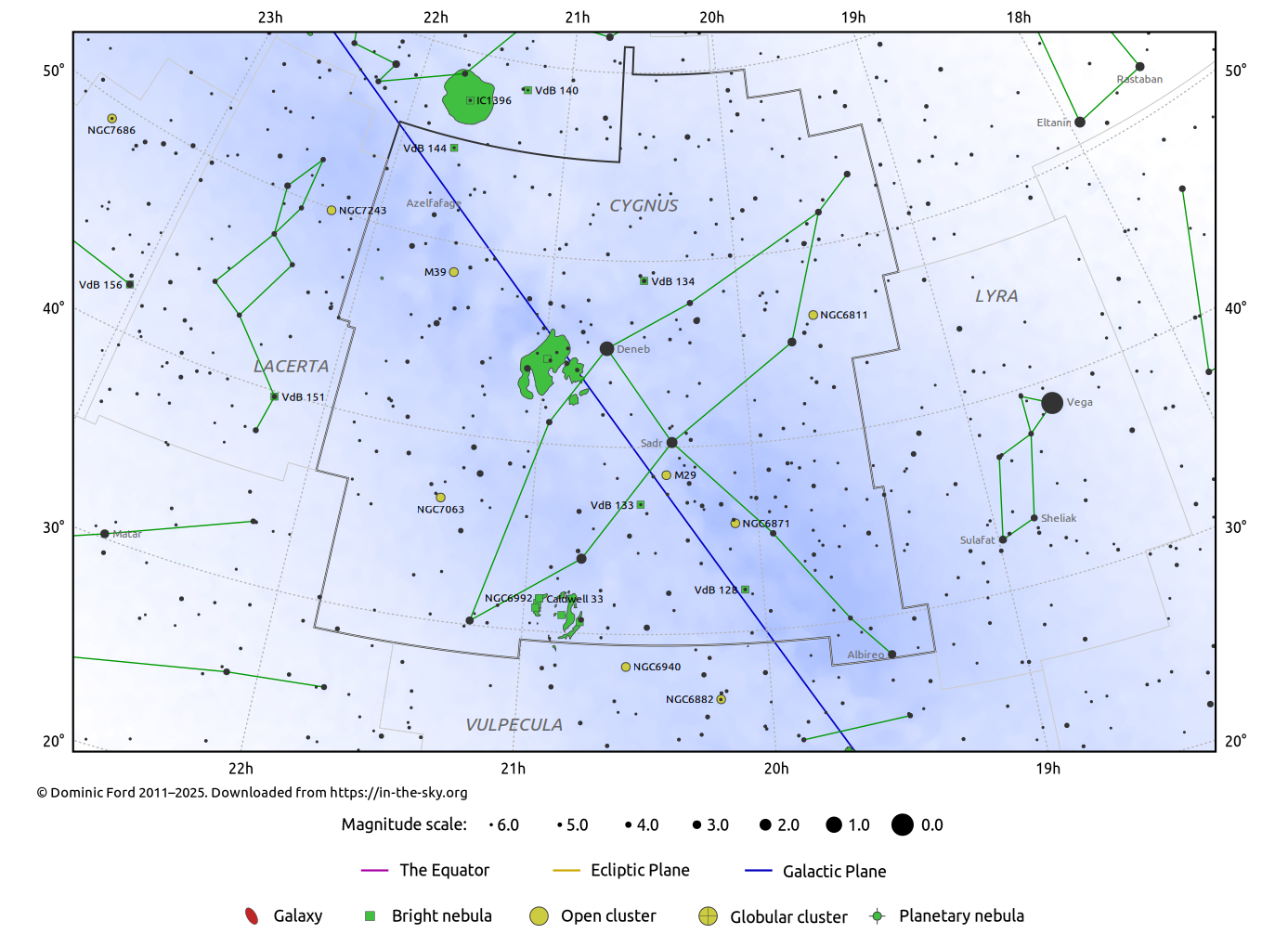
Cygnus is a large and easily recognisable constellation in the northern summer sky. Its brightest star, Deneb forms one vertex of the Summer Triangle asterism.
Visually, Cygnus appears as a ‘T’-shaped grouping of stars, with a fainter star Albireo (β¹-Cyg) making the T into a cross. For this reason, the asterism is sometimes known as the Northern Cross.
The Milky Way passes through the middle of the cross, littering it with some of the richest star fields in the northern sky. Among these are twenty open clusters of tenth magnitude or brighter. A pair of binoculars are quite sufficient to bring hundreds of stars into view.
The star Albireo (β¹-Cyg) is particularly often observed, as it is a binary whose two components have two strongly contrasting colors – one red and the other blue.
The name ‘Cygnus’ is Latin for ‘swan’, though accounts vary as to the swan’s identity. In one popular story, Cygnus is the god Zeus in disguise, pursuing one of his many love interests – perhaps Nemesis or Leda, mother of Helen of Troy.
| Stars | Open Clusters | Globular Clusters | Galaxies |
| Deneb (mag 1.3) | Messier 39 (mag 4.6) | NGC 6946 (mag 9.7) | |
| Sadr (mag 2.2) | NGC 6871 (mag 5.2) | NGC 7013 (mag 11.3) | |
| Gamma Cygni Nebula (mag 2.2) | Messier 29 (mag 6.6) | NGC 6824 (mag 11.8) | |
| ε-Cyg (mag 2.5) | NGC 6811 (mag 6.8) | IC 1392 (mag 12.9) | |
| δ-Cyg (mag 2.9) | NGC 7063 (mag 7.0) | IC 1302 (mag 13.3) | |
| NGC7114 (mag 3.0) | NGC 7082 (mag 7.2) | NGC 6764 (mag 13.6) | |
| Albireo (mag 3.1) | NGC 6819 (mag 7.3) | NGC 7116 (mag 14.1) | |
| ζ-Cyg (mag 3.2) | IC 4996 (mag 7.3) | IC 1303 (mag 14.2) | |
| ξ-Cyg (mag 3.7) | NGC 6910 (mag 7.4) | IC 1301 (mag 14.2) | |
| τ-Cyg (mag 3.7) | NGC 7039 (mag 7.6) | NGC 6798 (mag 14.4) | |
| ι-Cyg (mag 3.8) | NGC 6866 (mag 7.6) | NGC 6801 (mag 14.7) | |
| κ-Cyg (mag 3.8) | NGC 6834 (mag 7.8) | NGC 6783 (mag 15.2) | |
| V695 Cyg (mag 3.8) | NGC 6883 (mag 8.0) | NGC 6916 (mag 15.2) | |
| η-Cyg (mag 3.9) | NGC 7062 (mag 8.3) | ||
| ν-Cyg (mag 3.9) | NGC 7086 (mag 8.4) | ||
| ρ-Cyg (mag 4.0) | IC 1369 (mag 8.8) | ||
| V1488 Cyg (mag 4.0) | NGC 7031 (mag 9.1) | ||
| 41-Cyg (mag 4.0) | NGC 7128 (mag 9.7) | ||
| 52-Cyg (mag 4.2) | NGC 7067 (mag 9.7) | ||
| σ-Cyg (mag 4.2) | IC 5146 (mag 10.0) | ||
| π²-Cyg (mag 4.2) | NGC 7044 (mag 12.0) | ||
| 33-Cyg (mag 4.3) | IC 1311 (mag 13.1) | ||
| υ-Cyg (mag 4.4) | NGC 6846 (mag 14.2) | ||
| 39-Cyg (mag 4.4) | NGC 7093 | ||
| θ-Cyg (mag 4.5) | NGC 6832 | ||
| f²-Cyg (mag 4.5) | NGC 6856 | ||
| λ-Cyg (mag 4.6) | IC 1363 | ||
| 47-Cyg (mag 4.7) | NGC 7175 | ||
| Azelfafage (mag 4.7) | NGC 6895 | ||
| β²-Cyg (mag 4.7) | NGC 7127 |
Use the chevrons to choose the month:
Much of the material is provided with thanks to Dominic Ford on his excellent site in-the-sky.org.