

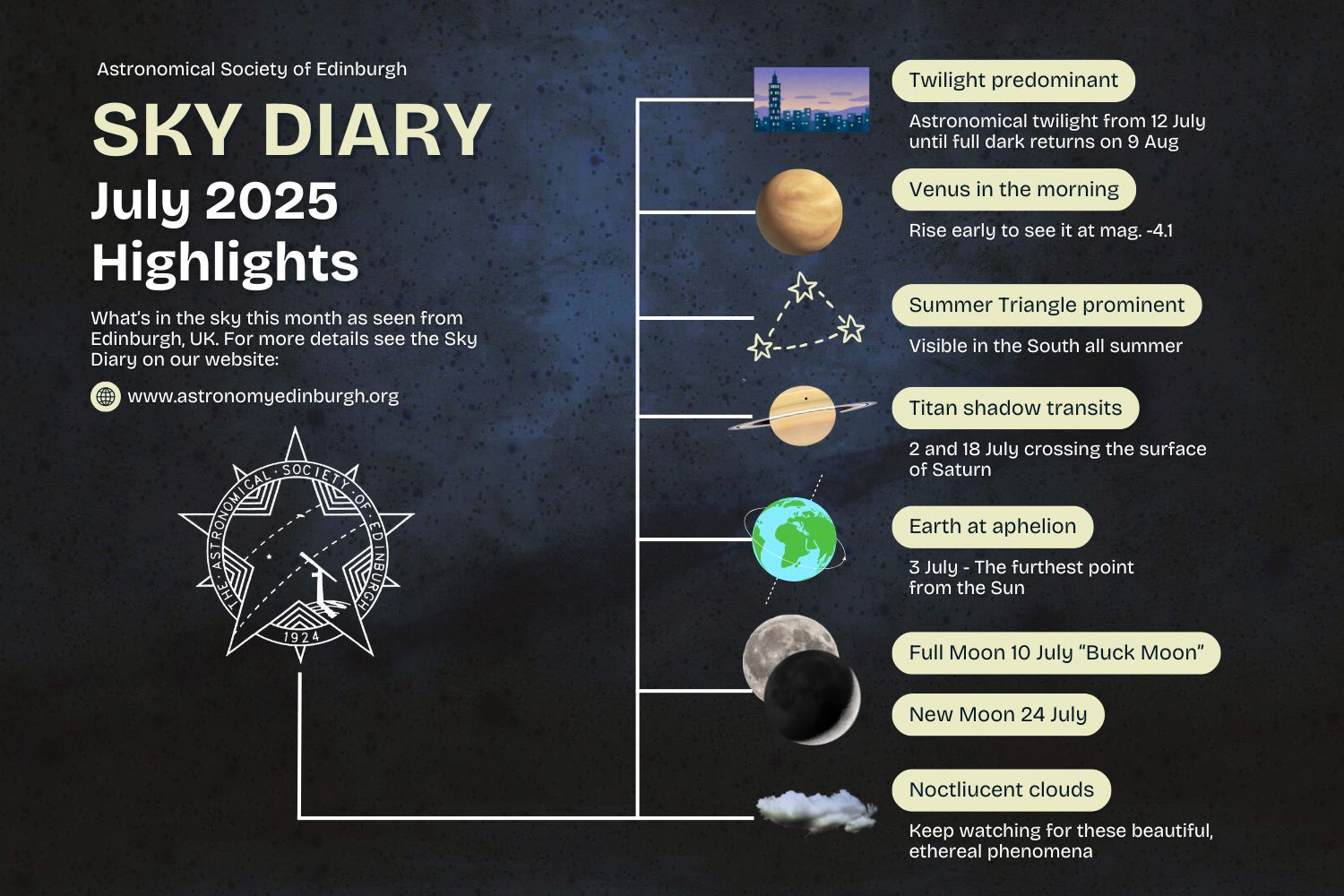
Summer Triangle, Titan shadow transits, morning Venus, noctilucent clouds and twilight
by Mark Phillips using data from Dominic Ford’s in-the-sky.org and other sources
July in Scotland is similar to June in that the sky really never gets very dark, but there’s always something to look out for. Read on for more about the different categories of twilight and the rare Titan shadow transits this month. Keep looking out for those elusive noctilucent clouds too.
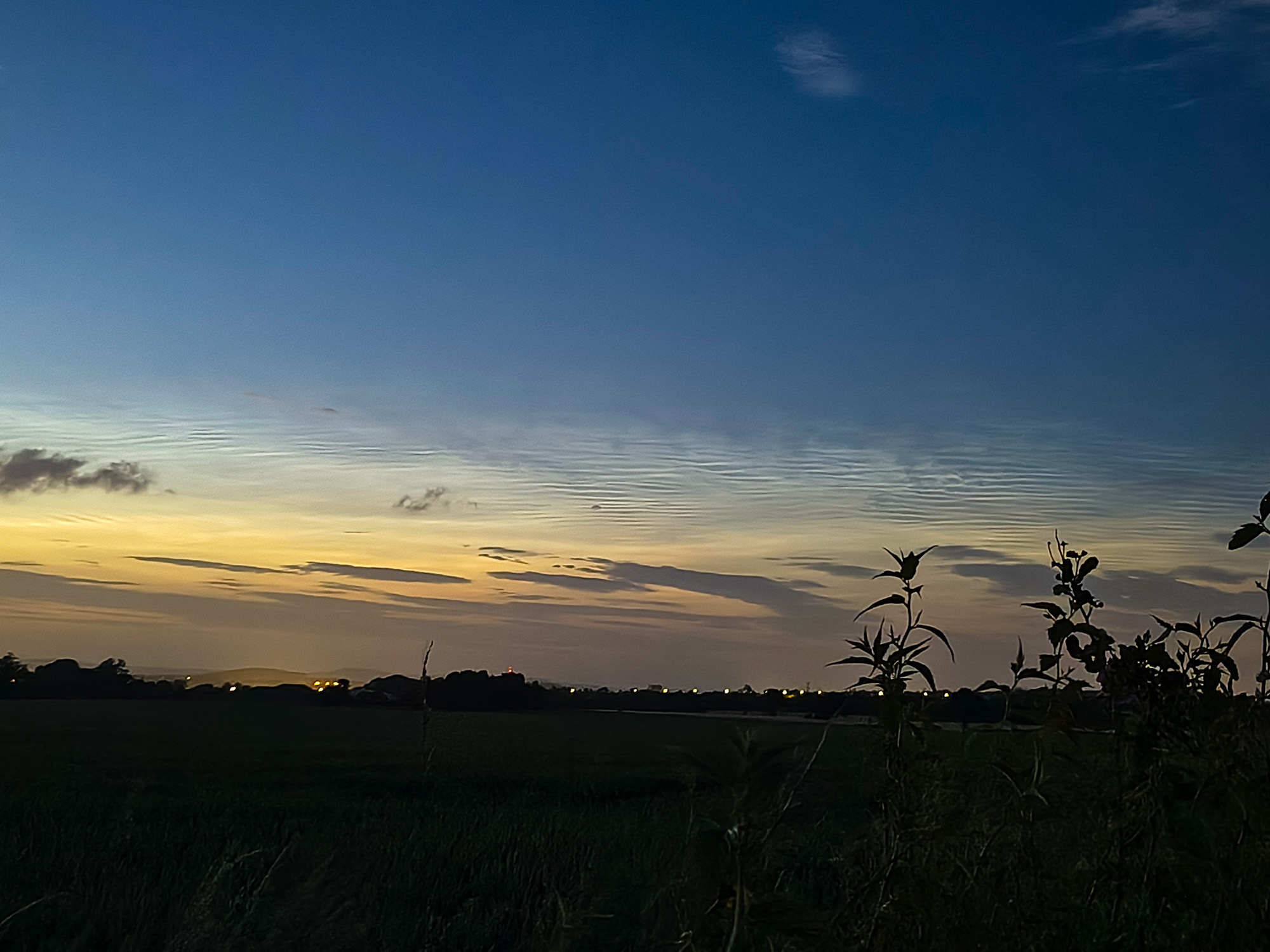
Noctilucent Clouds, Edinburgh 2025-06-28, Mark Phillips
Highlights:
- Twilight predominant with Astronomical twilight from 12 July until full darkness returns 9 Aug
- Venus is visible as a bright (mag. -4.1) morning object but you’ll need to get up early to see it
- Saturn is also visible before dawn
- Rare Titan shadow transits across Saturn’s surface on 2 and 18 July. Telescope needed.
- Earth at aphelion (furthest from the Sun) 3 July
- Full Moon on 10 July, known as the “Buck Moon”
- New Moon on 24 July
- Summer Triangle is now prominent in the south and remain well placed all summer (see June Sky Diary for more details)
- Look out for noctilucent clouds (see June Sky Diary )
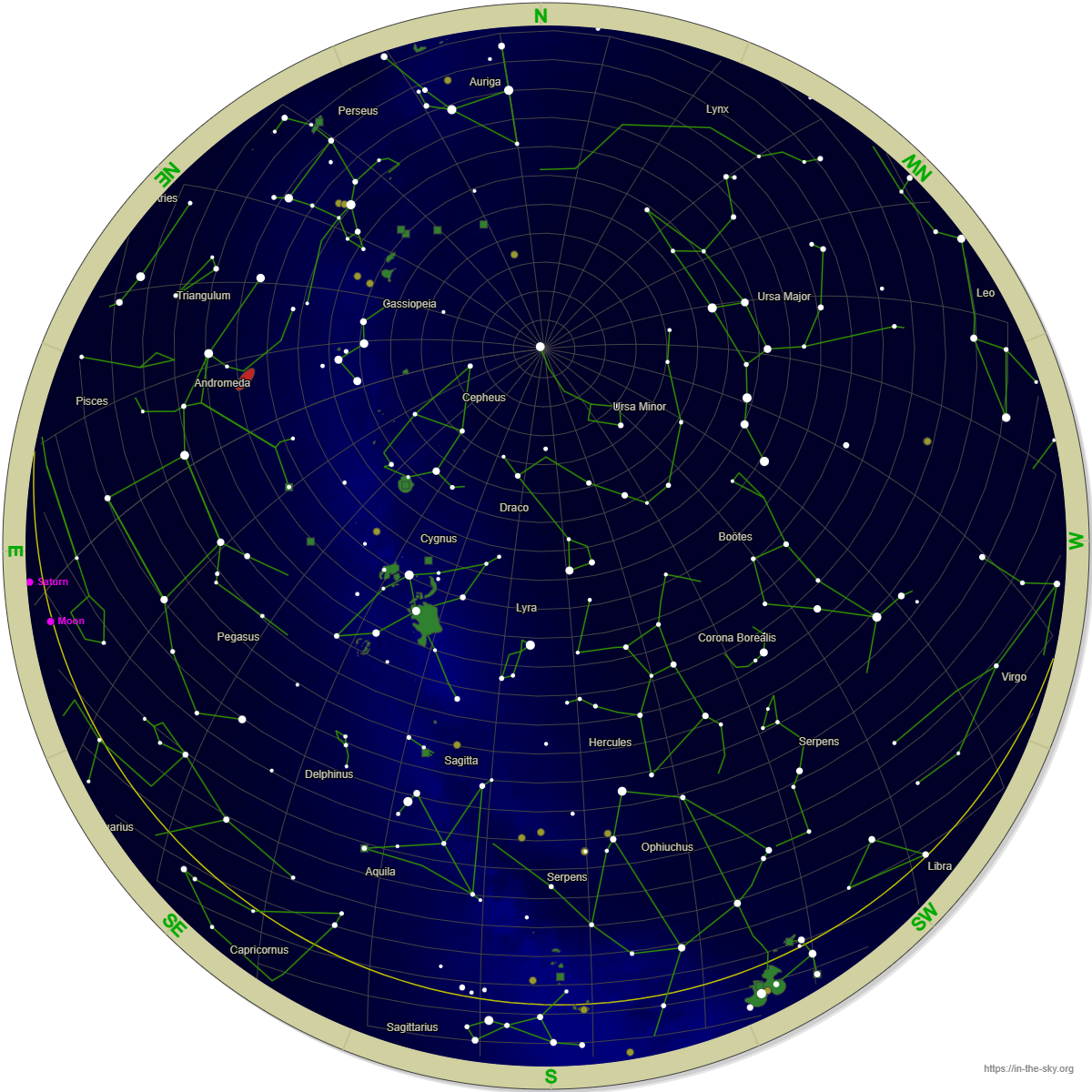
The chart shows the sky at midnight BST on 15 July 2025.
Twilight
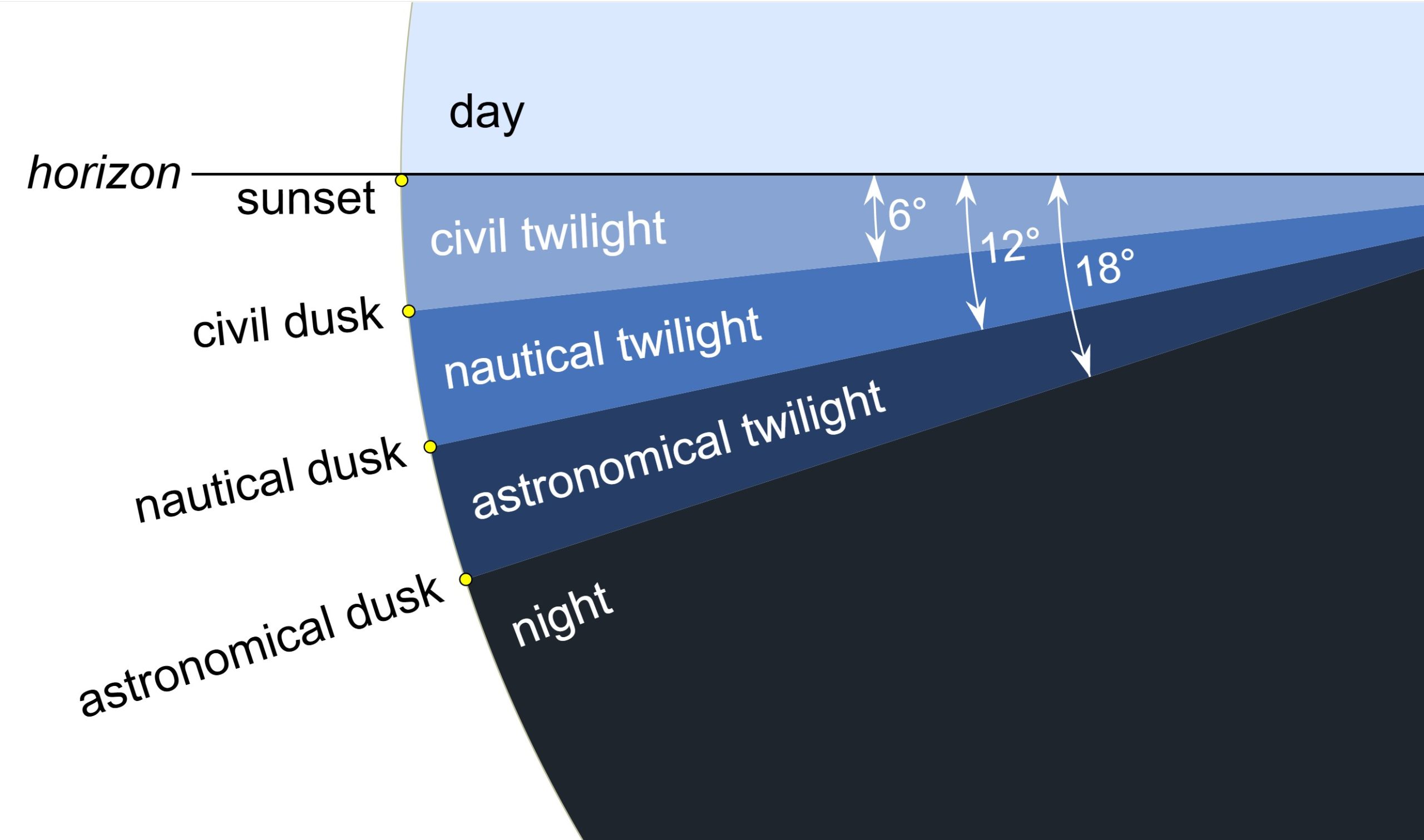
By TWCarlson – Own work, CC BY-SA 3.0
We often talk about different types of twilight and darkness, but what are they? Fundamentally it as about how dark the sky is, caused by how far the Sun is below the horizon.
- True darkness – or Astronomical darkness – is when the Sun reaches 18° below the horizon.
- Astronomical twilight (or Nautical darkness) – when the Sun is between 12° and 18°
- Nautical twilight – Sun between 6° and 12°
- Civil twilight – Sun between 0° and 6°
So at the start of July we will have Nautical twilight until 12 July when the Sun will reach 12° below the horizon and we have Astronomical twilight. Full darkness returns on 9 August, just in time to see the Perseids meteor shower.
Titan shadow transits
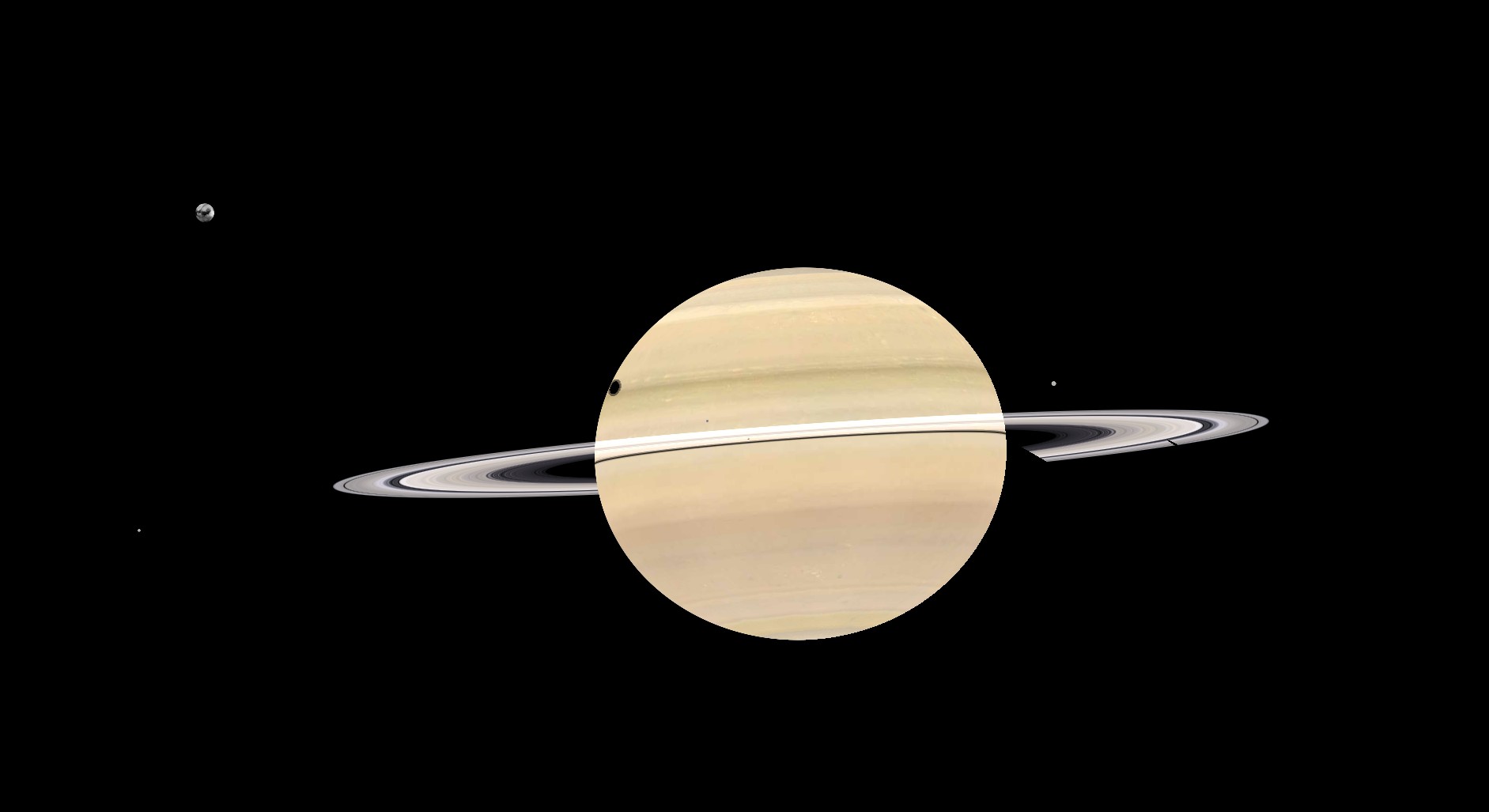
Titan’s shadow starting to cross the disk of Saturn, 2 July 07:40 UT. Image from WinJUPOS.
These are rare and happen when the orbital plane of Titan is edge on to Earth, which occurs about every 15 years. They are telescopic events and you will need a decent instrument to see them.
This year they will happen from July – September, with two events this month:
- 2 July 07:40 UT, mid transit 10:35 UT, end transit 13:03 UT
- 18 July 07:00 UT, mid 09:44 UT, end 12:05 UT
Unfortunately the Sun will be in the sky on both of these occasions so you will need to be very carful not to accidentally get the Sun in your field of view. Ideally, you will probably need:
- an already-aligned goto mount to find Saturn in the daytime sky (and avoid the Sun)
- a fast frame-rate planetary camera to capture the planet
- an infrared filter, which helps to reduce sky glow and provide contrast
Click on an item to expand for more information:

Showing for 15 July 2025
Mercury is an evening object but not observable.
04 Jul 2025 – Mercury at greatest elongation east
19 Aug 2025 – Mercury at greatest elongation west
22 Aug 2025 – Mercury at highest altitude in morning sky
29 Oct 2025 – Mercury at greatest elongation east
Venus is visible as a morning object, having recently passed greatest elongation west. From Edinburgh, it is visible in the dawn sky, rising at 02:04 (BST) – 2 hours and 40 minutes before the Sun – and reaching an altitude of 15° above the eastern horizon before fading from view as dawn breaks at around 04:12.
31 May 2025 – Venus at greatest elongation west
19 Aug 2025 – Venus at highest altitude in morning sky
14 May 2026 – Venus at highest altitude in evening sky
14 Aug 2026 – Venus at greatest elongation east
Mars is currently an early evening object, now receding into evening twilight and not observable.
24 Feb 2025 – Mars ends retrograde motion
10 Jan 2027 – Mars enters retrograde motion
19 Feb 2027 – Mars at opposition
20 Feb 2027 – Mars at perigee
Jupiter recently passed behind the Sun at solar conjunction and is not observable.
04 Feb 2025 – Jupiter ends retrograde motion
11 Nov 2025 – Jupiter enters retrograde motion
10 Jan 2026 – Jupiter at opposition
11 Mar 2026 – Jupiter ends retrograde motion
Saturn is currently emerging from behind the Sun. From Edinburgh, it is visible in the dawn sky, rising at 23:53 (BST) and reaching an altitude of 26° above the south-eastern horizon before fading from view as dawn breaks at around 03:30.
13 Jul 2025 – Saturn enters retrograde motion
21 Sep 2025 – Saturn at opposition
28 Nov 2025 – Saturn ends retrograde motion
26 Jul 2026 – Saturn enters retrograde motion
Data from in-the-sky.org
| Comet name | Mag | Constellation | Separation from Sun | Trend | Absolute magnitude last updated |
| 217P/LINEAR | 12.7 | Taurus | 30° | Fading | 30 Nov 2017 |
| 65P/Gunn | 13.6 | Sagittarius | 169° | Brightening | 1 Aug 2017 |
| 48P/Johnson | 14.0 | Cetus | 58° | Brightening | 31 Oct 2018 |
| 240P/NEAT | 14.1 | Cetus | 64° | Brightening | 1 Mar 2018 |
| C/2023 A3 (Tsuchinshan-ATLAS) | 14.1 | Lyra | 126° | Fading | 3 Dec 2024 |
| C/2021 G2 (ATLAS) | 14.1 | Libra | 129° | Fading | 4 Apr 2024 |
| 47P/Ashbrook-Jackson | 14.2 | Aquarius | 107° | Brightening | 29 Feb 2012 |
| 21P/Giacobini-Zinner | 14.4 | Orion | 19° | Fading | 4 Feb 2019 |
| C/2022 E2 (ATLAS) | 14.7 | Perseus | 57° | Fading | 3 Mar 2025 |
| C/2023 C2 (ATLAS) | 14.9 | Andromeda | 79° | Brightening | 5 Sep 2024 |
| C/2022 N2 (PANSTARRS) | 14.9 | Aries | 53° | Brightening | 3 Dec 2024 |
| C/2024 G3 (ATLAS) | 15.0 | Reticulum | 91° | Fading | 3 Mar 2025 |
| 12P/Pons-Brooks | 15.0 | Lupus | 141° | Fading – in outburst | 3 Oct 2024 |
| 60P/Tsuchinshan | 15.0 | Gemini | 10° | Brightening | 3 Oct 2020 |
| 69P/Taylor | 15.2 | Aquarius | 104° | Brightening | Unknown |
| 78P/Gehrels | 15.4 | Aquarius | 142° | Brightening | 30 Sep 2020 |
| C/2017 K2 (PANSTARRS) | 15.5 | Taurus | 5° | Fading | 2 Dec 2023 |
| C/2024 E1 (Wierzchos) | 15.7 | Draco | 97° | Brightening | 3 Jun 2025 |
| 210P/Christensen | 15.8 | Capricornus | 128° | Brightening | 28 Mar 2009 |
| 168P/Hergenrother | 15.9 | Lupus | 133° | Brightening | 15 Jan 2013 |
| C/2025 K1 (ATLAS) | 16.0 | Pegasus | 107° | Brightening | 3 Jun 2025 |
| 88P/Howell | 16.0 | Leo | 64° | Brightening | 1 Apr 2018 |
| C/2021 S3 (PANSTARRS) | 16.2 | Andromeda | 79° | Fading | 1 May 2024 |
| 110P/Hartley | 16.5 | Sagittarius | 168° | Brightening | 29 Feb 2012 |
| 67P/Churyumov-Gerasimenko | 16.8 | Libra | 145° | Fading | 1 Apr 2018 |
No major showers this month.
The α-Capricornid meteor shower will be active from 3 July to 15 August, producing its peak rate of meteors around 30 July.
The shower is likely produce its best displays in the hours around 01:00 BST, when its radiant point is highest in the sky.
From Edinburgh, the radiant of the shower will appear at a peak altitude of 24° above your horizon, and on the basis of this, we estimate that you are only likely to see only around 2 meteors per hour, even at the shower’s peak, since the radiant will be relatively low in the sky.
The Moon, in Virgo, will be around first quarter phase at the shower’s peak, presenting minimal interference.
| Date | Age of Moon | Sun | Moon | ||||||||
| Rise | Culm | Set | Constellation | Rise | Culm | Set | Constellation | ||||
| 2025 | Jul | 01 | 06 days | 04:28 | 13:15 | 22:01 | Gemini | 12:07 | 18:22 | 00:15 | Leo |
| 2025 | Jul | 08 | 13 days | 04:35 | 13:16 | 21:56 | Gemini | 21:18 | 23:38 | 01:18 | Scorpius |
| 2025 | Jul | 15 | 20 days | 04:44 | 13:17 | 21:48 | Gemini | 23:34 | 04:46 | 10:22 | Aquarius |
| 2025 | Jul | 22 | 27 days | 04:55 | 13:17 | 21:38 | Cancer | 01:19 | 11:02 | 20:46 | Taurus |
| 2025 | Aug | 01 | 08 days | 05:13 | 13:17 | 21:20 | Cancer | 15:02 | 19:02 | 22:50 | Virgo |

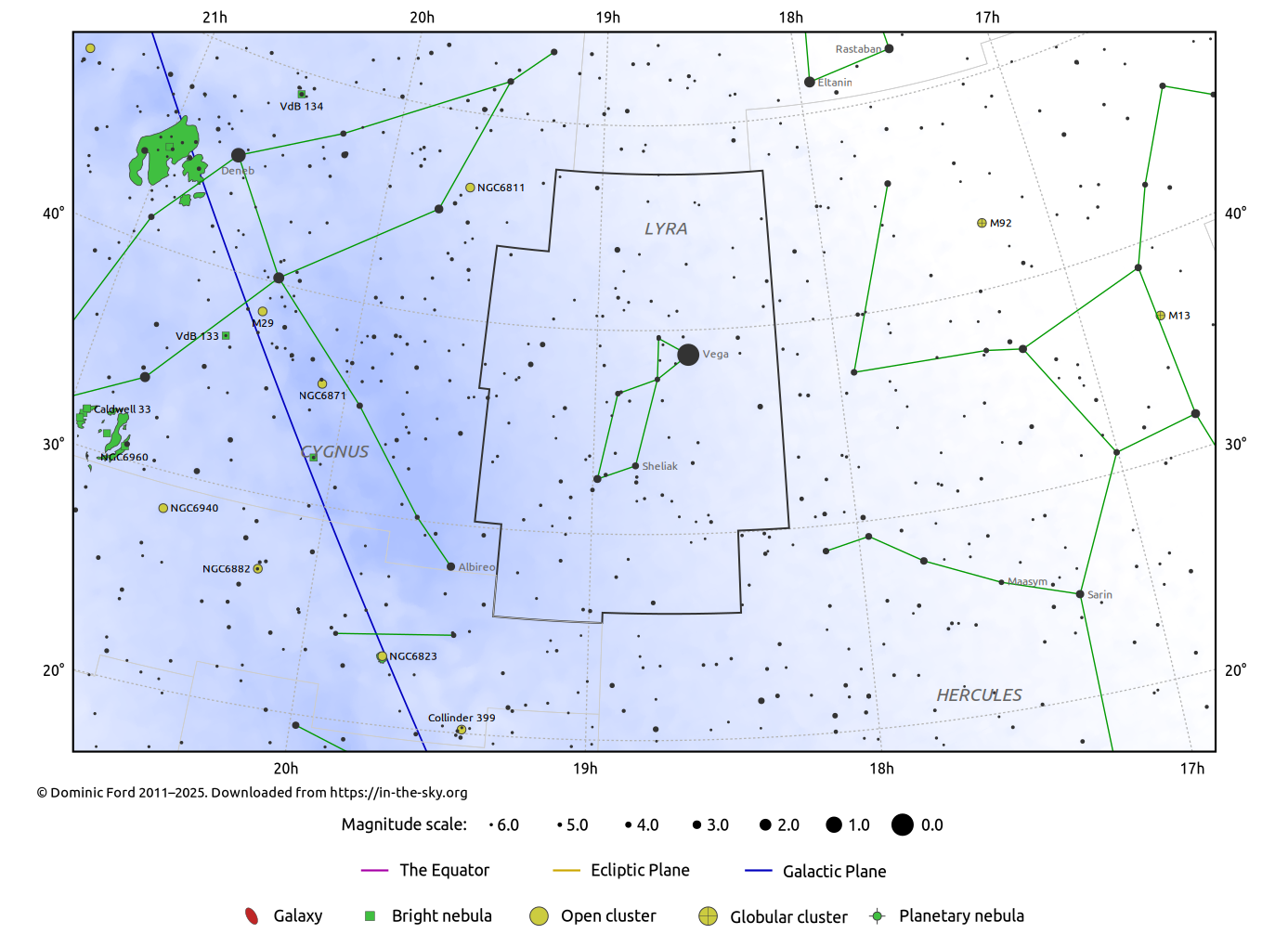
Lyra is a northern summer constellation, which is highest in the midnight sky in the months around June. It is best known for its brightest star, Vega, which forms one vertex of the Summer Triangle asterism. Vega is the fourth brightest star in the whole sky, and defines the zero point of the magnitude system.
Lyra’s other stars are all much fainter than Vega; none are brighter than third magnitude.
This area of the sky is home to the celebrated planetary nebula M57, the Ring Nebula, one of the brightest in the sky. It is also home to the globular cluster M56.
| Stars | Open Clusters | Globular Clusters | Galaxies |
| Vega (mag 0.0) | NGC 6743 (mag 8.2) | Messier 56 (mag 8.4) | NGC 6703 (mag 11.4) |
| Sulafat (mag 3.2) | NGC 6791 (mag 9.5) | NGC 6702 (mag 12.2) | |
| Sheliak (mag 3.6) | NGC 6646 (mag 12.6) | ||
| R Lyr (mag 4.2) | NGC 6710 (mag 13.1) | ||
| δ²-Lyr (mag 4.3) | NGC 6792 (mag 13.3) | ||
| ζ¹-Lyr (mag 4.3) | NGC 6675 (mag 13.3) | ||
| κ-Lyr (mag 4.3) | NGC 6695 (mag 13.5) | ||
| θ-Lyr (mag 4.3) | NGC 6671 (mag 13.7) | ||
| η-Lyr (mag 4.4) | NGC 6688 (mag 13.8) | ||
| HIP 92088 (mag 4.8) | NGC 6700 (mag 14.1) | ||
| λ-Lyr (mag 4.9) | NGC 6640 (mag 14.2) | ||
| ε¹-Lyr (mag 5.0) | NGC 6657 (mag 14.2) | ||
| 16-Lyr (mag 5.0) | NGC 6713 (mag 14.2) | ||
| μ-Lyr (mag 5.1) | IC 1288 (mag 14.2) | ||
| ε²-Lyr (mag 5.2) | NGC 6606 (mag 14.4) | ||
| ν-Lyr (mag 5.2) | NGC 6665 (mag 14.5) | ||
| HIP 93017 (mag 5.2) | NGC 6685 (mag 14.6) | ||
| 17-Lyr (mag 5.2) | NGC 6686 (mag 14.8) | ||
| ι-Lyr (mag 5.2) | NGC 6663 (mag 14.8) | ||
| HIP 93256 (mag 5.3) | NGC 6662 (mag 14.8) | ||
| TYC3122-3439-2 (mag 5.4) | IC 4772 (mag 14.9) | ||
| ε²-Lyr (mag 5.4) | IC 1289 (mag 15.3) | ||
| HIP 91235 (mag 5.4) | IC 1296 (mag 15.3) | ||
| HIP 90923 (mag 5.5) | NGC 6740 (mag 15.5) | ||
| HIP 92831 (mag 5.5) | NGC 6612 (mag 15.5) | ||
| HIP 93843 (mag 5.5) | NGC 6745 (mag 16.9) | ||
| HIP 89482 (mag 5.5) | |||
| δ¹-Lyr (mag 5.6) | |||
| ζ²-Lyr (mag 5.6) | |||
| HIP 93718 (mag 5.6) |
Use the chevrons to choose the month:
Much of the material is provided with thanks to Dominic Ford on his excellent site in-the-sky.org.