

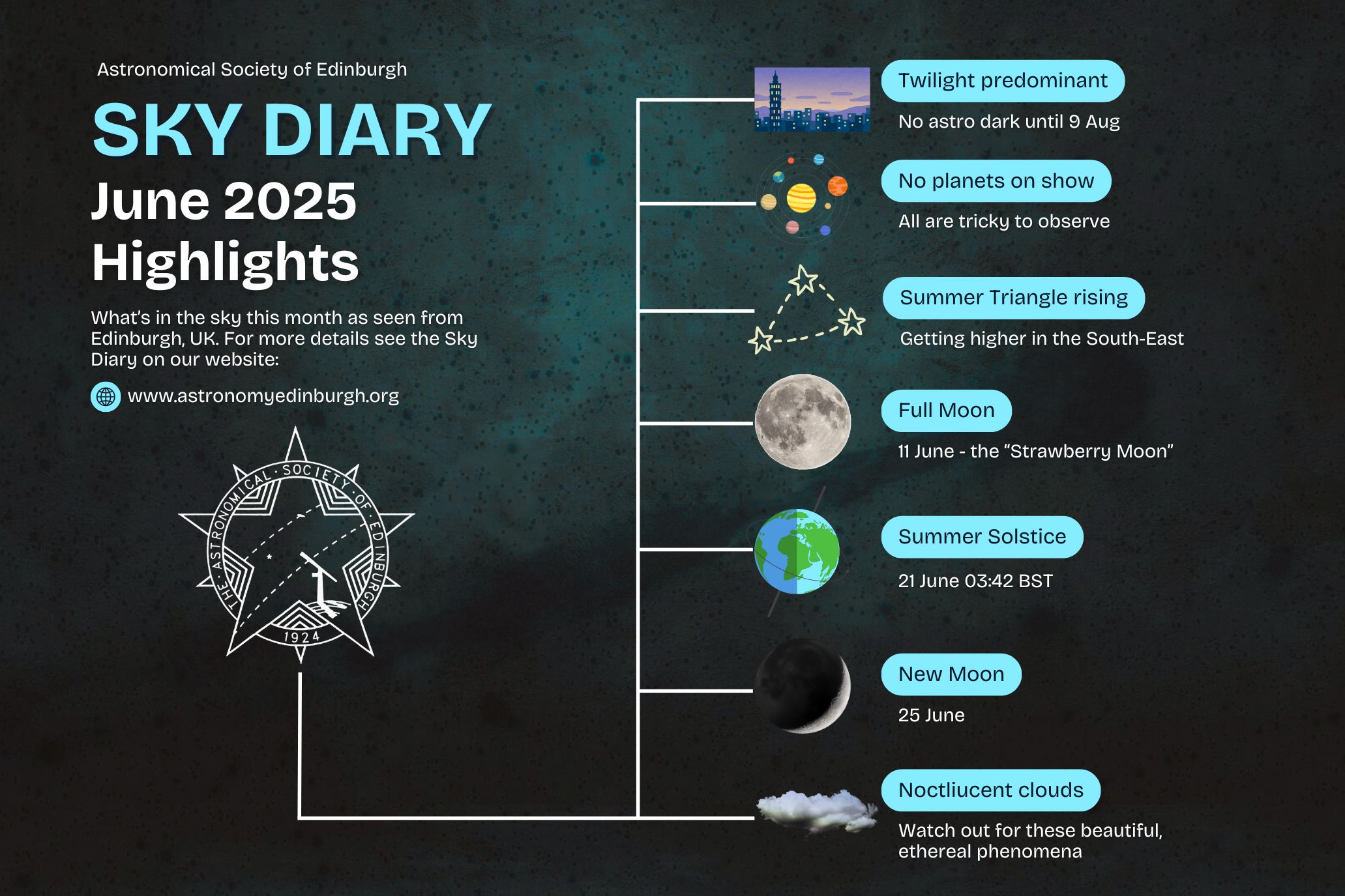
Summer Triangle getting higher, noctilucent clouds and twilight
by Mark Phillips using data from Dominic Ford’s in-the-sky.org
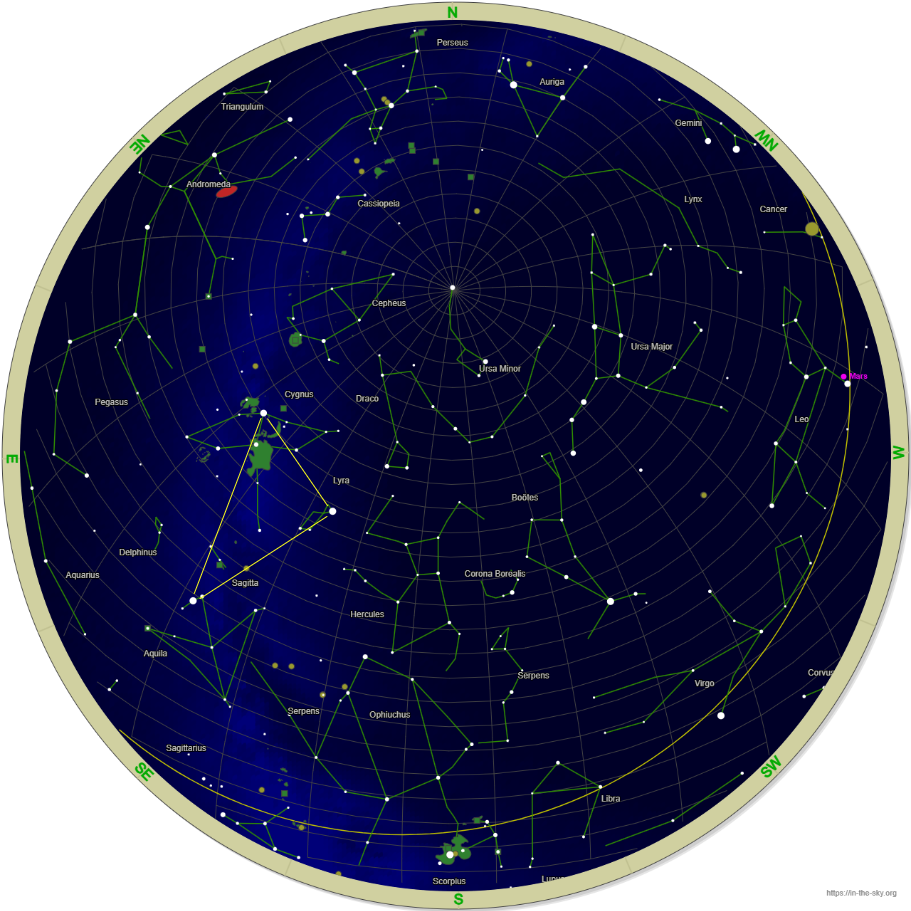
The chart shows the sky at midnight BST on 15 June 2025.
June is always a difficult month to write about as twilight in Scotland makes observing any night-time objects tricky. But don’t give up – there’s always something to see.
Highlights:
- Summer twilight predominant with no astro-dark until 9 Aug
- Summer Solstice 21 June 03:42 BST
- Full Moon on 11 June, known as the “Strawberry Moon”
- New Moon on 25 June
- Summer Triangle getting higher in the East
- Only minor meteor showers this month: Daytime Arietids and June Bootids
- Look out for noctilucent clouds (NLCs)
Noctilucent Clouds
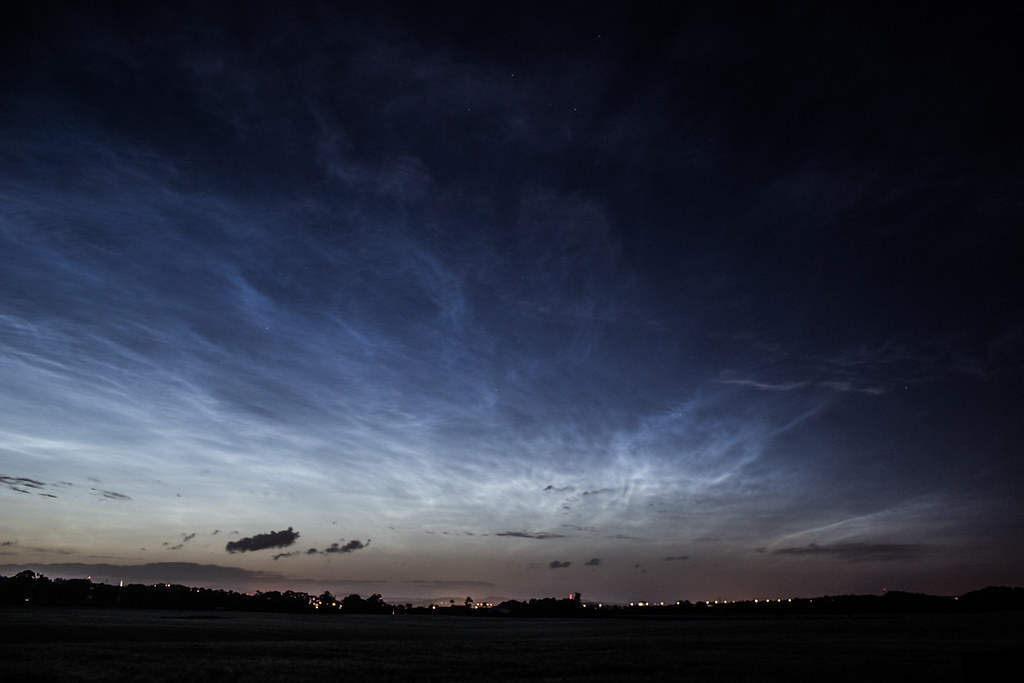
Noctilucent clouds, 18 June 2018 taken by Mark Phillips
These “night shining clouds” are a beautiful phenomenon to look out for in June and July. They are polar mesospheric clouds consisting of ice crystals visible during twilight at very high altitude, about 76 to 85 km, still illuminated by the Sun after it has set.
More info on Wikipedia
Summer Triangle
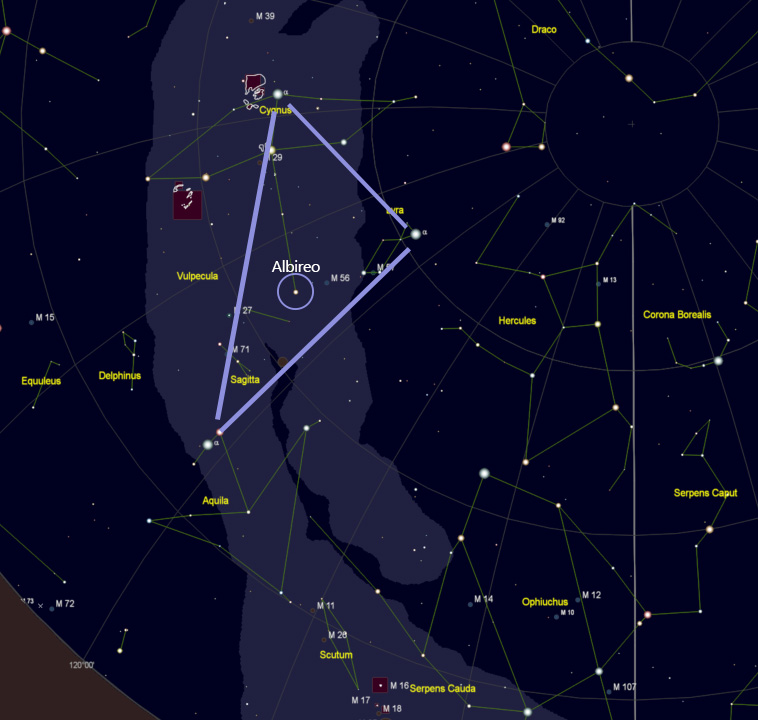
This familiar signpost is starting to rise higher in the eastern sky in June and will be with us for most of the rest of the year. It consists of the brightest stars in 3 constellations: Vega in Lyra, Deneb in Cygnus and Altair in Aquila.
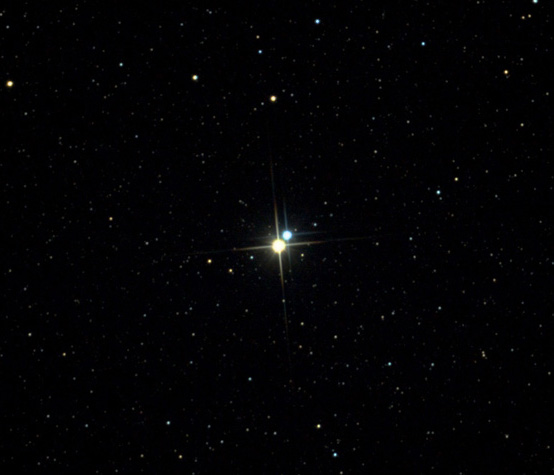
Many interesting targets lie within these 3 constellations and surrounding areas. Although twilight makes observing the fainter ones tricky, there are still brighter ones to see, such as the famous double star Albireo at the head of the swan.
Click on an item to expand for more information:

Showing for 15 June 2025
Mercury recently passed behind the Sun at superior solar conjunction.
21 Apr 2025 – Mercury at greatest elongation west
22 Jun 2025 – Mercury at highest altitude in evening sky
04 Jul 2025 – Mercury at greatest elongation east
19 Aug 2025 – Mercury at greatest elongation west
Venus is a morning object, having recently passed greatest elongation west.
31 May 2025 – Venus at greatest elongation west
19 Aug 2025 – Venus at highest altitude in morning sky
14 May 2026 – Venus at highest altitude in evening sky
14 Aug 2026 – Venus at greatest elongation east
Mars is an early evening object, now receding into evening twilight.
24 Feb 2025 – Mars ends retrograde motion
10 Jan 2027 – Mars enters retrograde motion
19 Feb 2027 – Mars at opposition
20 Feb 2027 – Mars at perigee
Jupiter will soon pass behind the Sun at solar conjunction.
04 Feb 2025 – Jupiter ends retrograde motion
11 Nov 2025 – Jupiter enters retrograde motion
10 Jan 2026 – Jupiter at opposition
11 Mar 2026 – Jupiter ends retrograde motion
Saturn is currently emerging from behind the Sun.
06 May 2025 – Equinox on Saturn
13 Jul 2025 – Saturn enters retrograde motion
21 Sep 2025 – Saturn at opposition
28 Nov 2025 – Saturn ends retrograde motion
Uranus recently passed behind the Sun at solar conjunction.
30 Jan 2025 – Uranus ends retrograde motion
06 Sep 2025 – Uranus enters retrograde motion
21 Nov 2025 – Uranus at opposition
04 Feb 2026 – Uranus ends retrograde motion
Neptune is currently emerging from behind the Sun.
07 Dec 2024 – Neptune ends retrograde motion
04 Jul 2025 – Neptune enters retrograde motion
23 Sep 2025 – Neptune at opposition
10 Dec 2025 – Neptune ends retrograde motion
Data from in-the-sky.org
| Comet name | Mag | Constellation | Separation from Sun | Trend | Absolute magnitude last updated |
| 217P/LINEAR | 12.4 | Cetus | 29° | Brightening | 30 Nov 2017 |
| 21P/Giacobini-Zinner | 12.9 | Taurus | 14° | Fading | 4 Feb 2019 |
| 65P/Gunn | 13.7 | Sagittarius | 139° | Brightening | 1 Aug 2017 |
| C/2023 A3 (Tsuchinshan-ATLAS) | 13.8 | Vulpecula | 106° | Fading | 3 Dec 2024 |
| C/2021 G2 (ATLAS) | 13.9 | Libra | 160° | Fading | 4 Apr 2024 |
| 48P/Johnson | 13.9 | Cetus | 44° | Fading | 31 Oct 2018 |
| C/2024 G3 (ATLAS) | 14.1 | Eridanus | 75° | Fading | 3 Mar 2025 |
| 12P/Pons-Brooks | 14.6 | Norma | 150° | Fading – in outburst | 3 Oct 2024 |
| C/2022 E2 (ATLAS) | 14.6 | Perseus | 38° | Fading | 3 Mar 2025 |
| 47P/Ashbrook-Jackson | 14.7 | Aquarius | 83° | Brightening | 29 Feb 2012 |
| 240P/NEAT | 14.7 | Cetus | 48° | Brightening | 1 Mar 2018 |
| C/2023 C2 (ATLAS) | 14.9 | Pegasus | 62° | Brightening | 5 Sep 2024 |
| C/2022 N2 (PANSTARRS) | 15.1 | Aries | 32° | Brightening | 3 Dec 2024 |
| 60P/Tsuchinshan | 15.2 | Taurus | 18° | Brightening | 3 Oct 2020 |
| C/2017 K2 (PANSTARRS) | 15.4 | Taurus | 23° | Fading | 2 Dec 2023 |
| 69P/Taylor | 15.6 | Aquarius | 79° | Brightening | Unknown |
| 43P/Wolf-Harrington | 16.0 | Taurus | 16° | Brightening | 4 Dec 2018 |
| 168P/Hergenrother | 16.1 | Lupus | 152° | Brightening | 15 Jan 2013 |
| 78P/Gehrels | 16.1 | Aquarius | 112° | Brightening | 30 Sep 2020 |
| C/2021 S3 (PANSTARRS) | 16.1 | Andromeda | 59° | Fading | 1 May 2024 |
| C/2024 E1 (Wierzchos) | 16.2 | Draco | 98° | Brightening | 1 Feb 2025 |
| 88P/Howell | 16.4 | Leo | 89° | Brightening | 1 Apr 2018 |
| 32P/ComasSola | 16.6 | Virgo | 142° | Fading | 14 Sep 2017 |
| 110P/Hartley | 16.7 | Sagittarius | 133° | Brightening | 29 Feb 2012 |
| 67P/Churyumov-Gerasimenko | 16.7 | Scorpius | 177° | Brightening | 1 Apr 2018 |
No major showers this month.
The Daytime Arietid meteor shower will be active from 14 April to 24 June, producing its peak rate of meteors around 10 June.
The June Bootid meteor shower will be active from 22 June to 2 July, producing its peak rate of meteors around 27 June.
The parent body responsible for creating the June Bootid shower has been identified as comet 7P/Pons-Winnecke.
| Date | Age of Moon | Sun | Moon | ||||||||
| Rise | Culm | Set | Constellation | Rise | Culm | Set | Constellation | ||||
| 2025 | Jun | 01 | 05 days | 04:32 | 13:09 | 21:46 | Taurus | 10:23 | 18:21 | 01:45 | Cancer |
| 2025 | Jun | 08 | 12 days | 04:26 | 13:10 | 21:54 | Taurus | 19:39 | 23:13 | 02:27 | Libra |
| 2025 | Jun | 15 | 19 days | 04:23 | 13:11 | 22:00 | Taurus | 00:55 | 04:25 | 08:05 | Capricornus |
| 2025 | Jun | 22 | 26 days | 04:23 | 13:13 | 22:02 | Gemini | 01:51 | 10:09 | 18:56 | Aries |
| 2025 | Jul | 01 | 06 days | 04:28 | 13:15 | 22:01 | Gemini | 12:07 | 18:22 | 00:15 | Leo |

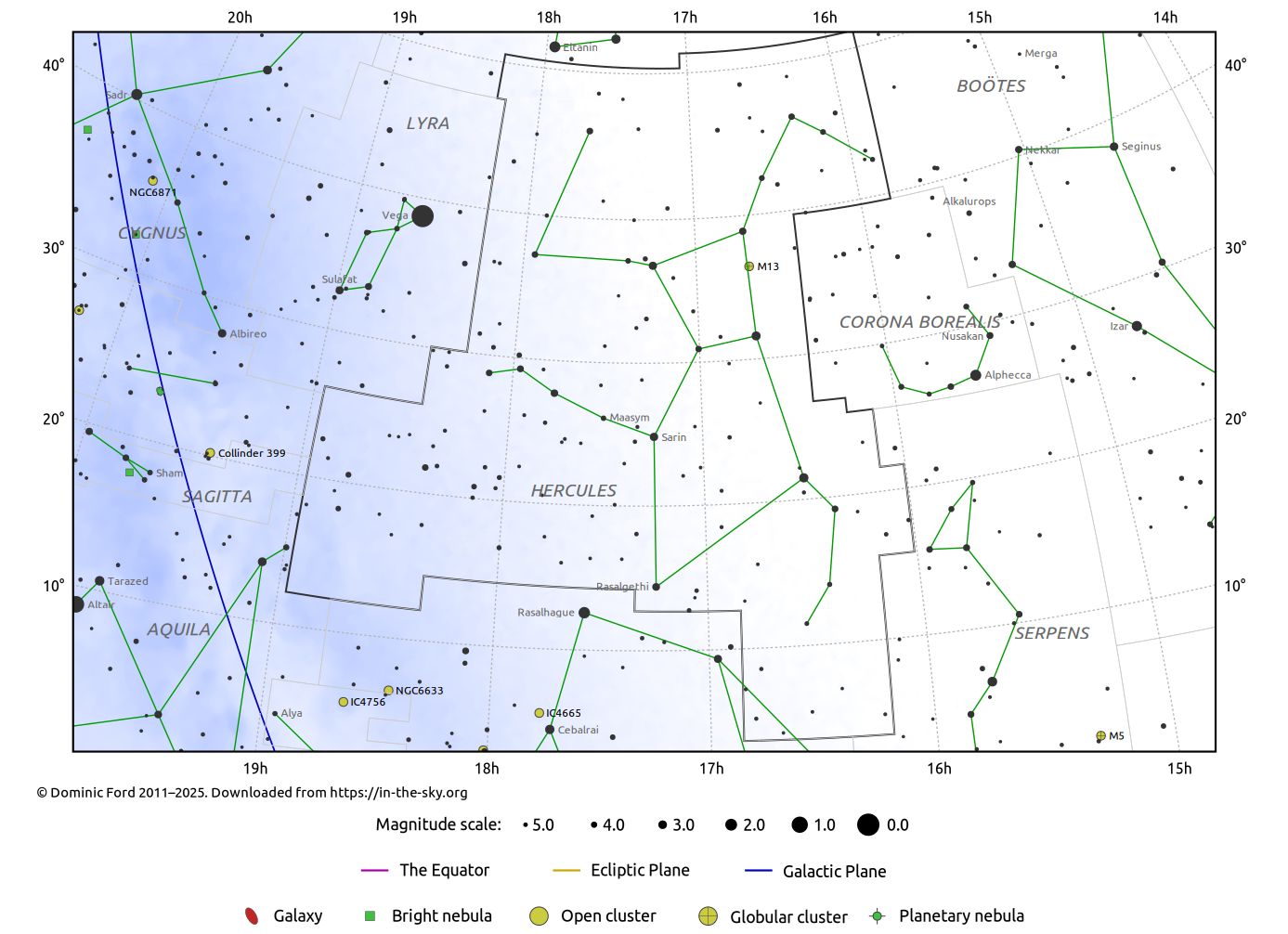
Hercules is a large northern constellation, culminating at midnight in May. It has the fifth largest area of all the constellations.
Despite this, it covers a rather dark area of the sky and has only two stars brighter than third magnitude. It is best known for its deep sky offerings, which include M13, often known as the ‘Great Globular Cluster in Hercules’. M13 is the brightest globular cluster to lie at a high northern declination.
It is also home to another bright globular cluster, M92, as well as the much fainter cluster NGC 6229.
| Stars | Open Clusters | Globular Clusters | Galaxies |
| Kornephoros (mag 2.8) | NGC 6659 | Messier 13 (mag 5.8) | NGC 6482 (mag 11.3) |
| ζ-Her (mag 2.9) | Messier 92 (mag 6.5) | NGC 6207 (mag 11.6) | |
| Sarin (mag 3.1) | NGC 6229 (mag 9.9) | NGC 6548 (mag 11.7) | |
| π-Her (mag 3.1) | NGC 6658 (mag 11.8) | ||
| Rasalgethi (mag 3.3) | NGC 6181 (mag 11.8) | ||
| μ-Her (mag 3.4) | NGC 6166 (mag 11.9) | ||
| η-Her (mag 3.5) | NGC 6574 (mag 12.0) | ||
| ξ-Her (mag 3.7) | NGC 6487 (mag 12.0) | ||
| γ-Her (mag 3.7) | NGC 6674 (mag 12.1) | ||
| ι-Her (mag 3.8) | NGC 6389 (mag 12.1) | ||
| O-Her (mag 3.8) | NGC 6587 (mag 12.1) | ||
| θ-Her (mag 3.8) | NGC 6173 (mag 12.1) | ||
| 109-Her (mag 3.9) | NGC 6632 (mag 12.2) | ||
| τ-Her (mag 3.9) | NGC 6106 (mag 12.2) | ||
| ε-Her (mag 3.9) | NGC 6501 (mag 12.3) | ||
| σ-Her (mag 4.2) | NGC 6269 (mag 12.3) | ||
| 110-Her (mag 4.2) | NGC 6660 (mag 12.4) | ||
| φ-Her (mag 4.2) | NGC 6555 (mag 12.4) | ||
| 102-Her (mag 4.3) | NGC 6239 (mag 12.4) | ||
| 111-Her (mag 4.3) | NGC 6146 (mag 12.5) | ||
| Maasym (mag 4.4) | NGC 6500 (mag 12.5) | ||
| ν-Her (mag 4.4) | NGC 6577 (mag 12.7) | ||
| HIP 85112 (mag 4.5) | NGC 6599 (mag 12.8) | ||
| ρ-Her (mag 4.5) | IC 1269 (mag 12.8) | ||
| ω-Her (mag 4.6) | NGC 6255 (mag 12.9) | ||
| 113-Her (mag 4.6) | NGC 6379 (mag 12.9) | ||
| χ-Her (mag 4.6) | NGC 6196 (mag 12.9) | ||
| e-Her (mag 4.6) | NGC 6372 (mag 12.9) | ||
| 93-Her (mag 4.7) | NGC 6030 (mag 12.9) | ||
| υ-Her (mag 4.7) | NGC 6447 (mag 13.0) |
Use the chevrons to choose the month:
Much of the material is provided with thanks to Dominic Ford on his excellent site in-the-sky.org.