


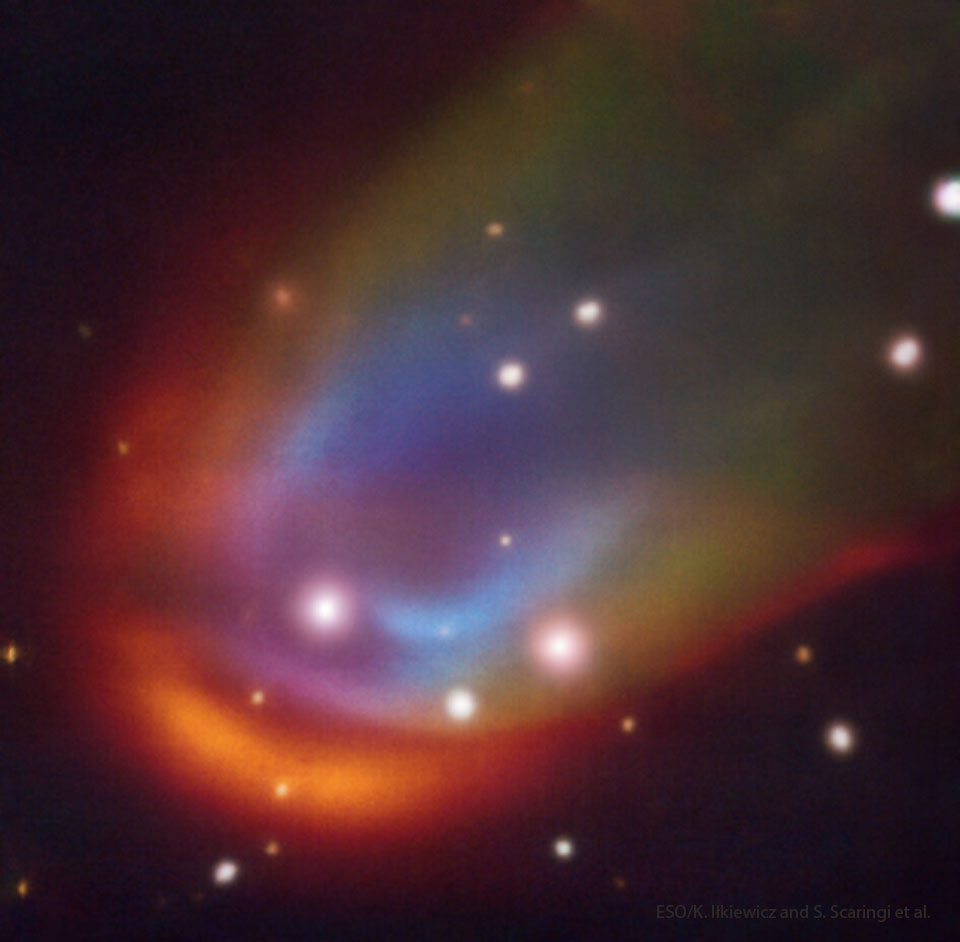
Binary Stars and Stellar Cannibalism
20 March @ 7:30 pm - 9:00 pm GMT
Talk by Dr. Noel Castro Segura, Astrophysicist & Research Fellow, University of Warwick.
Stars are the building blocks of the universe. The majority of the stars in our galaxy spend their lives associated with a stellar companion, bound by the gravitational pull between them. The population of so-called binary stars encompasses up to 80% of the stars in the galaxy, and approximately half of these systems have an orbital period short enough to induce mass transfer between the two celestial objects at some point in their evolution.
Many of these interacting binaries contain a compact stellar remnant, which accretes material stripped from the surface of its companion star, thus providing an ideal laboratory to study physical bodies with extreme gravity such as white dwarfs and neutron stars. Furthermore, they offer a unique opportunity to infer the presence of one of the most exotic objects in the universe: black holes. This allows us to learn how they interact with their environment while shaping the universe we observe.
Here, I will review the basics of binary evolution and provide an overview of the phenomena observed in these systems. Additionally, I will highlight how amateur astronomers and citizen scientists can contribute to advancing science.
Dr. Noel Castro Segura
I am an astrophysicist specializing in compact objects and time domain astronomy at the University of Warwick. My research focuses on understanding the fundamental processes of accretion and outflows in neutron stars and black holes.
My work combines multi-wavelength observational astronomy with theoretical modeling to explore some of the most extreme environments in the universe. I am particularly interested in how matter behaves under the extreme gravitational fields of compact objects.
Current research interests include X-ray binary systems, accretion disc winds, neutron star binaries, and the development of high-speed optical instrumentation for time-resolved astronomy. I am actively involved in the development of OPTICAM, a triple-camera optical system designed to explore the fastest timescales in astronomy.
I contribute to international collaborations and use data from space-based missions as well as ground-based telescopes to study the rapid variability and outflow phenomena in accreting compact objects.
Image Credit: ESO, K. Iłkiewicz & S. Scaringiet al.