


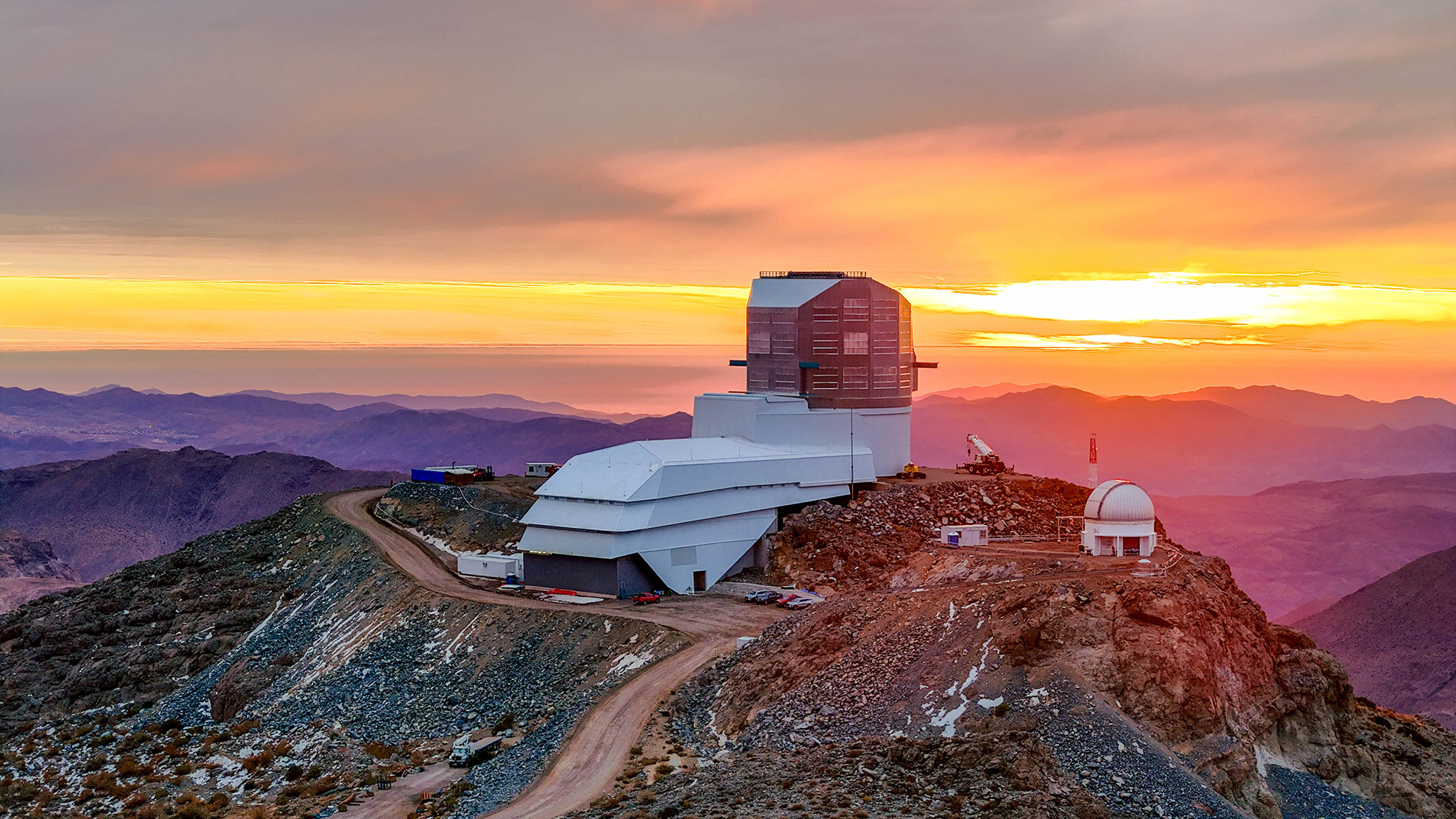
The Vera C. Rubin Observatory and the Legacy Survey of Space and Time
20 September 2024 @ 7:30 pm - 9:00 pm BST
Talk by: Prof Stephen Smartt CBE FRS
For the first time is in history, we can survey the whole visible sky multiple times every 24hrs and process the data in real time to find everything that moves, changes or flashes. A combination of wide-field, small aperture telescopes around the globe make this possible reaching about 19 – 20 mag on a nightly basis. Large CCD detectors and fast, affordable computing and storage make this possible. The field is about to be revolutionised with the Rubin Observatory and its Legacy Survey of Space and Time (LSST). This 8-metre telescope in the Chilean Atacama desert is specially designed as a survey facility with the larges camera ever built covering 10 square degrees. The telescope has the ability to map the whole southern sky every night, reaching 100 times deeper than current surveys. I will present an overview of the observatory and its capabilities and an outlook toward the future operations. I will review some of the science in my own field of time domain survey astronomy including supernovae, kilonovae, mergers and transients.
Prof Stephen Smartt CBE FRS is the Wetton Professor of astrophysics at the University of Oxford and Christ Church college. He works on understanding the most energetic explosions in the Universe. He leads several major telescope survey projects which scan the sky on a nightly basis, searching for transient, explosive, and moving objects. Stephen is known for determining which stars explode as supernovae and he discovered many new explosive phenomena in the Universe. He led one of the teams to discover the source of gravitational waves in 2017, when the merger of two neutron stars produced a glowing remnant powered by radioactive heavy elements.
Stephen has won several major awards including both the George Darwin lecture (2018) and the Herschel Medal of the Royal Astronomical Society (2021). He was a recipient of the Gold medal of the Royal Irish Academy (2018) and elected as a Fellow of the Royal Society in 2020 He is passionate about engaging with the public about science, having given many public and schools lectures, and has been acontributor to BBC radio, TV and online news stories.
Career : Graduated from Queen’s University Belfast with a BSc in Physics and Applied Mathematics followed by a PhD in astrophysics (1996). He worked on La Palma in the Canary Islands at the UK’s Isaac Newton Group of Telescopes and then was at the University of Cambridge for 5 years. He moved to a lectureship at Queen’ in 2004, was appointed to Professor in at in 2006 and was director of the Astrophysics Research Centre between 2011-2017. In 2023 he moved to the University of Oxford to take up the Wetton professorship in astrophysics.