

I Coming of Age: Early days to 1945
At a meeting in October 1933, the President, J.C. Johnston, noted with pleasure – even some relief – that the Edinburgh Astronomical Association had survived into a tenth season of activities. Only a few years afterwards, as we’ll see, he might have been still more cheerful – able to point to outstanding recent successes, and a much more secure financial position. Nevertheless, there was good reason to look back with satisfaction on the first years of the Association (later renamed the Astronomical Society of Edinburgh). Established in 1924, it had drawn on the success of a series of lectures delivered to the WEA – the Workers’ Educational Association, which had been offering free Adult Education in Edinburgh since 1912. The lecturer was R.A. Sampson, Professor of Astronomy in the University of Edinburgh and Astronomer Royal for Scotland from 1910 to 1937. In the years following the Great War, he was a world authority on stellar temperatures and on astronomical chronometry: a crater on the Moon was later named in his honour.

The old 22-inch refractor which until the 1920s stood in the City Dome. The figure in the background is probably Sir William Peck, the City Astronomer. Astronomical Society of Edinburgh archives.
Following his lecture series, a small committee developed plans for an Association which could continue involving the public in astronomy, and a first meeting was held on 15 October 1924, in the Royal Society of Arts Hall in George Street. The meeting immediately accepted the committee’s recommendation for a structure of office bearers – one which remains largely in place at the present day: Honorary President(s), President, Vice-Presidents, Secretary, Treasurer, and several members elected to a governing Council. Astronomers Royal for Scotland and Edinburgh University’s Regius Professors of Astronomy have generally served as Honorary Presidents. In 1924, R.A. Sampson was unanimously chosen for this office, along with Sir William Peck, who had been Director of the City Observatory on Calton Hill since 1889. Peck’s colourful early career had included working in Robert Cox’s Gorgie glue-factory, then steadily expanding his astronomical knowledge while running Cox’s private observatory in Murrayfield. Peck also found time in 1898 to establish the Madelvic Motor Carriage Company, manufacturing electric cars, and to join the Hermetic Order of the Golden Dawn, the Masons, and the Theosophical Society — perhaps extending the kind of esoteric interests in pyramidology followed by an earlier Astronomer Royal, Charles Piazzi Smith. Sharing arcane involvements in magic, metaphysics, alchemy, and astrology — for which Peck’s knowledge of positional astronomy might have been especially useful — other members of the Golden Dawn included the poet W.B. Yeats and Bram Stoker, author of Dracula (1897).
Peck’s assistant in the City Observatory, during the early 1920s, was J. McDougall Field, installed in 1924 as the Astronomical Association’s first President. Though often obliged to miss meetings due to evening duties on Calton Hill, Field continued to work for the Association for many years – as Secretary from 1927 to 1930, and as a Council member thereafter. He occasionally urged members towards greater involvement in observation, also recommending to them at least some ‘slight knowledge of higher mathematics’.

Rev Dr Hector Macpherson. Wikipedia, Public Domain.
How did the Association develop, and what were its early meetings like? After the first of them, featuring a lecture by one of the Vice-Presidents, Rev Dr Hector Macpherson – appropriately enough, about ‘Pioneers in Astronomical Science’ – meetings took place in the Royal Scottish Geographical Society’s premises in Synod Hall, on Castle Terrace; roughly on the site now occupied by the Traverse Theatre. They were usually scheduled for the third Monday of each month, from October to April, following a format which might still seem familiar to members in the twenty-first century. Lectures, followed by questions and discussion, were usually illustrated by ‘lantern slides’ – an early form of slide-projection, popular until more sophisticated apparatus developed in the 1950s. Lecturers were often congratulated on their use of this visual aid – Dr Macpherson, for example, was complimented on the ‘beautiful slides’ he used for that first-ever talk in 1924. Alongside a growing library of astronomy books – established by the early 1930s, mostly from donations – the Association gradually acquired a substantial collection of these lantern slides: as many as 700 of them, after some purchases later in the 1930s.
Lecturers included Association members, as well as experts or professional astronomers based in Edinburgh, or within easy reach of the city. Topics in the 1920s and 1930s were often of general interest, including accounts of comets, the Sun, the tides, Earthshine, the spectrum, the history of the telescope, asteroids, etc. Some were more Edinburgh- or Scottish-specific: ’Astronomy in a Bad Climate’, for example – not bad enough, the lecturer reckoned, to eliminate observation of comets and nebulae – or an account of mapping the Moon which noted the eleven Scotsmen commemorated in the naming of its features. Some, too, were probably quite demanding: McDougall Field, for example, explaining in 1934 the complex observations and mathematics required to trace the sun’s motion through space. R.A. Sampson may have been similarly challenging, also in 1934, when explaining the importance of Cepheid Variables in establishing stellar distances, or – a couple of years earlier – the extremely exact chronometry and longitude-calculation required to define the direction and extent of continental drift.
Seldom recorded at much length in the archives, details of these and other lectures are all the more absorbing when they can be found, as they highlight so clearly the state of astronomical and other sciences in the 1920s and 1930s. Theories of continental drift, for example, were far from fully verified or accepted at the time. ‘Notes on the Asteroids’, in 1933, mentioned that one of these bodies might come within 3.5 million miles of the Earth, but expressed very little of the twenty-first century’s concerns about nearer misses or collisions, and none of its views about the demise of the dinosaurs. A lecture on ‘Observatories of the New World’ still recorded the 100-inch Hooker reflector on Mount Wilson as ‘the greatest telescope in the world’, though plans for Mount Palomar were described at a later meeting, in 1937. Another, on ‘The Mapping of Mars’, discussed observations of canals and identified ‘seasonal changes which suggest vegetation’, implying the existence of ‘life in other forms’. For Rev. E. McD. Ross, lecturing in 1933 on ‘The Expansion of the Universe’, Relativity and the work of Edwin Hubble and Arthur Eddington offered ideas still new and barely-accepted, including the suggestion of ‘the existence of countless worlds like our own’.
As well as highlighting limits in current understanding of the heavens, records of meetings in the 1920s and 1930s regularly reveal the vicissitudes of contemporary life on earth. Reverend Ross, for example, was unable to answer many questions about the recession of the galaxies, as he had to recede rapidly himself, to catch the last train back home to Fife. Other speakers likewise had to abandon question-sessions and gallop off for a last departure to Glasgow. In those days, this was timetabled at 9.55 pm, though – after affiliation with the British Astronomical Association (BAA) in 1932, and adoption of its 24-hour clock two years later – the Edinburgh Association may have preferred to think of this as 21.55.

Astronomical Society of Edinburgh archives.
It would definitely have preferred a more secure financial position, in the early 1930s, as Minutes of its planning meetings often indicate. Though the expenses of lecturers from Glasgow or Fife seemed manageable, bringing an expert from Aberdeen was reckoned a speaker too far. Careful consideration was even given to the expenditure of 7/- (35p), required for setting up and printing the Association’s logo. This was designed by the Secretary, N.G Matthew, in 1934, and remans in use at the present day, though it was amended when the Association changed its name to the Astronomical Society of Edinburgh, and slightly redrafted again in 1994 and 2007. It became available as a lapel badge from 1961. Greater financial security seemed achievable principally through expanding the membership to bring in more annual subscriptions: set in 1924 at 2/6, these rose to 5/- two years later (12.5p, 25p), remaining at that level until 1949. This strategy entailed financial difficulties of its own, though. A front-page advertisement in The Scotsman, costing £3 in 1933, was reckoned too dear, and direct approaches to the WEA and the University were tried instead. Exact membership numbers are hard to ascertain, but probably remained between 50 and 70 around that time, with attendance at meetings sometimes falling to 20 or fewer.

Lorimer, John Henry; Sunlight in the South Room, Kellie; The National Trust for Scotland, Kellie Castle & Garden; http://www.artuk.org/artworks/sunlight-in-the-south-room-kellie-196969
All that changed at the end of 1936, when the Association’s fortunes were suddenly improved spectacularly – literally, by a fortune – following the death of J. H. Lorimer. A distinguished Scottish artist, Lorimer had exhibited at the Royal Scottish Academy and the Royal Academy (London), as well as internationally, in Paris, Australia and New Zealand: a retrospective of his work ran at the City Art Centre in Edinburgh in the Spring of 2022. He had been a Vice-President of the Astronomical Association in the early 1930s, and remained a much-respected member: his death was marked by a minute’s silence at a meeting shortly afterwards, on 5 November 1936. Three weeks later, the Association learned that he had bequeathed to it most of his considerable fortune – paintings, investments, and properties in Pittenweem and Edinburgh. When complicated legal processes were complete, and death duties paid, this legacy was valued at around £25,000, reckoned to promise an annual income of £750. Though difficult to translate exactly into twenty-first century values, this was a very generous bequest. It might help to note that the annual subscription to the Association, in 1937, still remained at 5/- (25p). £3m might not be an over-estimated equivalent, in 2020s terms, for Lorimer’s legacy.
The Edinburgh Astronomical Association, in other words – renamed the Astronomical Society of Edinburgh (ASE), evidently at Lorimer’s suggestion – ceased to be a modest star in the capital’s firmament, emerging instead as a brightening supernova. Rather than worrying about a shortage of members, the Council began to fear there might soon be too many, instituting a process of proposal and seconding for anyone who wanted to join. Various sub-committees discussed how Lorimer’s bequest might best be used to serve the Society’s growing membership, and the wider public, and soon developed new possibilities for doing so. Office-bearers were paid honoraria for their work for the Society, a practice continued for many years. By the mid-1970s, the Secretary was receiving £175 per annum, the Treasurer £125, and the Observatory Director £200: remuneration was eventually withdrawn in 1997. The library was quickly enlarged, incorporating new purchases alongside donations from J McDougall Field, and installed in the Synod Hall. This was reckoned a great improvement on the earlier housing of books in the Reference Room of the Public Library on George IV Bridge, considered – rather strangely – to be ‘away from main lines of traffic and hard to access’. As well as offering library space, the room rented from the Royal Scottish Geographical Society offered the Society a venue for meetings and a kind of permanent headquarters. One of the properties Lorimer had bequeathed, in Drummond Place, had been considered unsuitable for this purpose and sold instead. The new arrangements allowed members to browse the shelves, in the Society’s own premises, and to chat at their leisure after the conclusion of meetings.
The Astronomical Society of Edinburgh…
ceased to be a modest star in the capital’s firmament,
emerging instead as a brightening supernova!
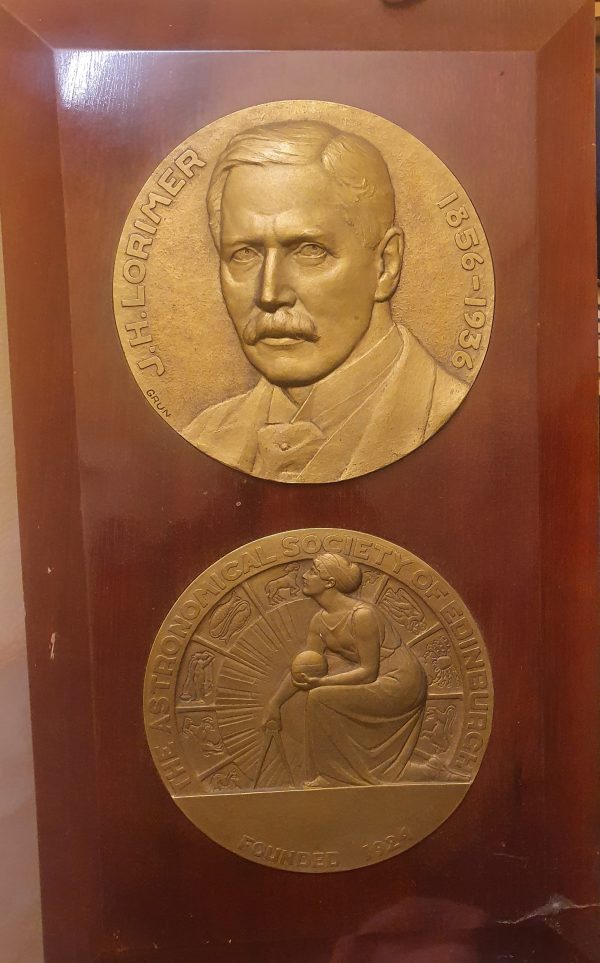
Lorimer Medal plaque. Astronomical Society of Edinburgh archives.
Plans were also soon in place to pay the speakers addressing these meetings – a fee of around £2 – and to consider including among them more ‘gentlemen of great eminence in the Science of Astronomy’. In particular, the Society planned to institute a Lorimer Medal to reward such ‘gentlemen’ for their work in astronomy, and to establish a ‘Lorimer Lecture’, with Sir James Jeans as the first speaker, and first recipient of the Medal. Author of numerous popular expositions, such as The Universe Around Us (1929) and The Mysterious Universe (1930), Jeans was the most celebrated astronomer of his day: a kind of 1930s Brian Cox, perhaps, or prototype Patrick Moore.

James Hopwood Jeans. Wikipedia, Public Domain
On 7 October 1938, he lectured on ‘The Depths of Space’, discussing aspects of the universe ‘only recently . . . thrown open to exploration’ – principally the distant galaxies – and pondering whether ‘space is finite or infinite . . . curved or flat’. Illustrated with the usual lantern slides, and illumined by Jeans’s trademark talent for communicating the nearly-inconceivable size and strangeness of the universe through adroit models and analogies, his lecture entertained a packed audience of over 2000 in the Usher Hall, with many more turned away. The sale of tickets, priced at 3/-, 2/- and 1/- (15p, 10p and 5p) – schoolchildren were admitted free – contributed handily to the Society’s coffers. New resources allowed Society members to deliver further lectures to students at Newbattle Abbey, to classes of schoolchildren, and to members of the public interested in acquiring a beginner’s introduction to astronomy.
In addition to his hugely popular lecture, Jeans undertook another duty in Edinburgh, earlier that October day: the formal reopening, in the presence of the Lord Provost, of the City Observatory on Calton Hill. Facilitated by Lorimer funds, its role in the Society’s affairs was both immediate and far-reaching in its consequences. In the 1920s and early 1930s, the ASE had probably been more of a learned society than a practical one, despite some visits to observatories, occasional chiding by McDougall Field, and a few reports at meetings of members’ recent observations. Significantly, it was only in 1935 that a proposal was first made – incidentally, by one of rather few women members of the Society – for the provision of a monthly diary of ‘notable astronomical events’. No-one volunteered to produce one – reminding us how lucky we are to have Alan Pickup and others recently undertaking this task – though arrangements were later made, by the early 1940s, to reprint the monthly astronomy article from The Scotsman for distribution to members.

City Observatory probably from the Scotsman newspaper
By that time, increased emphases on practical astronomy and observation were already much in evidence in the Society’s activities, centred around its growing involvement with the City Observatory, and resuming some long-standing connections with its work. Since 1896, when Calton Hill was handed over to the Town Council – following the Royal Observatory’s relocation to Blackford Hill – it had broadly shared the ASE’s aims of fostering local interest and research in astronomy, as well as many of the individuals involved in implementing them. This was in a way a natural or historical congruence. The City Observatory was established in its modern form, in 1811, by the Edinburgh Astronomical Institution, a group of landed gentry and nobles, along with university professors and other members of the professional classes. The group may have been more affluent or aristocratic than the founders of the Edinburgh Astronomical Association, a century or so later, but broadly similar in aims and enthusiasms – mostly amateur – for the night sky. At any rate, following the death of J. McDougall Field in 1937 – he had taken over from Sir William Peck as Director of the Observatory in 1925 – it seemed appropriate that the ASE should be more directly involved in its running. Within a year, it had agreed with the Town Council (referred to hereafter as ‘the City’) that in due course – following some repairs and renovation – it would take over the Observatory’s lease.

Cooke 6 inch photovisual refractor. Astronomical Society of Edinburgh archives
Improvements were undertaken mostly with funding from the City, though with help from the Society’s Lorimer-enhanced coffers, which allowed as much as £325 to be devoted annually to the Observatory. The ASE’s four-inch Cooke refractor was moved to Calton Hill, and the Observatory cleaned, repainted, and heated. Instruments and clocks were examined and restored, and a new Director appointed. The drive for the Crawford ten-inch telescope was eventually refurbished, an observing chair purchased, and some apparatus tentatively introduced for astrophotography – a plateholder, and a dark-room in the old Transit House, were available by 1939. The main dome was converted into a lecture theatre, with extensive seating, and beginners’ classes in astronomy began to be held there by mid-1938, along with meetings of the Society’s governing Council – sometimes of the full Society. By the end of the year, over 2000 members of the public had applied to visit and view the telescopes and instruments, or use them. Within the Society itself, moves towards observation and practical astronomy were further encouraged by establishing special-interest sections, in liaison with the BAA. These were devoted to work on Variable Stars, on the Moon and Planets, on Aurorae and Meteors, and on the development of the instruments and telescopes themselves.
The ASE’s Annual Report for 1938 thus had good reason to conclude that:
- the year has been the most interesting and successful in the Society’s history
- the progress of the Society has been satisfactory in every way
- and the scope of its activities has been widened considerably.

The library at Calton Hill showing Lorimer paintings and bust, Banks transit table. Astronomical Society of Edinburgh archives
Equipped with a useful library; a refurbished observatory; groups of dedicated observers; popular support and successful outreach – along with financial security, even affluence – the ASE could hardly have done more, by late 1938, to fulfil its aims and satisfy its membership. It looked set to continue doing so, too. Plans were in place, early in 1939, for an annual dinner, another big public lecture, further beginners’ and other classes, and an exhibit or planetarium in the Royal Scottish Museum, Chambers Street. Pictures, diagrams, models and a case of meteorites were eventually installed there, and an exhibit – maintained until 1973 – of a barometer, barograph and star-maps was set up at Register House.. The Society even began confidently to reach out towards the USA, financing a trip there by its long-standing Treasurer (1937-72), J. Gibson Kerr – much involved in legal work on the Lorimer bequest, and later also ASE Secretary (1941-65) as well as briefly a Director of the Calton Hill Observatory. He returned from this trip – the first of several – to report that he had secured the Director of the Mount Wilson Observatory and other notable professors, apparently including Albert Einstein, as future lecturers for the Society.
Yet few of its members, by early 1939, could have reckoned the skies ahead entirely cloudless and star-studded. ‘The wonder-making magnificence of the celestial sphere’, highlighted during Sir James Jeans visit to Edinburgh, contrasted particularly sharply, as a contemporary newspaper commented, with ‘a period of particular turmoil on our tiny earth’. The ASE’s Secretary had been obliged to report at the time that delivery of Jeans’s Lorimer Medal had been delayed by ‘the European crisis’. Featuring a likeness of Lorimer on one side, and of the Zodiac and the muse of astronomy on the other, it had to be manufactured from a die kept in Paris. Jeans graciously accepted a mere token in the Usher Hall, acquiring his actual medal several weeks afterwards, in December 1938.
By the following September, turmoil and European crisis had deteriorated into the Second World War. A few days after its outbreak, on 6 September 1939, the ‘new situation created by the war’ obliged the Society’s Council to establish an Emergency Committee. It was soon considering cancelling all planned lectures, worrying about precious lenses and instruments in the City Observatory, and wondering what could be done to facilitate access to it. Fear of air-raids plunged British cities into nightly blackouts which allowed wonderful views of celestial objects – almost for the first time, for some city-dwellers – but made for hazardous journeys, even on foot, not least on the steep paths of Calton Hill.

Crater Gassendi – from the Astronomical Society of Edinburgh archives
Yet despite many problems during the war, the Society largely maintained its membership – more numerous than ever by 1940 – and many of its established activities, adapting wherever possible to the challenges of the times. The difficulty of accessing the Observatory in the blackout was partly avoided by the purchase of several small telescopes, distributed to members for their use at home. The Observing Sections set up in 1938 mostly managed to continue their work. Though the Variable Star group had to curtail its activities, successful photographs were produced by observers of Aurorae and Meteors, while the Lunar and Planetary group also continued its observations, particularly focused on the crater Gassendi.
Difficulties getting around during the blackout were also avoided by rescheduling meetings for mid-afternoon on a Saturday. These sessions even took a step forward from their pre-war format, with a film – of solar prominences – included for the first time at a meeting later in 1939. Further film sessions followed in 1940 and later, and the Society soon agreed to purchase a cine projector and to match its extensive collection of lantern slides with a library of astronomical films – although, unfortunately, none of these could be imported from the USA during the war. Nor could any of the stellar speakers Gibson Kerr had promised after his first trip to the States in 1939. Instead, after a hiatus in 1940, more modest lectures were delivered throughout the war years, on a wide range of topics including the Moon, the planets, Halley’s Comet, ‘The Value of Astronomy to Society’, the beginnings and end of the universe, and the early history of the Observatory itself.
By June 1940, much of its more valuable equipment had been dismantled and safely stored away, though the 6-inch Cooke photovisual telescope continued in use. The Observatory continued to appeal to the public, too, sometimes even reaching new sections of it. A series of Observatory meetings for schoolboys, in 1940, proved particularly successful. Helped by the military’s education officers, Society members also went out to lecture to the armed forces, ‘over a considerable area of East Scotland’, sometimes dispensing copies of the Scotsman’s monthly astronomy articles and star-maps. These had quickly become popular with ASE members, continuing to be distributed until 1950 – when the ASE acquired a duplicating machine and replaced them for some years with its own material. They were also offered to visitors to Calton Hill. By 1941, these visitors often included RAF cadet officers, probably attracted by the chance to improve their skills in astral navigation. There were also plans for an RAF officer to deliver a lecture to the Society, explaining the techniques involved. Intriguingly, too, ASE Minutes mention ‘the co-operation of members of the Society with the Royal Air Force in connection with secret work’, also noting approaches from a Government Department, regarding ‘special war work’.
Likewise intriguingly, a Minute in January1945 records that ‘the Home Guard had removed their explosives from the Observatory but that certain trenches which they had dug had not yet been filled in’. Evidently, wartime risks on Calton Hill were not confined to the effects of the blackout. By early 1945, though, the war was almost over. Meetings were once again scheduled for evenings. Arrangements for a fire-watch at the Observatory, in place since 1941, had already been suspended. The Society even began planning how to celebrate its ‘Coming of Age’ – its 21st Anniversary – in October 1945. The tentative nature of the plans involved, though, and their eventual outcome – or rather lack of one – exemplify pressures endured during the war years and often in those following. New or ambitious initiatives suggested at the time almost invariably had to be deferred. Plans for a second Lorimer lecture, for example, were soon shelved, the projected Junior Astronomy Club for schoolboys never inaugurated, and even fairly modest proposals for publications curtailed by ‘difficulties with printing and paper’. Though it was eventually decided that the Society’s 21st anniversary should be celebrated by a private, members-only dinner, it does not seem ever to have taken place. This may have been inevitable, or just as well, in the conditions of shortage and rationing prevailing at the time. Early in 1946, even the suggestion that tea might be served at meetings was deferred until ‘the labour and food position became easier’. The Society had found its way through the war years, but towards a time of austerity which might have made the expansion and successes of the late 1930s seem remote.
II Into the Space Age: 1945-1970
Post-War
The Society nevertheless embarked on a period of repair and restitution – shared with the country more generally – during the years following the war. The spirit of those times contributed to the establishment of the Edinburgh Festival in 1947, intended to restore international understanding and the benign influence of the arts. As the Society opened the Observatory specifically to attract visitors at the new Festival, in the summer of 1947, it might have some claim to a foundational role in what was soon a world-famous institution. By the early 1950s, several hundred visitors were turning up during the Festival for special ‘late observing’ evenings and ‘open nights’, and these late-summer sessions remained popular throughout the decade and well beyond. 1000 visitors turned up in 1981, for example, with comparable numbers later in the 1980s
By the winter of 1947-8, the Observatory was also open again, on Friday evenings, and at other times by arrangement, for the use of members and sometimes their children. The observing groups established before the war continued their work, slightly reshuffled. There were sections now on the Moon and the Planets, sometimes working separately, and on Transit and Time, with a further photographic section, also graduating to work in photometry. By October 1948, the Lorimer Lecture and Medal-award had been reinstituted – Martin Davidson, author of several popular books on astronomy, lecturing on comets in the Central Hall, Tollcross. Davidson was Vice-President of the Royal Astronomical Society (RAS), whose members were invited to the lecture: attendees included Fred Hoyle, establishing himself at the time as a leading theorist in astrophysics. The occasion was the first in the RAS’s 128-year history that it had met officially outside London – though the lecture itself seems to have been less popular than Sir James Jeans’s, incurring a loss of £75. Undaunted, the Society committed itself shortly afterwards, at last, to an anniversary dinner — marking not its coming of age, but its ‘Semi-Jubilee’, in 1949. Membership stood at around 130 at the time: 43 of these members enjoyed an evening in the Roxburghe Hotel, in January 1950, at a cost of 12/6 (62.5p) each, ‘exclusive of wines’.
Regular ASE meetings also resumed in 1947. Held five or six times annually, they explored a wide range of topics – often representative, once again, of current developments in the field and in the techniques of astronomical research. A lecture on radio astronomy, and another on cosmic radio noise, for example, figured in the programmes for 1950 and 1952, reflecting rapid advances in this area, following wartime development of radar. Programmes usually included at least one film night annually, and from around 1950, some summer meetings in the Observatory, to hear papers from Society members – a practice maintained in later years. There were also visits to the Royal Observatory, in 1948, the Glasgow Observatory, in 1951, and the Mills Observatory in Dundee in 1950. Specifically set up as a public observatory, the Dundee institution was an especially appropriate destination for an ASE excurion, sharing a good deal with the role of the Observatory on Calton Hill.
This role had continued to develop during the war and in the years following. The Society had taken on a series of temporary leases, contributing £100 to the Observatory’s expenses from 1938, rising to £200, annually, in the early 1950s. It usually suggested, when extending the lease, that the City should likewise increase its share of running costs, helping to cover the salaries of a Director and lecturer. The request was reasonable, as large numbers of visitors were drawn from the local community – though no doubt augmented after 1947 by Festival tourists – and running costs were high. By the end of the war, the City Dome had become unusable, with repairs costed at £2000, and lectures had to be moved to a room on the west side of the building, ready for use only in 1949. Eventually, in 1950, the City agreed to pay for repairs to the City Dome, and maintenance was carried out on several of the others. By that date, the Society had resumed its classes for adults, as well as groups of Scouts, Guides and schoolchildren, and the Observatory was attracting around 4000 visitors annually. They were ‘shown celestial objects through the telescopes whenever possible’, enjoying lantern lectures or films when bad weather prevented observations, and often staying for as long as two hours. The Observatory was also being used by the WEA, and the University of Edinburgh’s Extra-Mural Department, for some of their classes.
On Calton Hill: the later 1950s and 1960s
It was soon to be used much further by the Society itself. In May 1953, the ASE moved its library and all its meetings to the Observatory, giving up its 30-year association with the Royal Scottish Geographical Society, and the use of its rooms as a headquarters. Though there were obvious advantages in centralising the Society’s affairs in the Observatory, the move may not have been universally welcomed. With help from Geographical Society staff, the library had been kept open on several weekday evenings, as well as during the day: hours on Calton Hill were more restricted. Members may also have been reluctant to toil up there for meetings – moved from Wednesday to Friday evenings, early in 1953. A free bus service, at any rate – maintained into the 1980s – was provided from the bottom of the Mound, in advance of the 8pm start, though no equivalent transport was organised for the journey back down. Members might nevertheless have reflected gratefully on the value this provision added to their subscription, held at 10/6 (52.5p) from 1949 until 1960, when it rose to £1.
Despite numerous problems, the Observatory itself continued to work largely successfully throughout the later 1950s and 1960s. Both successes and problems were owed to a productive but often strained relation with the City. On the one hand, the City administration seemed ready enough to increase grants to assist the Observatory’s work: from £200pa in the early 1950s to £400pa by 1960, £700 by 1970 and £1200 in 1972. This allowed a second and, briefly, a third assistant to be employed alongside the Director, N.G. Matthew, and his chief associate, Barney O’Neill, who retired in 1966 after 26 years’ dedicated service. When he died five years later, his legacy included a gift of £1000 to the Society, along with a grandfather clock, installed in the library.
On the other hand, the City often seemed dilatory in carrying out repairs, and reluctant to underwrite new projects on Calton Hill. Refurbishment of the City Dome and other buildings proceeded slowly in the later 1950s, and a new toilet block was likewise much delayed, eventually opening in 1968. The Society itself, meanwhile, worked on mounting the Crawford telescope – replaced in 1965 by a Kay 12-inch Cassegrain; undertook decoration, maintenance, and the digging of a trench for electric cabling; installed amplification and electric heating in the City Dome, and set up a new 12-inch Newtonian. Towards the end of the 1960s, a long wrangle began with the City over the building of a new dome, some components of which had been acquired from the Royal Observatory. At various stages the Society considered covering the costs itself, by selling two Lorimer paintings and spending some of Barney O’Neill’s legacy – eventually designated instead to fund an annual lecture. Patrick Moore could not accept an invitation to deliver this, and the Astronomer Royal for Scotland, Professor Hermann Brück, stood in to lecture on ‘Galactic Astronomy’ in December 1974. No further O’Neill lectures seem to have taken place, and the remainder of his bequest was used for library purchases. The dome issue dragged on into the early 1970s, growing more urgent with the need to house a an 18-inch Dall-Kirkham Cassegrain, donated to the Society in 1973 by a benefactor in Shetland. In the end, the 18-inch was assigned to the Crawford Dome, but underused, and later returned to Shetland. Plans for building a new dome were eventually abandoned, after much hard work and discussion, in 1983.
Undeterred by problems with maintenance and facilities, visitors continued to turn up at the Observatory in large numbers, throughout the period – generally between 3500 and 4000 annually. As in earlier years, they were shown planets, star-clusters and nebulae when weather allowed – usually through a 6-inch refractor – or films and displays when it was cloudy. Astronomy courses were offered annually, at several levels: some in association with the University of Edinburgh, or the City, or sometimes both. From 1957, a ‘Fellowship of Junior Astronomers’ – 12 to 18-year olds – met twice-monthly in the Observatory, for ‘tuition in general astronomy and in practical observation’. Members listened to talks, watched films, gave short papers, took part in discussions, studied the sky, and kept observation books. From 1968, the Fellowship also produced a quarterly magazine.
The Observatory continued to open from 8pm on Fridays for the use of full Society members – still around 130 of them, in the mid-1950s, falling to slightly less than 100 by the end of the next decade. Society meetings continued to be held monthly, usually from October to March, interspersed with some special events. One of these, in May 1954, commemorated the centenary of the Edinburgh astronomer Thomas David Anderson, discoverer – using minimal equipment, or none — of more than 50 variable stars, and at least two novas, including nova persei. briefly the third-brightest star in the sky in February 1901. Another, an ‘Open Night’ and supper at the Observatory, in October 1963, celebrated the first 25 years of its running by the Society. The 150th anniversary of its founding was marked five years later by a lunch in the Carlton Hotel, a simple ceremony on Calton Hill, and the floodlighting of the Observatory for two nights. A weekend Course in Practical Astronomy, held in association with the Carnegie Trust and the BAA in September 1964, introduced the still-newish topic of computers in astronomy.

Patrick Moore receiving the Lorimer Medal from President Sherriff J A Forsyth. Astronomical Society of Edinburgh archives
Throughout the period, too, the Society organised several Lorimer lectures and awards of the Lorimer Medal. It was offered in 1953 to the Astronomer Royal (UK) and President of the British Horological Society, Sir Harold Spencer Jones, celebrated for his work in positional astronomy, and later – less happily – for views expressed in 1957 about the extreme unlikelihood of travel to the Moon for ‘many generations’. Like its predecessor in 1948, his lecture in Central Hall incurred a substantial loss. The Professor of Astronomy in the University of Glasgow, W.M. Smart – author of many textbooks, and an expert on celestial navigation – fared slightly better with his 1958 Lorimer lecture, ‘The Sun and the Hydrogen Bomb’, delivered in the Heriot-Watt Building in Chambers Street. The kind of popularity Sir James Jeans enjoyed in 1938 returned when the Lorimer Medal was awarded to Patrick Moore, ‘in recognition of his outstanding work in spreading a knowledge of astronomy’. Moore had presented ‘The Sky at Night’ on BBC television since the programme’s inception in 1957, and had lectured to the ASE the previous year, and again in 1958. His Lorimer lecture on ‘Exploration of the Moon’, in Leith Town Hall in December 1962 – offering a more sanguine view of space-travel than Spencer Jones’s – attracted an audience of 700, with adults paying 2/6d and children charged 1/6 (12.5p, 7.5p). Moore returned to Edinburgh to lecture to the ASE in 1966, and again in September 1969 for a joint meeting of the Society and the BAA, delivering a lecture to around 250 people on ‘1969 – the Year of Space’.
Subjects for monthly Society lectures ranged very widely, as always, across established astronomical topics, also continuing to pick up – like Moore’s lecture on lunar exploration – contemporary interests and new developments in the field. A meeting later in 1954, for example, heard reports from members who had witnessed the solar eclipse of 30 June from various points along the path of totality – which touched only Shetland, within the United Kingdom. Perhaps there was a melancholy or troubled contemporaneity, too, in W.M. Smart’s 1958 reference to the hydrogen bomb. The Society, at any rate, very quickly reflected interest in a new space age, with a lecture on ‘Astronomy and Artificial Satellites’ delivered on 1 November 1957, only three weeks or so after the launch of Sputnik 1. This first-ever artificial satellite was still passing regularly overhead at the time of the lecture. Though its batteries had already failed, it remained in orbit throughout November and December.

Antenna on Calton Hill., Astronomical Society of Edinburgh archives
Further sessions on satellites and space-probes followed – on the Mariner and Ranger missions, for example, in 1963, 1964 and 1965. As early as March 1970, the Society was hearing preliminary views of lunar rock samples, returned to Earth by Apollo missions the previous July. Throughout the period, too, lectures continued to extend that interest in radio astronomy already evident at the start of the 1950s. Further sessions on the topic figured in the programmes for 1956, 1957, 1959, 1960, 1962 and 1967. In the later 1960s, it was often suggested that the Lorimer Medal should be awarded to Sir Bernard Lovell, founder and director of the Jodrell Bank Observatory, site of what was then the world’s largest radio telescope. He eventually received the Medal in 1968, lecturing on ‘The Nature of the Universe’, the following March, in the Royal Scottish Museum Hall.

Sun and Mars observations 1958 – 9. Astronomical Society of Edinburgh archives.
The Society’s interest in radio astronomy also took a practical form, with a ‘simple radio telescope’ acquired in 1963 – only a couple of years, as it happened, before the police installed radio equipment of their own within the Observatory grounds. Fortunately, there is no record of signals received by the two new antennae ever being confused – though the police were later concerned that an association of radio enthusiasts, allowed for a time to work in the Observatory, might interfere with their transmissions. An ASE radio astronomy group was soon added to the observing sections established in the late 1930s. These special-interest sections continued working, in the 1950s and 1960s – in communication with the BAA – on variable stars; photographic, photoelectric and photometric astronomy; transit and time; the Moon and Planets (sometimes separately). Another group particularly concerned itself with instruments. All these groups were able to access the Observatory on most evenings: small instruments were also generally available for loan to individual members involved. The lunar group, for example, concentrated on craters such as Alphonsus, Plato, and Linné, and on the rupes recta, while looking – partly in response to the recent work of lunar probes – for TLPs: transient lunar phenomena, such as colour changes, light emissions, or possible eruptions. None were recorded.
The planetary section concentrated mostly on Jupiter and on Saturn, looking closely at the rings – edge-on, in 1966 – while mostly leaving Mars, after some observations at Opposition, for the closer views newly offered by the Mariner probes. The new radio astronomy section, meanwhile, had worked on aurorae, on solar influences on the upper atmosphere, on radio bursts related to phenomena on Jupiter, and on satellite tracking. The photographic section’s imaging of stars and the Moon also extended to numerous pictures of artificial satellites, encouraged by the Society visit to the Royal Observatory’s satellite-tracking station in 1969. By the end of the 1960s, in other words – Patrick Moore’s 1969 ‘Year of Space’ – the Society itself was in a good space: engaging with astronomical interests both new and longer-standing, and sharing the knowledge and excitement involved with the many visitors to Calton Hill.
III Towards the Millennium: 1970 to 2000
Late on the evening of 31 December 1999, the ASE’s Secretary completed arrangements for a unique, Millennium-marking moment. In 1854, the Astronomer Royal for Scotland, Charles Piazzi Smyth, had set up a time-ball on Calton Hill, largely for the benefit of mariners moored in Leith. Ever since, it had been dropped daily at 1pm. To celebrate the Millennium, it was to fall instead at midnight GMT, then again at 12.12 GMT– or, presumably, nearly 12.13 – midnight on the Edinburgh meridian. For those who reasoned the new Millennium truly began after midnight on 31 December 2000, the event was repeated exactly a year later. As he made his way up Nelson’s Column, in the last moments of 1999,, what might the Secretary, Graham Rule, have been thinking about the recent life of the Astronomical Society of Edinburgh? Or about its prospects in the new Millennium?
In one way, the Society could look back on the last three decades of the century as changeful times in which most of its activities had nevertheless been solidly maintained. ‘The work . . . continues as in previous years’, the Annual Report suggested in 1975. Throughout the period, the Society continued its monthly meetings, six or seven times annually, to hear distinguished speakers. These were usually attended by around half the membership, and once again supplemented by more informal summer sessions, in which members presented papers or discussed topics reflecting their own special interests. As in previous years, monthly lectures offered introductions or updates to phenomena accessible to the observation or interest of amateur astronomers. Topics ranged across the celestial sphere, from the solar system to the furthest galaxies, often reflecting newer or developing concepts in the field of professional astronomy and cosmography.
Growing acceptance of the Big Bang theory of the universe’s origin, for example, was reflected in several lectures; likewise an interest in the likelihood of an asteroid impact having wiped out the dinosaurs. By the end of the century, within a few years of their discovery, the Society was also hearing about the existence of exoplanets. Throughout the period, too, many talks reflected the growing knowledge-field offered by spacecraft. Though 1960s excitement about space-travel faded a little in later decades, there was still scope for lectures, during the1970s alone, on the Apollo missions, the Voyager and Viking probes, and in general on the immense increase in knowledge of the Moon and planets provided by both Russian and US spacecraft. During the Festival in 1978, an exhibition on astronautics and spaceflight attracted nearly 1000 visitors to Calton Hill.

Small lecture room in the Playfair Building, sometimes used in the Summer months. Astronomical Society of Edinburgh archives
Lectures also described new developments in the techniques of earth-bound observation and research, including ones which were becoming increasingly available to amateur astronomers – in particular, astrophotography, discussed at a meeting in 1976. Though the Society had been involved in photographing the sky even before the Second World War, astrophotography had long seemed a tool principally useful to established observatories. But by the early 1980s, ‘astrophotography was beginning to sound interesting’ even to the amateur, thanks partly to the growing availability of more sensitive film, up to 1000 ASA. The Society continued to foster this interest at meetings in succeeding years, and by 1997 had acquired a device for sensitising film, distributed to interested members. It also noted, though, that ‘CCD cameras seem to be all the rage these days’, explaining to members how this resource, as well as conventional film, might best be used.
In other ways, too, the Society quickly adapted to opportunities new technologies were offering late in the century. It acquired its own computer in 1995, offered members a demonstration of the Internet, and established in the same year its own presence – initially hosted on the Royal Observatory’s server – on ‘the World Wide Web Network’, as it was still called at the time. Enquiries about membership from abroad soon followed, along with advice for members, as the digital revolution continued to develop, about celestial maps, observing guides, timing devices, and photo-stacking programmes available on the Web.
Advice of this kind was available not only through meetings, lectures, and the Web itself, but also from the Society’s Journal, established in 1980 and long edited by Dave Gavine. Members had previously been well supplied with information about observing highlights through a sequel to those monthly Scotsman articles – a regular Bulletin, distributed before ASE meetings. Often produced by Alan Pickup – though by others during his absences abroad – its information included monthly sky charts, superseded after 1995 by the maps included in the Fellowship of Astronomical Societies’ Calendar, annually distributed free to ASE members until 2019.
The Journal – photocopied with help from the Royal Observatory – was a different and more diverse publication. Along with word-games, quizzes, a crossword, and cartoons, its first number in 1980 offered ‘Society News’ alongside articles about the Moon and the Earth, variable stars, occultations, Unidentified Flying Objects, and the possibility that terrestrial life had originated in outer space. There were also detailed accounts of members’ observations of the sun, aurorae, noctilucent clouds and meteors – such as the 114 Perseids counted by Alan Pickup, the Society’s President at the time, from Blackford Hill on 11 August 1980.
Usually appearing twice yearly, subsequent issues generally had fewer crosswords or cartoons, favouring instead articles ranging from basic introductions to astronomy to accounts of complex topic such as Bode’s Law. Several issues also featured Dave Gavine’s excellent histories, describing astronomers and observatories throughout Scotland, sundials in the Lothian region, and even the total eclipse of the sun witnessed in Scotland in 1598. Copies of the Journal continued to appear until 2010 – online from 1998 – and can be found on the Members’ Area of the ASE website. They continue to offer much interesting reading – not only about the activities of the Society, but the subject of astronomy itself. A handy index to articles and their topics appears on the ASE website, and a brief history of the Journal’s publication is included in its June 2008 issue (no.56).
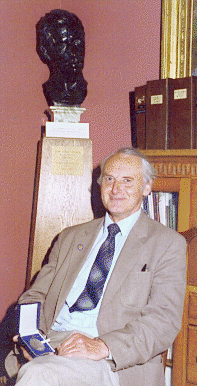
Dave Gavine after the presentation of his medal. The statue is of John Henry Lorimer, RSA. Photograph by Duncan Waldron. Astronomical Society of Edinburgh archives.
A past president of the society, from 1983-5, Dave Gavine was awarded the Lorimer Medal in 1995 – by no means only for his work for the Journal or for ASE. It rewarded a lifetime promoting astronomy – through co-founding the Dundee Astronomical Society, the Aurora Section of the BAA, the Society for the History of Astronomy and the British Sundial Society, as well as a long career in teaching. His Lorimer award was typical of ones the Society made in the later decades of the twentieth century, eschewing the fanfare surrounding the Medal in earlier years. Rather than involving a much-advertised large-scale public event, recipients usually contributed a lecture simply to the Society’s regular monthly programme. They were likewise – like Dave Gavine – often less illustrious figures than the luminaries of professional astronomy rewarded previously: local heroes, distinguished by much valued work at grassroots, hands-on levels.
The Lorimer medallist in 1984, Harry Ford – a friend of Gavine’s, and co-founder of the Dundee Society – also belonged to this category. Renowned for his work as an instrument-maker, and as an observer of the Moon at Dundee’s Mills Observatory, he was also Head of the BAA’s Lunar Section, and an admired author of children’s books on astronomy. Awarded the Medal in 1992, Nora Jenkinson – a local heroine – was likewise distinguished by an extended observing career, and by work with young people. For many years, she was the main mover in the Harpenden Astronomical Society, in Haddington, which met every Tuesday to hear talks, build models and instruments, and observe the heavens through a 14-inch Dobsonian, an 8.5 inch reflector and a 4-inch refractor.
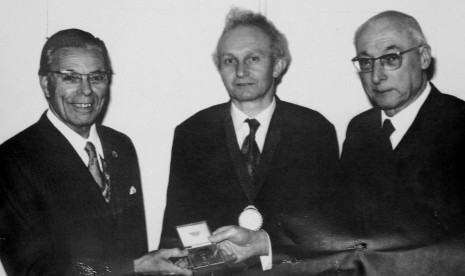
Norman G. Matthew (left), presented with the Lorimer medal by Prof Stoy (right). ASE President Dr John Rostron in centre. Astronomical Society of Edinburgh archives.
The 1976 medallist, Norman G Matthew, FRAS, delivered a Lorimer lecture entitled ‘Astronomy in my Lifetime’. An equally appropriate title might have been ‘My Lifetime in Astronomy’. No-one could have devoted their lives more thoroughly, or for longer, to the advancement of astronomical knowledge in Edinburgh, and in Scotland more widely. Matthew was a founding member of the Edinburgh Astronomical Association in 1924, serving for decades, from the early 1930s, as its Secretary, or Joint Secretary. From the beginning of the ASE’s tenure in 1938, he was also Director of the Calton Hill Observatory (except during the war years), remaining in this position until his retiral in 1973. During this extended career he delivered innumerable lectures to schools, locally and throughout Scotland, along with annual classes for the WEA and Edinburgh University’s Extra-Mural Department. He was also long responsible for organising visits to the Observatory by groups and individuals, and for its regular opening for Festival visitors, offering observing or educational opportunities for all and sundry on Calton Hill, and initiating the Fellowship of Junior Astronomers in 1957.
Matthew’s retiral was one of several seismic changes in ASE personnel in the early seventies, which saw the end of J. Gibson Kerr’s similarly extended commitments as Secretary, and for long periods as Treasurer. Nevertheless, at the Observatory as in other areas, the Society’s work mostly did ‘continue as in previous years’. As in those years, it was facilitated by difficult but usually functional relations with the City – with local government in Edinburgh. These were further complicated by reorganisation in 1975, establishing the Edinburgh District Council – which had responsiblity for maintenance of the Observatory and its fabric – and Lothian Regional Council, concerned more with matters of education. The ASE generally managed to secure help from the former body for the repairs required on Calton Hill. Dry rot was discovered in the Observatory buildings, late in the century, seriously affecting the Society’s library. Earlier, in the 1970 and 1980s, the Cox Dome had required extensive repairs, and there were extended delays in reinstalling a false ceiling in the City Dome. When finally in place, in 1987, it prompted the wry observation that ‘some people have even taken their coats off’ during winter meetings, as well as finding themselves able, once again, through improved acoustics, to hear the speaker. A year earlier, space had somehow been found for a planetarium, donated by Leith Nautical College.
Financial relations with the City likewise required regular repair. Several crises occurred when its grant to the Observatory was diminished, or late in delivery, or when it began requiring payment of rates, during the 1990s – of as much as £2000 annually, albeit with a large percentage reduction. The ASE had to consider on several occasions – including in 1981, 1986, 1991 and 1995 – whether it had a practicable future on Calton Hill, and what possibilities there might be for acquiring other premises. Compromises generally seemed feasible – the District Council eventually increasing its grant to £1825 in 1981, for example, with further increases, or rate-rebates, thereafter.
Fortunately, the Society’s own finances mostly remained viable, and significantly healthier after the early 1980s. Membership during the last decades of the century averaged around 100, occasionally falling as low as 75, though reaching 140 in 1987, and subscriptions were raised from £1 in 1974 to £2 in 1979, £4 in 1980; £5 in 1982, and £10 in 1993. The Society also continued to benefit from J.H. Lorimer’s bequest, as well as from the sale of two of his paintings in 1973. This income became more reliable after 1983, when it was realised that the law firm managing the bequest had sometimes swallowed up more than half its annual dividend in ‘administration expenses’ – occasionally large enough even to eat into the original capital. After the termination of this wasteful arrangement, the Society received around £1000pa in investment interest.
All this allowed the Observatory’s activities to be maintained during the years following Matthew’s departure, and to an extent thereafter. Extra-Mural and WEA classes continued to be offered more or less throughout the period, often to groups of around 50 students, some of whom were encouraged to take the Astronomy GCSE. Visits to the Observatory by groups and individuals continued regularly, sometimes on a large scale – around 3000 people turned up during 1975, for example, and there were still around 1000 in 1994, as well as, typically, a further 1000 during the Festival. On Fridays, or by request, the Observatory remained available for members’ use. Telescopes were at work on 76 nights in 1971, and 86 the following year. Special observing sessions allowed the public to view particular cosmic events, matching or supplementing opportunities offered by the Royal Observatory and its Visitor Centre, at work from the 1980s. These included the 1988 Opposition of Mars – which 300 people came to observe – the impact of Comet Shoemaker-Levy on Jupiter in 1994, the near-total eclipse of 1999, the dazzling visit of Comet Hale-Bopp a few years earlier, and Halley’s more modest appearance in 1985.

Calton Hill, probably from the Nelson Monument. Astronomical Society of Edinburgh archives.
Calton Hill also proved useful for many terrestrially-oriented events and meetings. The bicentenary of the Observatory itself was celebrated in 1976. The Society’s fiftieth anniversary, two years earlier, seems to have passed quietly, but the sixtieth, in 1984, was celebrated by an exhibition, a dinner, and a lecture from Malcolm Longair, Astronomer Royal for Scotland at the time, and later an adviser on the James Webb Space Telescope project. Ten years later, in recognition of the Society’s 70 years, 65 ASE members attended the Observatory for a buffet dinner, followed by a ‘beautiful’ home-made cake and the chance to observe Saturn through the 6” Cooke refractor. Annual events such as National Astronomy Week, established in 1981, the Science Festival, from 1989, and Edinburgh’s ‘Doors Open’ days were often marked by ASE public lectures or observing opportunities – 1000 visitors turned up during Astronomy Week in 1986, for example, 300 during the Science Festival of 1994, and another 1000 for ‘Doors Open’ in 1996. A meteorite exhibition in 1998 – ‘Rocks from Space’ – also attracted good attendances. The BAA occasionally held annual or section meetings on Calton Hill, as did the Scottish Astronomy Group – an informal body, established in 1970, which drew its members from all the Scottish astronomy societies and beyond, publishing the Astronomical Quarterly from 1977-81. The Junior Astronomy Society – a UK-national body – held its annual conventions at the Observatory in 1978 and 1983, featuring in each case a distinguished assemblage of writers and broadcasters.
Edinburgh’s own Fellowship of Junior Astronomers had continued to thrive in the 1970s: perhaps almost too enthusiastically, as its members were accused in 1975 of having occasionally ‘run riot’ in the Observatory. Thereafter, their energy seemed gradually to dissipate. Attempts were made in the mid-1980s to incorporate them as a Junior Section of the ASE itself, attending ‘Beginners’ Meetings’ before the Society’s monthly lectures, or, later, their own separate Saturday sessions. These attracted a couple of dozen participants for a time, though attendances proved hard to sustain.
Observatory attendance sometimes seemed similarly hard to maintain among senior members of the ASE – considered, by an Annual Report in the mid-1970s, to include ‘too many armchair astronomers and not enough practical people’. At the start of the decade, the kind of observing groups working since the late 1930s still continued to function, exploring areas including Photometry, Variable Stars, Radio Astronomy, and the Moon and Planets – a section still looking for Transient Lunar Phenomena, as well as studying Mars, Jupiter and Saturn. Yet work in all these areas soon diminished or faded away altogether – the newish Radio Astronomy group lasting only until 1975. Attempts to ‘re-organise and revitalise observing sections’ in 1978, and later – or even to establish a single ‘Observing Group’ – failed to generate much enthusiasm. ‘Not much activity at present’, an Annual Report complained in 1992.

Meteors and star trails. Astronomical Society of Edinburgh archives.
One example of successful collective activity did stand out, though: the Meteor Group, active throughout the 1980s and beyond. Under the leadership of Neil Bone – secretary of the BAA Meteor Section for Scotland – this group formed part of a network of sky-watchers throughout the country, looking out for sporadics as well as observing major showers. Registering meteors’ apparent magnitudes, and the scale, timing and location of their appearance, their results were recorded in impressive detail in the ASE Journal and also published elsewhere. Their work was encouraged by the Society’s purchase of three Lubital meteor cameras in 1981, and by the choice of Calton Hill as the venue for the BAA’s Meteor-Section meetings in the same year, and again in 1991. As meteor-watchers need to monitor the sky as widely as possible, and for as much of the night as they can, those involved naturally spotted aurorae fairly regularly, too. This contributed to a further set of interests for the Society at the time – developed by a dedicated Aurora group, anticipating displays by means of the jam-jar magnetometers designed by Ronald Livesey. Director of the BAA’s Aurora Section from 1976-2005, an Assistant Director thereafter, a regular contributor to the ASE Journal, a lifelong promoter of astronomy in Scotland, and a member of ASE since 1956, Ron Livesey was awarded the Lorimer Medal in 2019.
Though sometimes less than keen to work in groups, or to use Calton Hill as regularly as in the past, many Society members obviously continued to study the sky as individuals, and to report their findings to the BAA where appropriate. They also showed some interest in new observing opportunities during the 1980s and 1990s, supporting plans to establish a smallish observatory in a long-unused dome at the Glenburn Hotel. This new venture seemed promising for a time in the mid-1980s, but enthusiasm faded when the dome mechanism jammed, and the hotel later changed hands. A similarly dark-sky location at Earlyburn – once used as a satellite-tracking station by the Royal Observatory – attracted stronger interest at the end of the century, 40 members turning out in 1999 to examine the location and to enjoy, or endure, a midge-molested barbecue. Interest in new out-of-town sites suggests the Society was growing warier of light-pollution in Edinburgh – subject of a meeting with the City Engineer in 1997, and of further approaches to the City in later years – and perhaps also the condition of some of the instruments on Calton Hill. New telescopes were acquired – including an 8.75” Dobsonian in 1995 – but instruments such as the 13” Cox were beginning to need extensive refurbishment, or generally show their age. Though still reliable, the 6” Cooke refractor, like the Cox, had been in use for a century by the mid-1990s.

Looking West between the Crawford and Tweedie domes. Astronomical Society of Edinburgh archives.
The ASE’s difficulties on Calton Hill, by this time, nevertheless resulted less from deteriorating buildings and instrumentation than from the changing role of the whole area: part-victim, as well as beneficiary, of its appeal to tourists, and as a handy venue for public events and city societies. Throughout the period, the Observatory had played host to several of these societies, including the Edinburgh and District Amateur Radio Club, which had at one point figured as a possible replacement for the Society’s defunct Radio Astronomy section, whose equipment had been sold in 1975. Instead, they paved the way for the use of the Observatory as a broadcasting point for several radio companies, such as Fresh Air FM and Festival FM, whose fees for the use of the Observatory grounds, the Society hoped, might help pay its increased rates bill. The Observatory’s capacious buildings also came to be used by groups including the Edinburgh Brass Band, various jazz ensembles and Fringe theatre companies, and the Expo Dance Company.
Increasingly, too, the grounds and surrounding area became an ideal and often very crowded observing point – or sometimes launch-pad – for annual firework displays. One of these – the Fireworks Concert – regularly marked the end of the Festival, with another, also centred on the Castle, bringing in the New Year. A further display was often set up on Calton Hill itself, some days before Hogmanay, though for the Millennium, fireworks were also launched from near the Observatory at midnight on 31 December 1999. In a way, Society members benefited from these arrangements, as they were able to observe the fireworks comfortably from within the Observatory grounds, but the local displays often left mess and damage across Calton Hill. Another measure of its increasing but problematic role in public spectacle appeared in the City’s decision, in 1994, to floodlight its buildings. Fortunately, it did permit the Society to turn the floodlighting off during periods of observation, also exempting ASE members from a 1995 ban on traffic on the access road after 9pm.
Throughout the 1990s, the City Council (reformed out of District and Regional Councils in 1995) engaged in extensive planning for Millennium events on the Hill, and more generally for expanding its use by tourists – possibly including a new role for the Observatory, a new Visitor Centre, and maybe even a funicular railway. All these plans and proposals involved the ASE in negotiations, extensively and sometimes awkwardly. Particular difficulties, though, arose from a venture the Society had originally encouraged itself. This was the ‘Living City’ 3D-slideshow first presented by the Observatory Director in the summer of 1983, soon developing into a stopping-point for City Tour buses and a major visitor-attraction generally. Variously re-named as ‘Edinburgh in Depth’, the ‘Edinburgh Experience’ or sometimes ‘Stereodome’, by 1988 it was attracting as many as 15000 visitors to the City Dome over the summer season, continuing this success into the next decade. In one way, of course, this was good publicity for the Society, encouraging audiences for the show to learn about the Observatory, too. A ‘conflict of interest’ nevertheless became increasingly apparent between what had become a business or tourist enterprise and the ASE’s core commitment, enshrined in its constitution, to advance and disseminate astronomical knowledge free of charge. Recognising this conflict, the Observatory Director resigned in 1998, leaving an ASE ‘Observatory Committee’ in charge of affairs on Calton Hill.
Long before this position was reached, the ASE and its Council found itself more and more embroiled in issues of business- and estate-management. As one set of its Minutes remarked, late in the 1990s, ‘astronomy is not always to the fore in the Council’s discussions’. On the contrary, as these Minutes and the Society’s Annual Reports indicate, Council members’ attention was steadily deflected from the heavens down to earth. Among many other pressing matters, they had to discuss the state of the Observatory’s toilets and drains, litter and spent fireworks dropped into its grounds, maintenance of its garden, Hogmanay crowds on the Hill, whether electricity should be supplied to the ice-cream van parked nearby, or, more generally, the often-fragile prospects of support from the City. While Hogmanay fireworks whizzed around his head, in other words, and the time-ball dropped downward into a new millennium, the ASE Secretary might well have reflected on 75 years of successful engagement with astronomical knowledge, but also the increasingly diverse demands confronting the Society by the year 2000.
IV Into the Twenty-First Century
How did the Astronomical Society of Edinburgh deal with these demands? How did it fare generally at the start of the new century? Regarding its opening years, one answer might be ‘with difficulty’. As early as July 2000, the ASE Council was obliged once again to consider moving out of the Calton Hill Observatory. Perennially challenging relations with the City had prompted similar reflections several times during the 1980s and 1990s. In 2000, too, they were deflected through a reassuring meeting with City officials, later in July. But they soon recurred, and intensified, in response to difficulties encountered on Calton Hill in the first decade of the century.
These problems were at least three-fold, and interlinked. A primary difficulty was simply financial. As well as terminating an annual grant – long provided to help with running the Observatory – from the mid-1990s the City had billed the Society for the payment of rates: for around £1300-£2000pa, even with a reduction. Rebates were requested regularly, but in the end implemented only with effect from 2005. By then, the Society had also made some progress in renegotiating substantial charges for water and electricity, but its finances nevertheless dwindled by around £9000 between 1999 and 2004. Though covered at the time by funds made available from the Lorimer Trust, losses on this scale naturally appeared to the ASE Council to be ‘not sustainable in the longer term’.
A second set of problems arose from the extent of the ASE Council’s own roles and responsibilities. Following the termination of the position of Observatory Director in 1999, the Council’s sub-group, the Observatory Committee, had continued to look after the wide range of estate-management issues mentioned at the end of Section Three, above. Frequently distant from interests in astronomy, the demands involved inevitably stretched the enthusiasm, patience and leisure-time of the Committee, while also deterring other volunteers. The ASE Journal mentioned in 2002 that it was ‘difficult to persuade ordinary members to come forward to help with the running of the Society’ – specifically, with ‘tiresome administrative matters relating to the Calton Hill Observatory’. A year or so later, a melancholy Council Minute noted only one offer of help with the tea rota, and that ‘nobody volunteered for the Astromind competition, for writing observing guides, for the Venus transit, or for opening [the Observatory] on Friday nights’.
The main difficulties for the Society, though, arose neither from the enthusiasm or otherwise of its members and office-bearers, but from the deteriorating condition of the Observatory itself, along with uncertainty about the City’s commitment to improvement or repairs. Initiated early in the 1990s, its planning for Calton Hill’s future seemed no closer to a final strategy, ten years or more later, nor to determining what the Society’s role – if any – might be within one. Meanwhile, the shortcomings of aging buildings and instruments – though the City did agree to refurbish the Cooke telescope in 2006 – were greatly exacerbated by vandalism and theft. These were not new problems. Thieves had removed lead from the roof of the Cox Dome in the 1950s, and there were several break-ins during the decade, including three in 1958 alone. Another, in 1951, ruined rock-thermometers first installed deep in Calton Hill in 1836. These had been wrecked previously – by a mad Portuguese sailor in 1876 – but fairly soon restored. Replacement on this occasion was delayed until 1966, seriously interrupting monitoring maintained for well over a century.

Inside the Tweedie Dome. Astronomical Society of Edinburgh archives.
Occasional burglaries continued in the 1970s, followed by the disappearance in 1982 of a Civil Time clock and a large lens – subjects of legal proceedings strangely rumbling on for two decades afterwards. From the start of the new century, though, vandalism, theft, and damage to the Observatory’s fabric came to seem almost routine. The Cox Dome was broken into in 2000 and 2001. Seven doors on the Observatory site were damaged in 2002, with some buildings left open to trespassers. Lead and copper were stolen from the roofs of the Playfair and Cox Domes in 2007, with further vandalism inflicted on each the following year. By 2009, the Tweedie Dome had collapsed, two other buildings had been boarded up, and the Observatory’s toilets almost entirely destroyed. The City did undertake some repairs, though occasionally rather tardily, but roofs seemed to be damaged almost as soon as they were mended, making weather- and water-damage inevitable.
In one way, this perhaps reprised challenges the Observatory had faced a few decades after its opening. Soon after the new Astronomer Royal for Scotland, Charles Piazzi Smyth, arrived on Calton Hill in the mid-nineteenth century, he lamented in a letter to the Herschel family that a defective roof required ‘buckets, jugs and basins to prevent a great mess being made’ in the Observatory. Recollections about illustrious previous tenants, though, could scarcely distract ASE members from the mess the Observatory was in at the present day. Council Minutes in 2005 and 2006 continued to note that the Observatory’s ‘general state is declining’ and that the Society’s occupancy might not remain viable in the longer term.
This conclusion was further confirmed by the collapse of a water-damaged ceiling in the Playfair Dome in 2005, rendering the Cooke refractor inaccessible to members. As problems of this kind continued to multiply, it was suggested to the ASE Council at the end of 2008 that ’in the absence of usable toilets and leak-proof roofs . . . the Society had no choice but to find somewhere else for its regular meetings’. A consequent decision ‘to leave the Observatory completely’ was taken by the ASE Council – unanimously – on 16 January 2009. The Society quickly removed its library and equipment – globes, models, images, artwork and telescopes – and agreed to meet in future at the Augustine United Church on George IV Bridge. This avoided any further charges incurred by the use of Calton Hill, though it initially required a nearly-equivalent outlay for storage and hall-hire.
*
Problems on Calton Hill – and in adjusting, later, to a different base – might have forced the Society to curtail its activities substantially during the opening decades of the century. Yet many of its interests and commitments were adapted or maintained. Evening classes and introductions to astronomy long provided at the Observatory were discontinued, with attempts to revive them in 2006 and 2007 thwarted by a lack of participants. Gone, too, were the thousands of visitors who had turned up throughout the year, for much of the twentieth century – often in in great numbers during the Festival – to be shown the night sky and the Observatory’s equipment. Calton Hill nevertheless remained for some time a viable venue for meetings – of the BAA Aurora Section in 2001, for example, and the Scottish Astronomy Group in 2004 – and for other forms of public engagement. A chance to view Mars at opposition, along with a related exhibition, attracted around 50 visitors per night in August 2003, for example, and over 100 when the sky was clear – all of them offered a specially-produced observing guide. Members of the public were also invited to view other celestial events, including a Transit of Mercury in 2003, a Transit of Venus the following year, and a lunar eclipse in 2007. Telescopes were taken to the National Seabird Centre in North Berwick for Moonwatch-week in March 2008, attracting 100 or so interested observers. A year later, during the International Year of Astronomy in 2009, a popular Moonwatch event was held on Calton Hill, almost as a farewell to the Observatory. Several times during the period, too, crowds of visitors turned up for ‘Doors Open’ days. As many as 2000 visited the Playfair Dome in 2008 – tentatively back in use after the City restored its fallen ceiling.

12″ Lewis Dobsonian. Astronomical Society of Edinburgh archives.
In preceding years, the Observatory had continued to be available for the use of members, along with their guests and other visitors, every Friday from 8pm to 10pm, providing the weather was clear and a volunteer could be found to open it. In later years, opening had to be reduced to every third Friday of the month. Even this became unmanageable later in 2006, though members remained able to borrow the smaller telescopes available on Calton Hill, including a 4.5” Newtonian, a 10” Meade, and a new solar telescope purchased in 2001. Though the Dall Kirkham telescopes were returned to Shetland in 2002, two Dobsonians – the 8”, acquired in 1995, and a 12” – had also been available for members’ use at the Society’s Earlyburn dark-sky site (see Section 3) until its lease expired and the land was sold in 2005. The Dobsonians were returned to Calton Hill, though for some years afterwards – until 2013 – members were able to use their own telescopes at another dark-sky location. An arrangement with the West Calder Model Flying Club, based at Addiewell, near Livingston, allowed the use of their runways or car park as conveniently solid telescope-bases. An article in the Society’s Journal nevertheless wryly records many challenges, as well as opportunities, involved in observing there on a winter night of ‘bone chilling wind’.

Journal no 64, final issue. Astronomical Society of Edinburgh archives.
The Journal continued to be published on the web – Horst Meyerdierks succeeding Dave Gavine as editor in 2006 – until a last issue at the end of 2010. From 2013, a blog took over some of its functions, eventually extended by the weekly newsletters posted on the website, and delivered to members by email, from 2018. Material in the Journal during its last decade remained similar to what had appeared in earlier issues. Book reviews, Society news, occasional crosswords and accounts of observations appeared alongside longer articles about the history of astronomy and cosmological phenomena: sometimes ones offering complex analyses – of the nature of elliptical orbits, for example, or of gravitational mass centres.

Dr Mary Brück (left) with Lorna McCalman (President) and Dr Dave Gavine (former recipient of medal). Astronomical Society of Edinburgh Journal.
The Journal also reported further awards of the Lorimer Medal, presented in 2001 to Mary Brüick. During her time (1962-84) lecturing at Edinburgh University – where a building is named after her – she had continued research into the interstellar medium, photometry, galactic evolution and the Magellanic clouds. Often involved with the Society during this time, and later, she had also produced the definitive biography of Charles Piazzi Smyth, The Peripatetic Astronomer (1988), written with her husband Hermann Brück – Astronomer Royal for Scotland from 1957 to 1975, and Honorary President of the ASE. Further biographical studies of her own were to follow, highlighting women’s contributions to astronomy in works such as Agnes Mary Clerke and the Rise of Astrophysics (2002) and Women in Early British Astronomy: Stars and Satellites (2009).

Alan Pickup. Astronomical Society of Edinburgh archives.
Satellites and their orbits figured in the broad expertise of Alan Pickup, the Lorimer Medal winner in 2011. His award, though, recognised not only his professional scientific work, including for the Royal Observatory in Edinburgh and in Hawaii, nor only his numerous substantial roles in the ASE – at various times, as Secretary, Treasurer, Vice-President and President. For decades, he had also been a unique communicator of popular astronomical knowledge, delivered in monthly guides to the night sky published in the Guardian and the Scotsman. This expertise was directly extended to members of the ASE, too, either in sky-surveys published in various bulletins, newsletters and the Journal, or in talks delivered at its monthly meetings.
Held from September to May – supplemented by occasional Members’ Nights in summer – these meetings and their guest lectures continued a mainstay of the Society, whether held on Calton Hill or eventually in the Augustine Church. As in previous years – indeed, throughout the Society’s history – lectures reflected both well-established views of the cosmos, or of the history and practice of astronomy, along with descriptions of new discoveries, research, or observational techniques. Programmes in the first decades of the century thus included, for example, accounts of telescope-making, lunar occultation, and astronomical publishing in Edinburgh, alongside descriptions of the search for extra-solar planets, CCD-imaging techniques, Hubble Deep Field, gravitational waves, Dark Energy, Dark Matter, the Higgs boson, and the James Webb Space Telescope (eagerly anticipated from 2011). Along with a special cake, three special lectures marked the Society’s ninetieth birthday in 2014, one of them promisingly entitled ’The Golden Years of Astronomy: Will They Ever Cease?’

ASE members at the Musem of Flight, November 2017, with members’ telescopes beneath Concorde. Astronomical Society of Edinburgh archives.
As well as its lecture programme, the Society’s outreach activities were to an extent maintained – also in ways familiar enough from previous years – after departure from Calton Hill. Though ‘Doors Open’ days were no longer held there after 2011, the Society shared instead in the Royal Observatory’s annual opening to the public, distributing information to visitors and encouraging them to view the Sun through solar telescopes – including a new device purchased in 2015. The Society collaborated further with the Royal Observatory, and the BBC, in setting up ‘Stargazing Live’ events at the Botanic Gardens in January and October 2012, and again at Linlithgow in 2014. There were occasional returns to Calton Hill, too, as a public viewing-point for celestial events, such as the Transit of Mercury in 2016. The Scottish Parliament proved another popular venue for observations, particularly of the partial eclipse in March 2015. Though arrangements with the National Seabird Centre lapsed, a similar connection developed with the Museum of Flight in East Fortune. From 2014 to 2017, dark-sky observation was offered there over a late-Autumn weekend, along with talks and a small exhibition, attracting as many as 500 members of the public each year.
*
These continuities in public engagement and monthly meetings might suggest that the departure from Calton Hill was straightforward and undamaging. Yet generations of ASE members, for 70 years, had welcomed the chance to meet, work, observe and socialise there, or even just gaze out over Edinburgh, the Pentland Hills, and across the Forth to Fife. For 50 of those years, the Observatory had been the Society’s only headquarters. Picturesquely perched above the city, its familiar buildings had contained the ASE’s library and many wonderful – if aging – astronomical instruments, offering enthralling views of the sky. Friday evenings could be devoted to scanning the heavens through the Cooke refractor, or other instruments, then retiring to the pub to discuss the wonders they had just revealed. Relinquishing all this could scarcely have occurred without regret, or even a sense that Golden Years of astronomy had ceased.

Visitors on Calton Hill viewing the partial eclipse with ASE members.Astronomical Society of Edinburgh archives.

President Mark Phillips preparing the Cooke for the partial eclipse live stream. Astronomical Society of Edinburgh archives.
For a time, too, such feelings were compounded by uncertainty regarding the finality of departure. The original decision to ‘leave the Observatory completely’ was reaffirmed in 2011, a Minute recording ‘no enthusiasm in the ASE Council for ASE to participate in running the City Observatory’. Yet hopes continued to be expressed within the Society, in the same year, about some form of renewed activity at the Observatory, perhaps in participation with the City. Occasional overtures from the latter maintained some interest in this possibility. It remained in view even after the City at last finalised its plans for Calton Hill, offering a 25-year lease of its buildings to Collective Gallery in 2015. By 2018, this organisation had opened the planned gallery, built a restaurant, and consolidated the Playfair Dome. It also established contacts with the Society, suggesting once again some possibilities for liaison in using the Observatory. These were developed in October 2022, when the Playfair Dome and the Cooke telescope were used by the Society to livestream a partial solar eclipse. Described on the BBC’s ‘Reporting Scotland’, and attracting many watchers on Calton Hill – along with more than two thousand views on YouTube – the event suggested that regrets about the loss of the Observatory might eventually be dispelled, partially at least, by some form of the ASE’s return there.
By 2022, in any case, the Society had largely moved beyond difficulties encountered earlier in the century. Throughout its first decade, disappointment about the Observatory’s condition and uncertainty about its future had contributed to a decline in membership, adding further to financial difficulties at the time. In 2000, when a subscription cost £10, there were around at around 100 members – a figure nearly maintained the following year, when the annual fee rose to £15. Membership diminished in 2004, though, after the subscription was increased to £25. By 2009, it had fallen to 58 – its lowest point for decades – rising again only gradually, by around 20 members, over the next five years. In other words, though core activities were largely maintained during these years, they scarcely realised the optimistic view of the future recorded in the Journal in 2009. This expressed the ASE Council’s hope that the decision to ‘cease to occupy the Observatory’ might be ‘a break with the past [which] will allow us to revitalise the Society’.
Fortunately, signs did begin to appear, by around 2011, of factors which would reinvigorate the Society by the end of the decade. Some of these were owed to enhanced opportunities for amateur astronomy, generally, made available by increasingly sophisticated equipment: others, to developing use of the internet and improved organisation within the Society itself. Technologies beginning to be available for astrophotography, at the end of the twentieth century, advanced especially rapidly during the decades that followed, as astrocameras and methods of computerised image-stacking became widely and more cheaply available. A Society sub-group for CCD astrophotography formed in 2000: though it worked only fitfully in succeeding years, fading out around 2007, it was followed by much more productive support for imaging after 2010, including the ASE’s purchase of a CCD camera. Throughout the months of dark nights, from September to April, an Imaging Group once again met regularly, usually in Juniper Green Village Hall – not necessarily to take astrophotos on the spot, but in order to share advice about equipment and techniques.

Astronomical Society of Edinburgh archives.
As members’ expertise advanced, and available technologies continued to develop, the Imaging Group produced increasingly impressive results – often matching or even surpassing those generated by established observatories. Shared on Flickr pages and elsewhere, the Group’s work not only offered those involved a shared sense of satisfaction and technical achievement. It also extended to all members the excitement of the new, often beautiful visions of the cosmos the Society’s imagers steadily delivered. This work developed, too, by 2020, into several collective endeavours, such as the ASE Lunar 100 and Messier projects, each working towards a comprehensive set of pictures of specific celestial targets. Astrophotography was further incentivised by an ‘Image of the Quarter’ competition, along with another for ‘Image of the Year’, instituted in 2022. Members’ meteor cameras, around this time, added night-long sky-scenarios to the rich array of images steadily being produced by the ASE.
Improved management played a further role in revitalising the Society. Administrative duties which had sometimes tried the patience of ASE Council members, earlier in the century, began to be organised into more focused, manageable sets of responsibilities. Engagement with the wider public was likewise further formalised, shaped around a ‘Four Steps to the Stars’ programme – Buying a Telescope, Telescope Help Shop, Navigating the Night Sky and Introduction to Astrophotography – providing beginners with a complete guide to amateur astronomy. Initially delivered in public meetings, these sessions were soon handily available online, and eventually in leaflet form.

Charles Piazzi Smyth exhibition
The Society’s public profile was further extended by its extensive contribution – of finance as well as expertise – to the Charles Piazzi Smyth bicentenary exhibition, at the Nelson Monument on Calton Hill, which attracted 60,000 visitors in 2019. A redesigned website also enhanced outreach, offering a comprehensive range of news and information not only for members, but for anyone interested in astronomy. An expanding audience was likewise guaranteed – in Edinburgh and beyond – by a Twitter account, which had acquired more than 2000 followers by 2017, and a Facebook presence, advertising Society events to as many as 50,000 people by 2021.
Invaluable at the best of times, resources of this kind proved especially crucial at one of the worst. By early 2020, the Society’s monthly meetings were enjoying renewed popularity, with audiences sometimes of as many as 150, as university students and other guests recognised a valuable resource for their studies and interests. But these healthy turnouts were soon thoroughly jeopardised by the crisis in public health which followed within a few months. By the end of March, the Covid virus had enforced a nationwide lockdown: a ban on almost all public meetings and activities, potentially leading to ‘the most challenging period in the Society’s history’, according to its Annual Report.
Yet what might have been a disaster proved if anything an opportunity, even a blessing, furthering what an ASE Council Minute described as a ‘huge growth in . . . online presence and activities . . . fundamentally chang[ing] the way the society engages with its members, other stakeholders and the general public’. The improved website ensured that a range of information and news, such as the ‘Four Steps to the Stars’ programme, remained readily available to the public, while also securing continuous contact with members. WhatsApp messaging, meanwhile, helped co-ordinate the Imaging Group, which soon moved its meetings onto the ‘Zoom’ web-platform, amalgamating with those of the Observing Group. This looser affiliation had also resumed sessions in 2000, looking at sunspots, variable stars and Messier objects, reconvening intermittently in later years in Roseburn Park or Duddingston, and occasionally elsewhere, for observation of annual meteor showers.

David H Levy speaking to the ASE via Zoom. Astronomical Society of Edinburgh archives.
Probably the most influential change enforced by Covid, though, was in altering the nature and frequency of the Society’s ‘monthly’ meetings. These, too, moved onto Zoom, and were rescheduled to take place twice weekly, until the summer of 2020, and twice monthly thereafter. Now readily available at home, these frequent meetings provided members with regular stimulus during the long months, menaced by isolation and ennui, which lockdown often entailed. Handy for members, Zoom also offered new opportunities – as it did for many institutions at the time – for attracting distinguished speakers from beyond as well as within the UK. The celebrated comet-hunter David Levy, for example, might not have chosen to cross the Atlantic to address the Society in the Augustine Church – even if it could have afforded his airfare – but he was happy to offer it a lecture on Zoom, in November 2021.
Earlier in the year, Edinburgh University’s Regius Professor of Astronomy, Andy Lawrence, had likewise taken the chance to assemble distinguished international experts for a Zoom webinar on ‘Losing the Sky’. Judging the Society’s technical resources and public outreach a welcome complement to the University’s, he chose ASE as an ideal partner for this discussion of astronomers’ difficulties with recently launched mega-constellations of satellites, exacerbating longer-standing problems of light-pollution. Zoom also facilitated the sharing of this and all other ASE lectures on YouTube, and their subsequent archiving on the website. Alongside its Twitter and Facebook presence, this continued greatly to extend the Society’s outreach. Alan Pickup’s comprehensive guide, ‘Navigating the Night Sky’, for example, attracted nearly 4000 YouTube views in January 2021. Later, in June, the ASE President Mark Phillips’s livestream of a partial solar eclipse – anticipating the event observed from Calton Hill the following year – likewise expanded the Society’s audience, attracting around 1000 viewers.

A full ASE meeting at the Augustine United Church. Astronomical Society of Edinburgh archives.
Though the end of lockdown allowed less exclusive reliance on web and online resources, they continued to help expand and consolidate ASE audiences. Some meetings continued on Zoom, while from October 2021, monthly sessions adopted a ‘hybrid’ format, with members present in the Augustine Church joined by others online, and by a wider public audience on YouTube. Though this system involved many challenges in managing the technology, it clearly appealed strongly both locally and more widely. Membership stood at 110 by the end of 2019, rising briskly during lockdown and thereafter, evidently in response to the move online. By late 2022, it had reached 180. This was the highest figure in the Society’s history, reflecting the new scale of its appeal beyond as well as within Edinburgh – quite often beyond the UK. On a plaque placed in what became the City Observatory, when it first opened in 1818, a Latin inscription suggests that ‘a renowned city should no longer lack the facilities for the pursuit of the fairest and grandest of the sciences’. Two hundred or so years later, after a century of its own activities, the ASE was vigorously extending knowledge of the ‘fairest and grandest of sciences’ towards a world-wide audience, as well as – much as always – within the ‘renowned city’ itself.
As documents used in writing this history suggest (Horst Meyerdierks’s carefully archived Council Minutes; Annual Reports; Journals; etc), innumerable Society members – as well as its dedicated office bearers – contributed enthusiastically to this first century, sustaining a fascination with the night sky even in the most challenging circumstances. That account of bone-chilling observing at Addiewell, mentioned earlier, matches countless others of sessions soaked or clouded out, or offering minimal glimpses of the stars – the Journal description in 1981, for example, of somehow photographing six Geminid meteors, despite ‘very cold conditions’ and ‘interludes of heavy rain’. Though no doubt cursing their geographical space and its cold, cloudy climate, those involved might still have reflected on the good fortune of the time they lived in. The ASE’s founding, in October 1924, coincided very closely with the first publicising, a month later, of Edwin Hubble’s conclusions about the nature and distance of the galaxies – a foundational moment for modern cosmology and astronomical research generally. Throughout the succeeding century, astronomers continued to deliver an astonishing series of momentous discoveries. As the UK Astronomer Royal, Martin Rees, commented in 2022, following the Hubble-inspired recognition of the expanding universe, astronomy has been ‘on a roll’. The 50 years of his own professional career, Rees reflected, had witnessed a particularly ‘exciting record of change, due to new ideas [and] much more powerful instruments, in space and on the ground’.
Developing instrumentation during this period, Rees added, ensured that the excitement involved could be shared – more widely and directly than ever – by amateur as well as professional astronomers. At the end of its first century, in other words, the Astronomical Society of Edinburgh could look back on ups and downs – often dictated by the ups and downs of Calton Hill – but certainly on its good fortune in sharing such a uniquely productive period for ‘the fairest and grandest of sciences’. Given the revitalised state of the Society itself, by this time, it could also look forward to advancing into its second century ‘on a roll’, hoping with some confidence, after all, that ‘Golden Years of Astronomy’ were set to continue.
A huge thank you must go to ASE member, Professor Randall Stevenson, who took on the daunting challenge of putting this history together.
Also to Horst Meyerdierks, for sifting through the ASE archives over many years and organising the data into a logical and useable form.