

Saturn, Brilliant Venus, Meteor Showers and a Planetary Encounter
by Mark Phillips
Using data from Dominic Ford’s in-the-sky.org and other sources
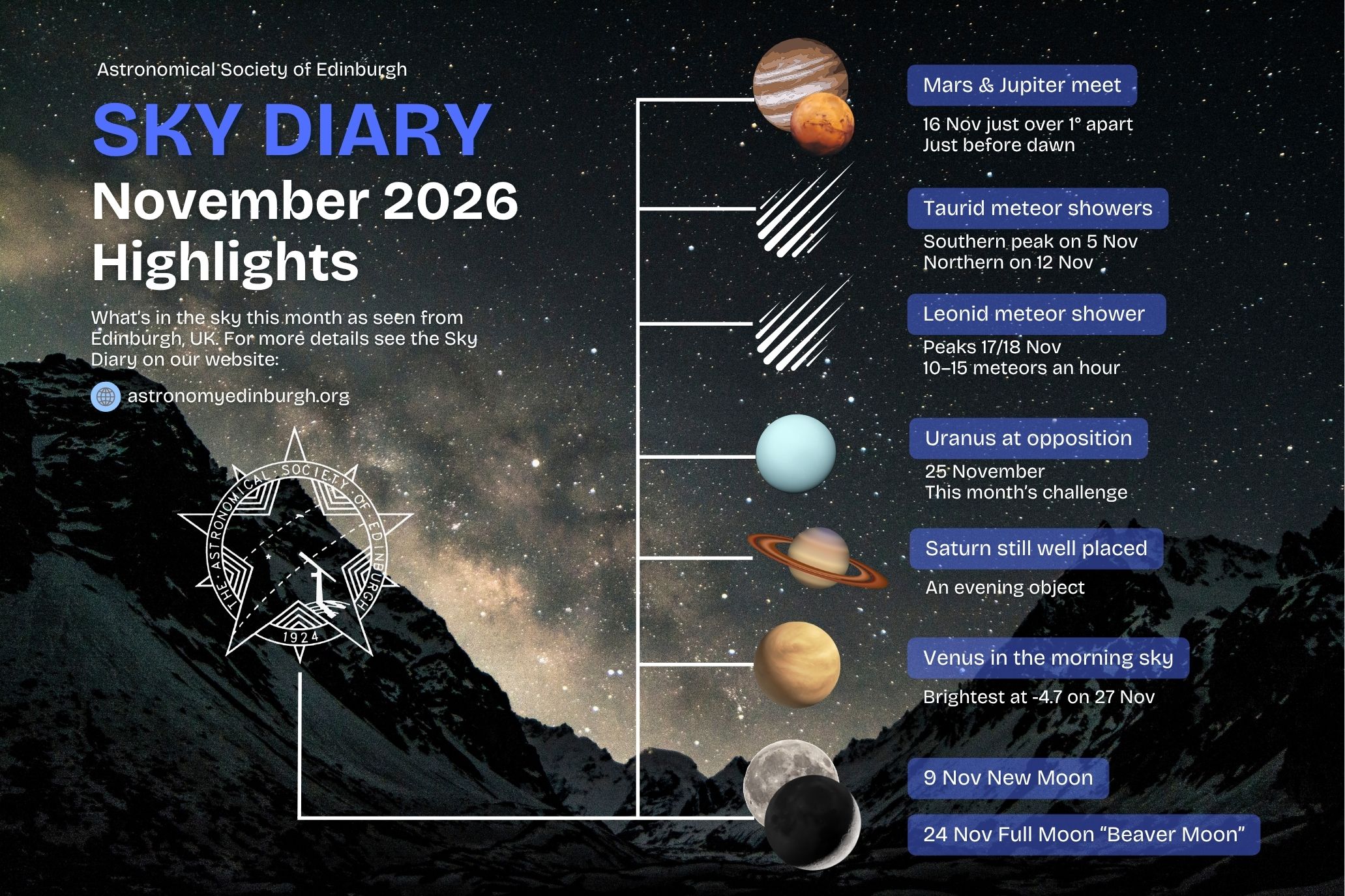
November brings even longer nights, giving us plenty of opportunities to enjoy the night sky. Saturn is still well placed in the evening, while brilliant Venus lights up the morning sky. We also have two meteor showers, a close meeting of Mars and Jupiter, and Uranus at opposition. The beautiful star clusters of Perseus are well placed for evening observing too.
Mars and Jupiter meet – 16 November
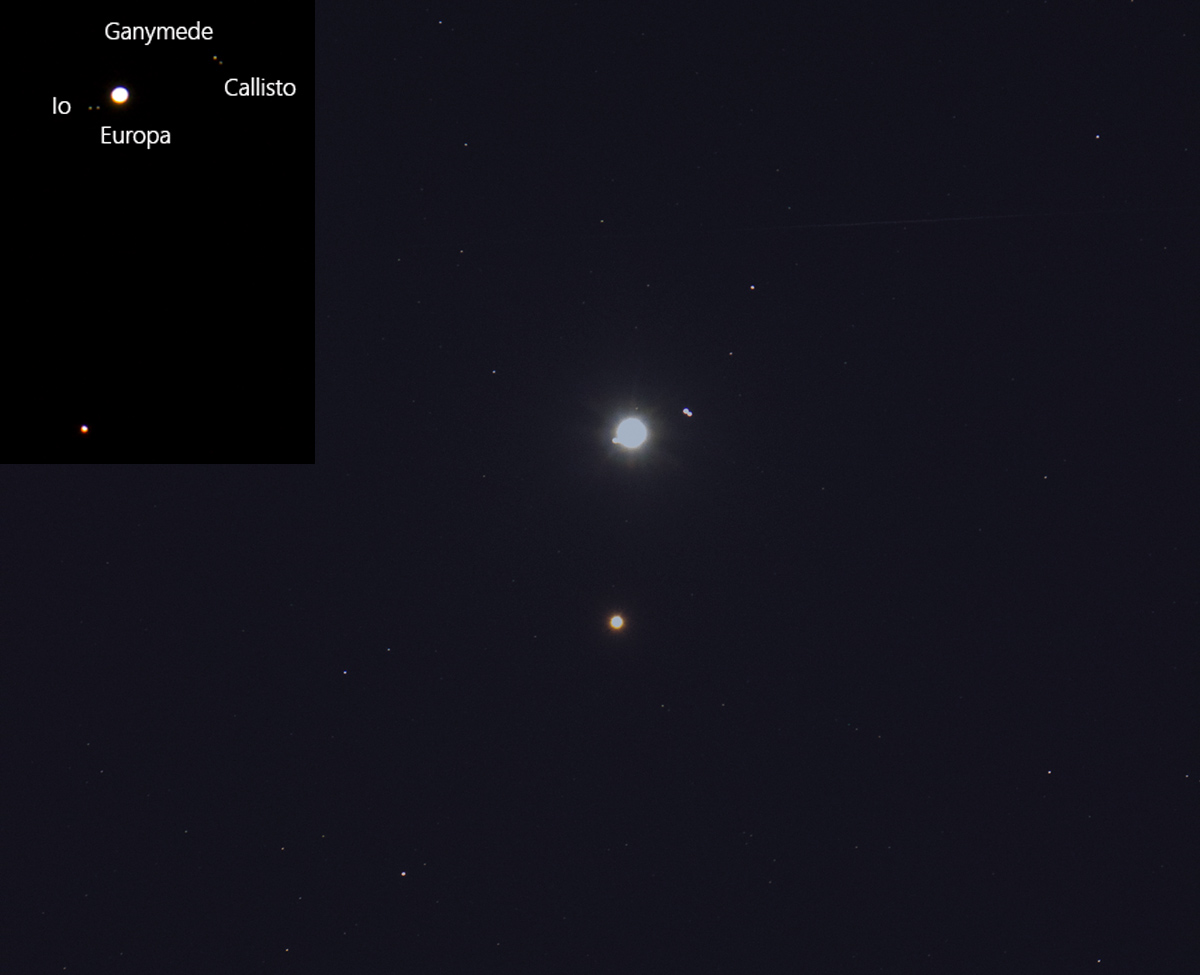
Jupiter & Mars conjunction in Jan 2018
Before dawn on 16 November, look towards the south-east for a close pairing of Mars and Jupiter in the constellation Leo.
The two planets will appear just over one degree apart, about twice the apparent width of the Full Moon. Bright Jupiter will be easy to spot, with the distinctly orange Mars nearby.
You won’t need a telescope to enjoy this sight, although binoculars will show both planets comfortably in the same field of view. The pair will also make an excellent photographic subject.
Taurid meteor showers – 5 and 12 November
November brings us two branches of the Taurid meteor shower. The Southern Taurids peak around 5 November, followed by the Northern Taurids around 12 November.
The Taurids aren’t particularly prolific, usually producing only around five meteors an hour from each branch under ideal conditions. However, they’re known for producing occasional spectacular fireballs, which can be much brighter than the usual shooting star. Keep an eye on our meteorcam page to see what we capture.
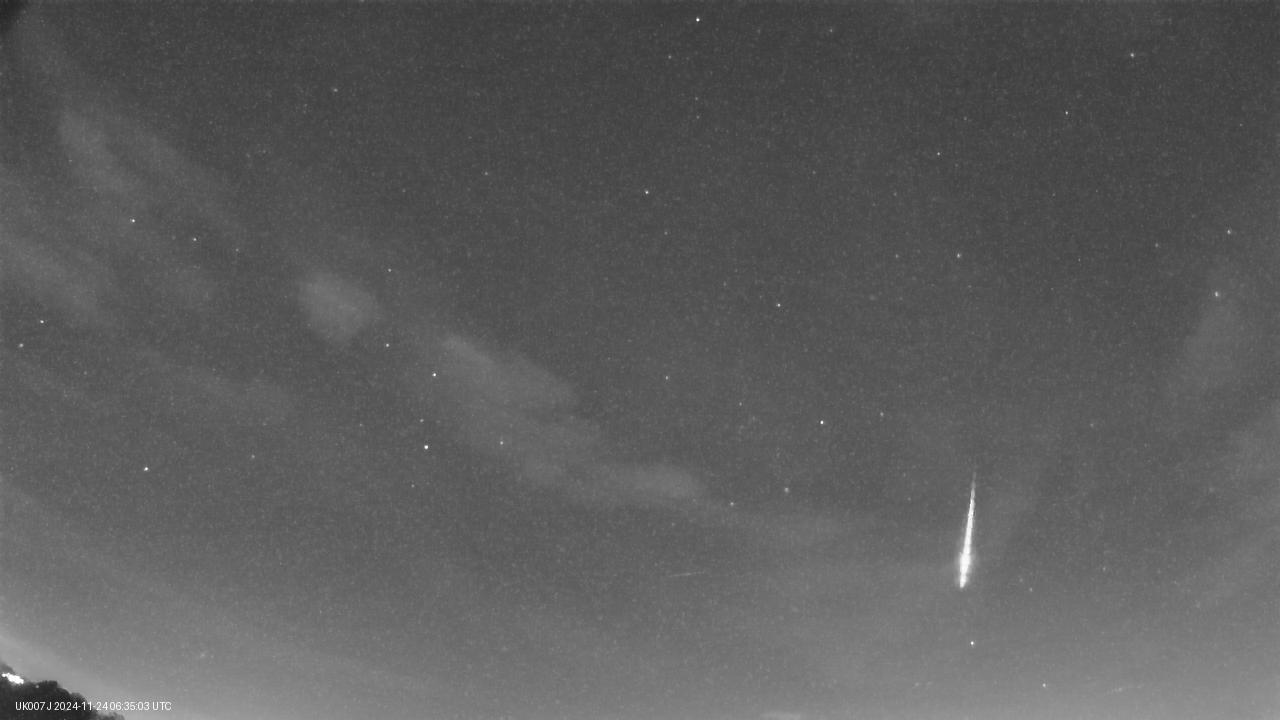
Leonid meteor 24 Nov 2024 UK007J
Leonid meteor shower – 17/18 November
The Leonids reach their peak overnight on 17–18 November. These fast-moving meteors are produced by debris left behind by comet 55P/Tempel-Tuttle. In an ordinary year, the Leonids produce around 10–15 meteors an hour under ideal conditions, although they have occasionally produced spectacular meteor storms in the past.
The Moon reaches First Quarter on 17 November, so will interfere with observations during the evening. Conditions improve after the Moon sets, making the hours after midnight and before dawn the best time to watch.
Saturn in the evening sky – 20 November
Saturn remains well placed in the evening sky throughout November, following its opposition in October. Look towards the south after darkness falls to find the planet shining steadily below the Great Square of Pegasus.
A small telescope will reveal its famous rings, which are gradually opening up again after last year’s edge-on appearance. On 20 November, the waxing gibbous Moon will be nearby, about six degrees away, making an attractive naked-eye pairing.
Uranus at opposition – 25 November
Uranus reaches opposition on 25 November, when Earth lies between the planet and the Sun. This makes Uranus visible throughout the night and places it at its brightest for the year. At magnitude 5.6, Uranus is just within naked-eye range under exceptionally dark skies, but binoculars make it much easier to find. It’s currently in the constellation Taurus.
Through a small telescope, Uranus looks like a tiny blue-green disc rather than a point of light. You won’t see much surface detail, but it’s satisfying finding a planet nearly three billion kilometres away.
 The Double Cluster in Perseus
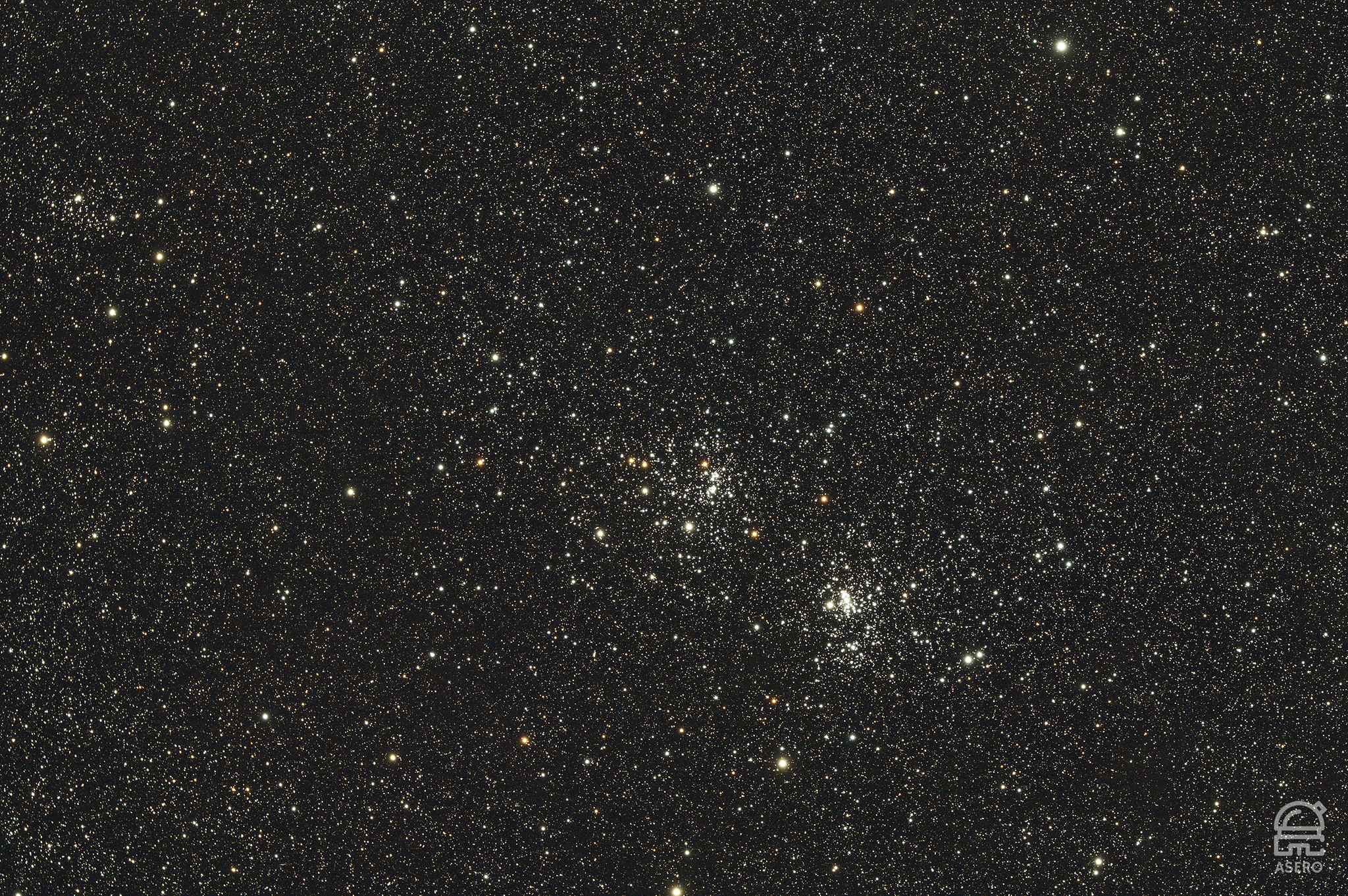
November is a wonderful time to explore the constellation Perseus, high in the evening sky. One of its finest sights is the Double Cluster, two neighbouring open star clusters known as NGC 869 and NGC 884. They lie roughly 7,500 light-years away and contain hundreds of stars.
Under a dark sky, the Double Cluster is visible to the naked eye as a faint misty patch between Perseus and Cassiopeia. Binoculars reveal two beautiful concentrations of stars, while a small telescope at low magnification gives a particularly impressive view.
Venus shines in the morning sky – 27 November
Venus returns to the morning sky during November, becoming a brilliant sight in the south-east before sunrise. It reaches its greatest brightness on 27 November, shining at around magnitude −4.7, far brighter than any star.
By the end of the month, Venus rises several hours before the Sun, making it easy to spot even as the sky begins to brighten. Through a small telescope, it appears as a crescent.
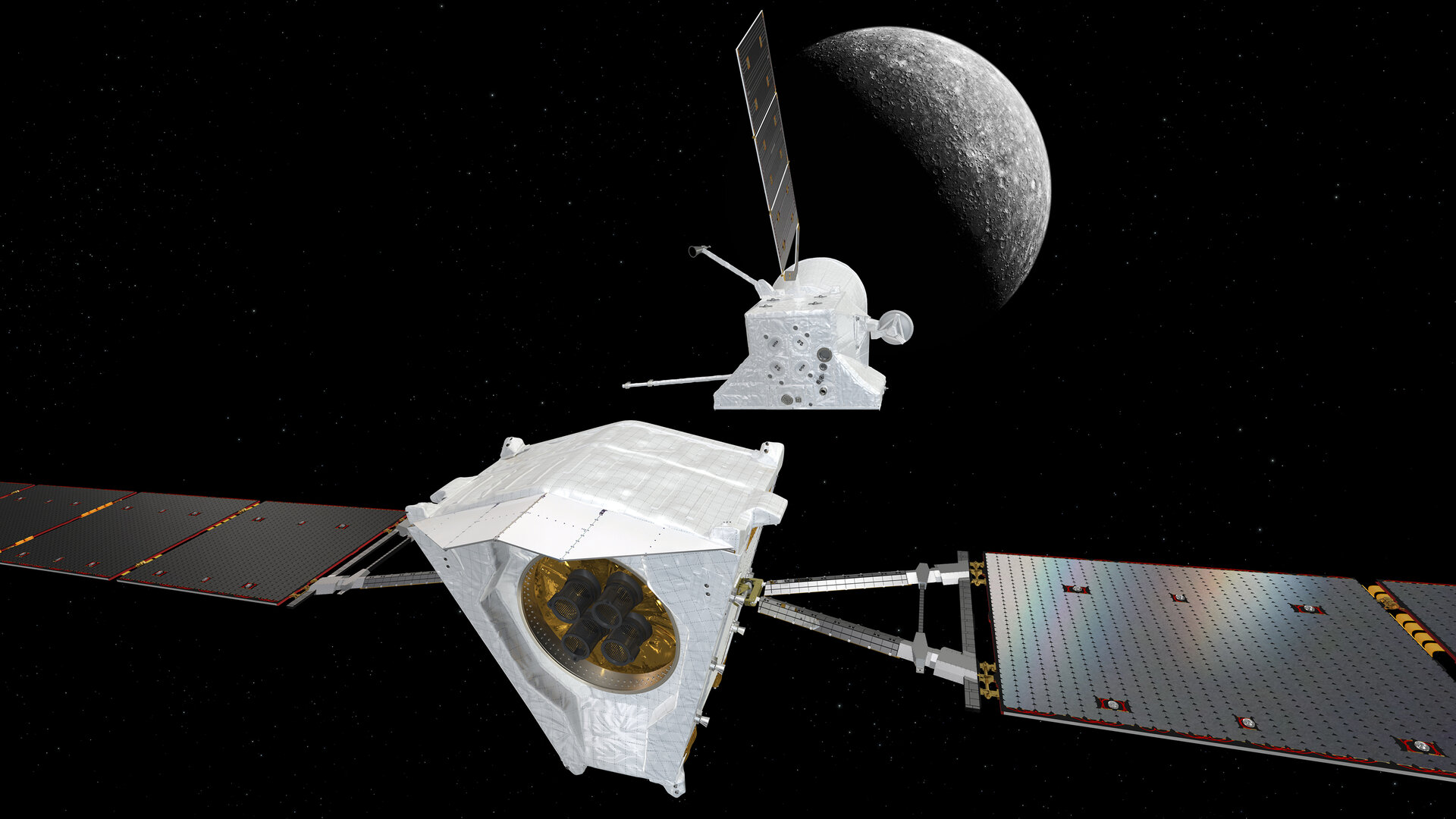
spacecraft: ESA/ATG medialab; Mercury: NASA/JPL
BepiColombo arrives at Mercury – 21 November
After an eight-year journey through the inner Solar System, the European and Japanese BepiColombo mission is due to enter orbit around Mercury on 21 November. Launched in 2018, the spacecraft has travelled nearly 10 billion kilometres, using a series of planetary flybys to reach its destination. The mission carries two orbiters, one European and one Japanese, which will separate in December.
Together they’ll study Mercury’s surface, interior and magnetic field, helping us understand this little-explored planet and its surprisingly complex history. The main scientific observations are due to begin in April 2027.
ESA is keeping a live mission updates page as arrival approaches.
This month’s challenge: Find Uranus
It’s not difficult because it’s particularly faint, but because it looks so much like an ordinary star. You’ll need binoculars, a good finder chart or planetarium app, and preferably a reasonably dark sky.
Once you’ve identified it, try returning a few nights later. Uranus will have moved slightly against the background stars of Taurus, confirming that you’ve found a planet rather than a distant star. If you have a telescope, see whether you can detect its tiny disc.
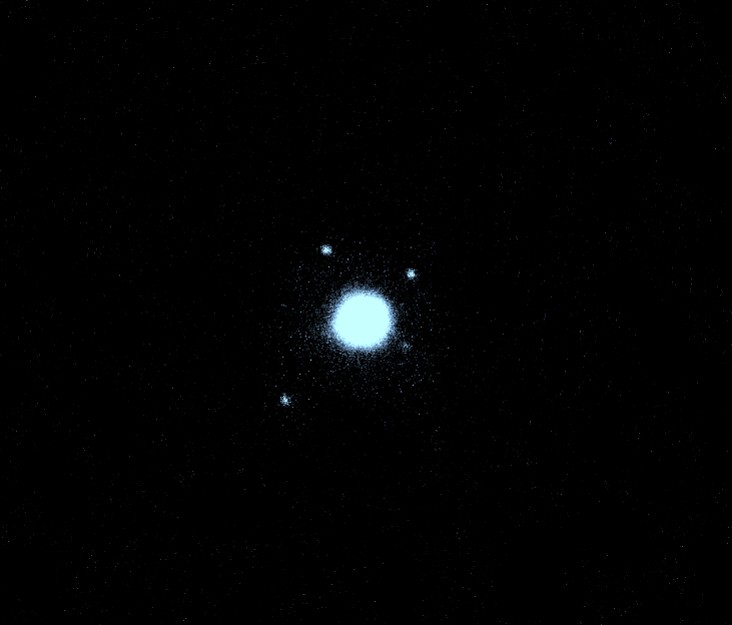
Uranus and 4 Moons Peter Black Nov 2016
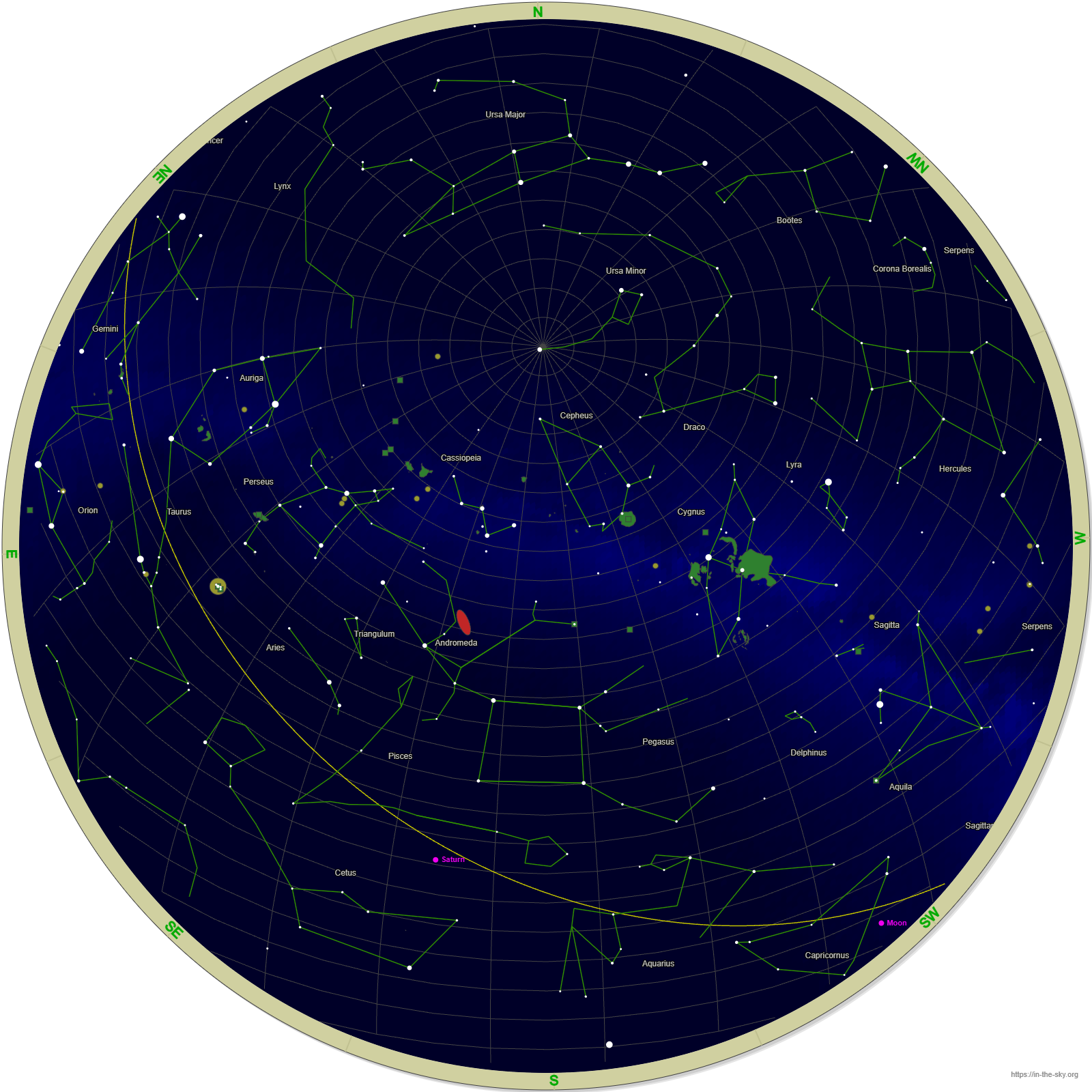
The evening sky at 20:00 on 15 November 2026
Click on an item to expand for more information:

| Comet name | Mag | Constellation | Separation from Sun | Trend | Absolute magnitude last updated |
| 107P/Wilson-Harrington | 9.5 | Sagittarius | 58° | Brightening | Unknown |
| C/2026 M3 (MASTER) | 10.1 | Ophiuchus | 52° | Brightening | Unknown |
| 10P/Tempel | 10.2 | Sculptor | 123° | Fading | 1 Apr 2018 |
| 161P/Hartley-IRAS | 11.6 | Delphinus | 97° | Fading | 30 Sep 2026 |
| 78P/Gehrels | 12.0 | Gemini | 94° | Fading | 30 Sep 2020 |
| 69P/Taylor | 12.1 | Canis Minor | 101° | Brightening | Unknown |
| 2P/Encke | 12.7 | Pegasus | 149° | Brightening | 14 Mar 2017 |
| D/1884 O1 (Barnard) | 13.1 | Sagittarius | 64° | Fading | Unknown |
| C/2025 D1 (Groeller) | 13.1 | Draco | 80° | Brightening | Unknown |
| C/2024 T5 (ATLAS) | 13.2 | Lepus | 117° | Brightening | 30 Sep 2026 |
| P/1999 D1 (Hermann) | 13.2 | Virgo | 25° | Fading | Unknown |
| 88P/Howell | 13.6 | Aries | 167° | Fading | 1 Apr 2018 |
| P/2026 R2 (Leonard) | 13.8 | Norma | 52° | Fading | Unknown |
| 84P/Giclas | 13.9 | Capricornus | 94° | Brightening | 8 Feb 2017 |
| 168P/Hergenrother | 14.0 | Lynx | 84° | Fading | 15 Jan 2013 |
| 63P/Wild | 14.2 | Virgo | 7° | Fading | 1 Aug 2013 |
| 11P/Tempel-Swift-LINEAR | 14.4 | Triangulum | 155° | Brightening | 5 Jan 2021 |
| C/2024 J3 (ATLAS) | 14.4 | Lyra | 82° | Fading | 1 Jul 2026 |
| 123P/West-Hartley | 14.7 | Virgo | 34° | Brightening | 3 Jun 2019 |
| P/2010 H2 (Vales) | 14.9 | Sagittarius | 67° | Fading | Unknown |
| 220P/McNaught | 15.1 | Cetus | 157° | Fading | Unknown |
| P/2019 Y2 (Fuls) | 15.1 | Virgo | 4° | Fading | Unknown |
| 260P/McNaught | 15.2 | Auriga | 115° | Fading | 3 Sep 2026 |
| 65P/Gunn | 15.3 | Cetus | 147° | Fading | 1 Aug 2017 |
| C/2026 A2 (Bok) | 15.5 | Draco | 97° | Brightening | Unknown |
| Date | Age of Moon | Sun | Moon | ||||||||
| Rise | Culm | Set | Constellation | Rise | Culm | Set | Constellation | ||||
| 2026 | Nov | 01 | 21 days | 07:16 | 11:54 | 16:32 | Libra | 22:25 | 05:43 | 14:09 | Cancer |
| 2026 | Nov | 08 | 28 days | 07:31 | 11:55 | 16:17 | Libra | 07:00 | 11:11 | 15:09 | Virgo |
| 2026 | Nov | 15 | 05 days | 07:46 | 11:55 | 16:04 | Libra | 13:25 | 16:58 | 20:40 | Sagittarius |
| 2026 | Nov | 22 | 12 days | 08:00 | 11:57 | 15:53 | Libra | 14:23 | 22:16 | 05:01 | Pisces |
| 2026 | Dec | 01 | 21 days | 08:16 | 12:00 | 15:43 | Ophiuchus | –:– | 06:11 | 12:49 | Leo |

Use the chevrons to choose the month:
Much of the material is provided with thanks to Dominic Ford on his excellent site in-the-sky.org.