

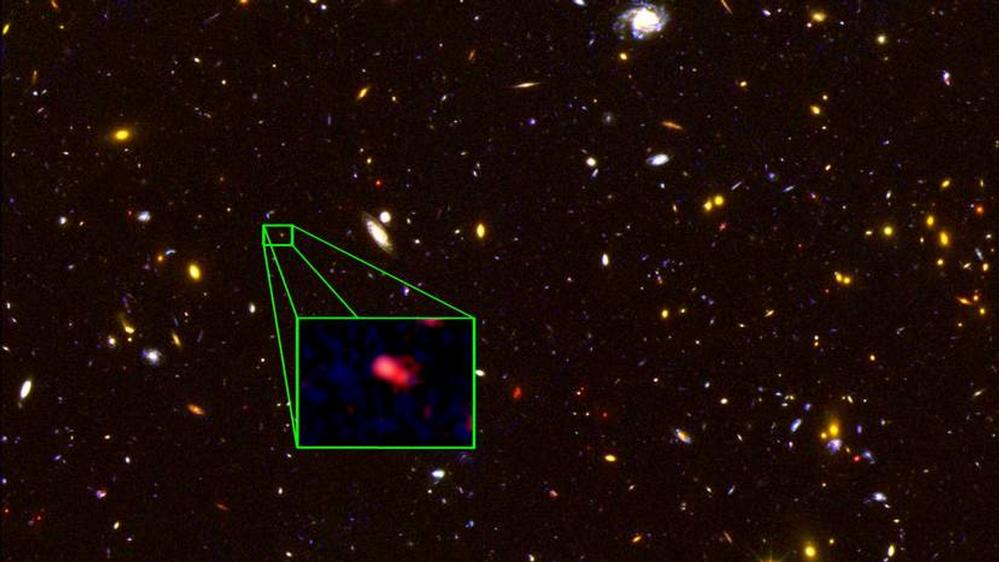
Observations by the James Webb Space Telescope have found hundreds of galaxies less than a billion years old crammed full of stars, and supermassive black holes far heavier than they should be according to ɅCDM. Here is an alternative that allows the black holes to form quickly and grow their host galaxy
By Gareth Mayze
18 July 24
Banner image credit: NASA
Since the James Webb Space Telescope, JWST, was launched two years ago it has produced a stack of new and puzzling discoveries. It has found distant compact galaxies that have luminosities many times greater than expected, implying that they are either crammed full of stars or have quasars that are overmassive and gobbling up material at a ferocious rate. Either way it poses a problem for simulations using the cold dark matter paradigm as these galaxies shouldn’t form this quickly, only, they have.
It’s almost as if these galaxies have found a way of generating their own gravity, and that’s exactly what this new approach proposes.
Every star has a nuclear fusion core producing copious numbers of energetic neutrinos which fly outwards oscillating, filling and surrounding the galaxy. Could it be that these neutrinos are produced to generate this extra, and fast-acting gravity? Note however, sterile massive neutrinos have been ruled out by experiment, so that’s not the answer.
The new proposal is that neutrino oscillation acts directly at a quantum level with spacetime, which has internal stucture, distorting it to produce the appearance of mass. So despite the neutrino itself being massless, it produces an effect via this mechanism which is called virtual mass. This acts at the same speed as gravitational waves – the speed of light, and so pulls the gas in the galaxy inwards to compress it quickly into star forming regions which in turn produces even more stars accelerating the process further. This explains why they are packed full of stars.
But what of the supermassive black holes? Did the galaxy form and then the black hole? Or did the black hole come first and then the galaxy formed around it? It’s chicken and egg time! In fact it turns out that the egg came first….
When material falls into a black hole it heats up and emits light, and once this reaches the Eddington limit radiative pressure inhibits more material falling in, limiting the growth rate. It appears the supermassive black holes here have exceeded this limit by quite a bit. How do they do this? My study of Supernova 1987A shows there is a lot more going on.
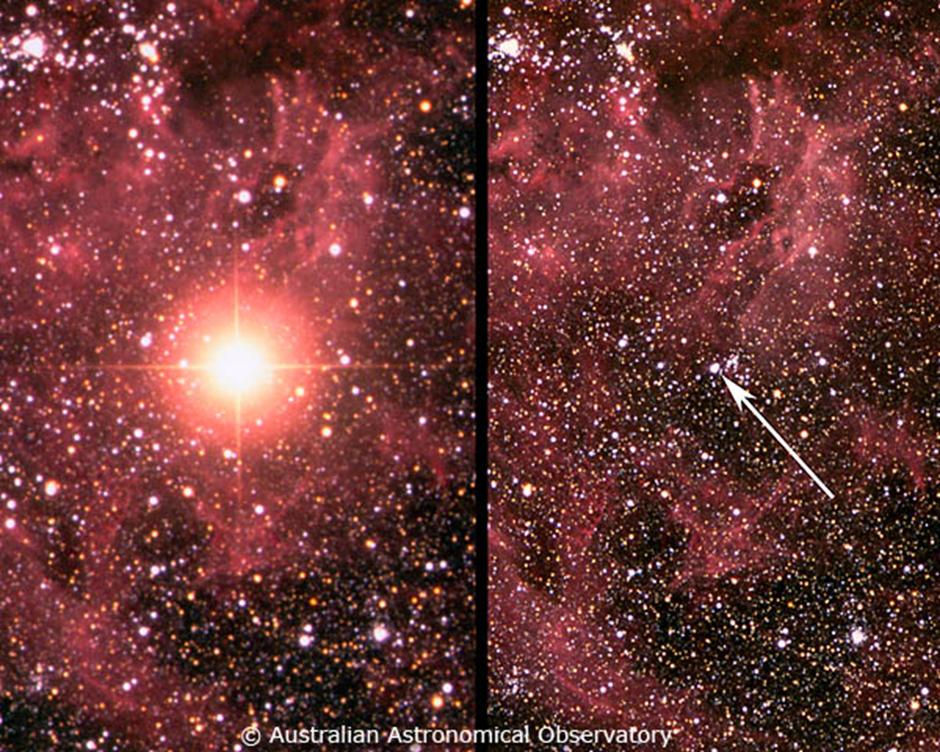
SN1987A Progenitor star and resulting type II supernova. Picture Anglo-Australian Telescope
Before the visible erruption, the core of the progenitor star Sanduleak 69-202 in the Large Magellanic Cloud ran out of fuel and collapsed into a neutron star. This has never been found by Hubble or even JWST, so something must have happened to the neutron star before the visible light subsided. It continued emitting burst of antineutrinos for a few hours while it gobbled up the remains of the star’s inner envelope, the infall onto the surface heated it violently creating bursts of these particles.
It was however now growing heavier and heavier, and once a neutron star reaches the Tolman-Oppenheimer-Volkoff limit of two and a bit solar masses, neutron degeneracy can no longer support it. A calculation using the energetics of collapse from the measured antineutrinos suggested a new compact object had formed of approximately 6km radius, down from the neutron star of 11km or so. The only reasonable explaination was that the neutrons had been crushed into a sea of their constituent parts – quarks – a quark star had been born. But this should have a surface temperature considerably hotter than a neutron star so why couldn’t the space telescopes find that new object?
When the red-shift for this new object was calculated it came back as infinity – and that meant only one thing – it was also a black hole! But wait a minute, supposedly nothing can support an extended core as the trajectories of all particles must be inwards, Roger Penrose showed they must form a singularity. Actually this is an assumption. No experiment has ever shown neutrinos being red-shifted or gravitationally lensed.
The proposal for virtual mass doesn’t say that spacetime influences neutrinos, it’s the other way round, neutrinos bend spacetime. So those antineutrinos did escape from behind the horizon and did get detected here on earth. It provides a natural explaination for how the quark core is supported – at a temperature of trillions of degrees the quarks decelerate violently as they collide producing thermal neutrino/antineutrino pairs providing support.
So there you have it, that’s what’s inside a black hole – not a singularity but a quark core.
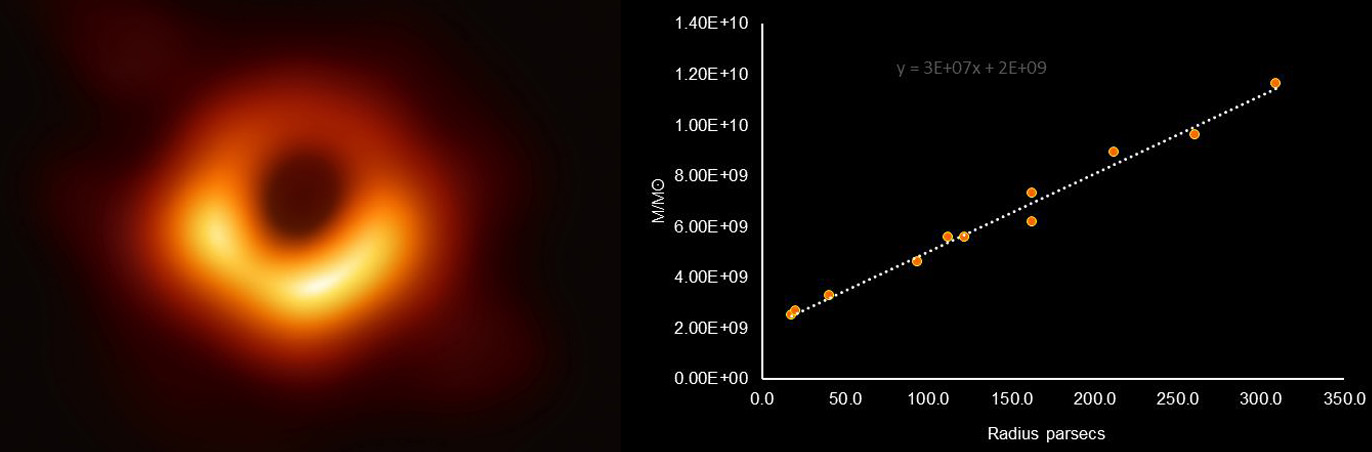
M87 black hole with measured mass at radius out to 320parsec. Picture Event Horizon Telescope
And to complete the picture, if antineutrinos can escape then there is a simple way of proving that neutrinos can escape – measure the apparent mass at radius of an accreting black hole, in this case M87. Infall through the horizon is neutronised when it reaches the core surface releasing initially an electron neutrino. This then oscillates and is free to escape the black hole distorting spacetime as it goes. En-mass, these neutrinos increase the apparent baryonic mass of the quark core from 2 billion solar masses up to a measured value of over 11 billion at 320parsec. It is a linear increase as predicted by the theory and continues outward gradually dissapating as the neutrinos lose their energy.
This is why the central supermassive black holes in these very early galaxies produce this long range force, which quickly gathers surrounding gas into new star forming regions. Neutrino virtual mass is a compelling new theory to explain these ‘little red dots’.
Reference:
https://www.astronomyedinburgh.org/2023/09/26/spacetime-distortion-by-the-neutrino/